Size and Appearance
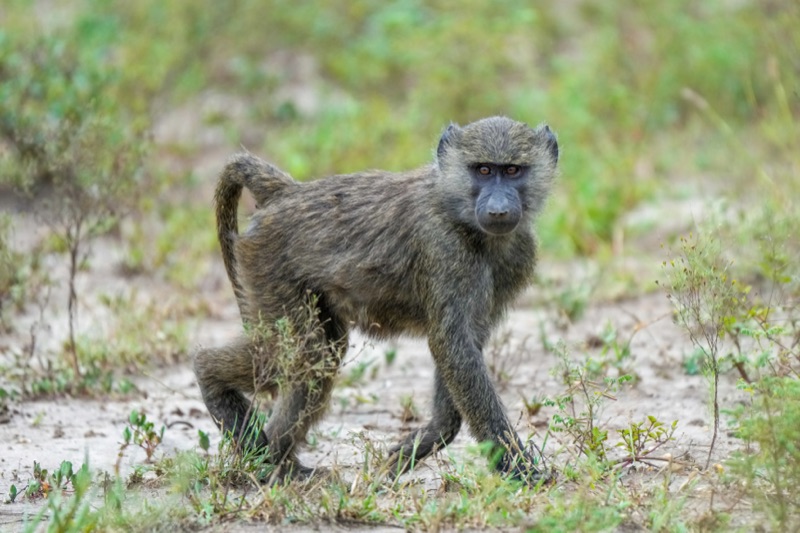
Baboons have long snouts that give their faces a dog-like appearance, which is why some people call them “dog-faced monkeys.” Their size varies a lot depending on the species. The smallest species, the Kinda baboon, is about 50 centimeters (20 inches) long and weighs around 14 kilograms (31 pounds). The largest, the chacma baboon, can grow up to 120 centimeters (47 inches) long and weigh as much as 40 kilograms (88 pounds). Males are usually much larger than females, sometimes twice their size. All baboons have thick fur, strong jaws with sharp canine teeth, and rough pads on their rear ends called ischial callosities that act like built-in seat cushions.
Where They Live
Baboons are very adaptable and can survive in many different environments. They are found in savannas, open woodlands, rocky hillsides, and even semi-desert areas. Some baboon populations live near forests or along rivers where food and water are easier to find. The hamadryas baboon is the only species that lives outside of sub-Saharan Africa, making its home in the dry, rocky lands of Ethiopia, Eritrea, and parts of Saudi Arabia and Yemen. No matter where they live, baboons sleep in trees or on high cliff ledges at night to stay safe from predators like leopards and lions.
What They Eat
Baboons are omnivores, which means they eat both plants and animals. Most of their diet is made up of grasses, fruits, seeds, roots, and bark. However, they are very opportunistic feeders and will eat just about anything they can find, including insects, spiders, bird eggs, lizards, and even small mammals. Some baboons have been observed hunting young gazelles or vervet monkeys. Baboons that live near human communities sometimes raid crops and garbage, which can cause conflict with farmers. Their ability to eat such a wide variety of foods is one reason baboons have been so successful across Africa.
Troop Life and Social Structure
Baboons are highly social animals that live in groups called troops. A typical troop has about 50 members, but troops can range from as few as 5 to as many as 250 individuals. Within each troop, there is a strict hierarchy, or ranking system, that determines which baboons get first access to food and the best resting spots. Male baboons compete for dominance through displays of strength, loud vocalizations, and sometimes physical fights. Female baboons tend to inherit their rank from their mothers. Grooming, where one baboon carefully picks through another’s fur, is an important social activity that helps strengthen bonds and reduce tension within the group.
Raising Young
Female baboons give birth to a single baby after a pregnancy that lasts about six months. Newborn baboons have dark fur and pink skin, and they cling tightly to their mother’s belly as she moves around with the troop. After a few weeks, the baby begins riding on its mother’s back like a tiny jockey. Young baboons are curious and playful, spending much of their time chasing each other, wrestling, and learning important survival skills. Mothers are very protective of their babies, and other females in the troop often help watch over the young. Baboons in the wild typically live 20 to 30 years, though they can live up to 45 years in captivity.
Intelligence and Communication
Baboons are considered some of the most intelligent monkeys in the world. They use more than 30 different vocalizations to communicate, including barks, screams, grunts, and a special two-syllable call called a “wahoo.” Each sound has a different meaning, from warning the troop about a predator to greeting a friend. Baboons also communicate through body language, such as showing their teeth, raising their eyebrows, or slapping the ground. In experiments, baboons have demonstrated the ability to solve problems, recognize patterns, and even learn basic concepts similar to reading. Their intelligence helps them find food, avoid danger, and navigate the complex social relationships within their troop.
Baboons and Humans
Baboons have lived alongside humans for thousands of years. In ancient Egypt, the hamadryas baboon was considered sacred and was associated with Thoth, the god of wisdom and writing. Today, baboons sometimes come into conflict with people when they raid farms or scavenge food in towns. In some parts of Africa, expanding human settlements have pushed baboons out of their natural habitat. Despite these challenges, baboons are not currently endangered. Their adaptability and intelligence have allowed most species to maintain healthy populations. Conservation efforts focus on reducing conflict between baboons and local communities while protecting the wild spaces where baboons live.
 OtterKnow Kids Encyclopedia