Size and Appearance
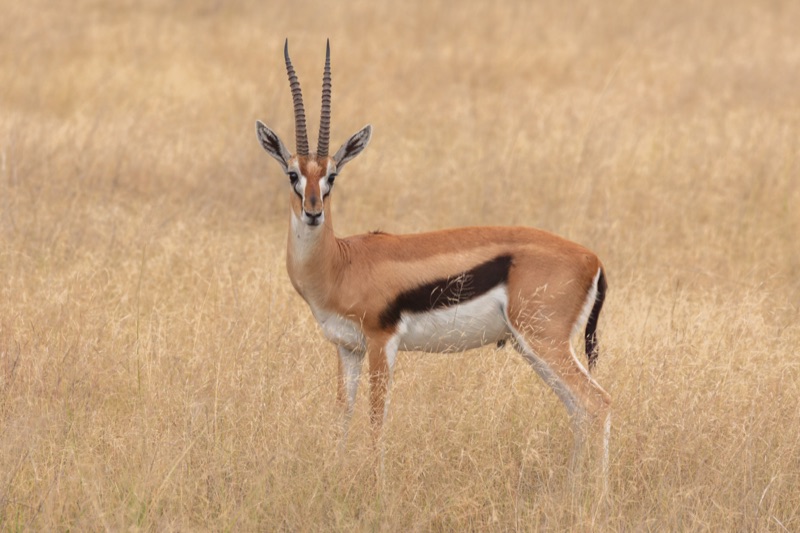
Gazelles are medium-sized animals with lean, muscular bodies built for running. Most species have tan or reddish-brown fur on their backs, white bellies, and a distinctive dark stripe along their sides. Their large, dark eyes sit high on their heads, giving them a wide field of vision to spot danger from almost any direction. Both males and females have curved, ringed horns, though males tend to have longer ones. The largest species, the dama gazelle, can stand about 120 centimeters (47 inches) tall at the shoulder and weigh up to 75 kilograms (165 pounds), while the smaller Thomson’s gazelle stands only about 60 centimeters (24 inches) tall.
Speed and Movement
Gazelles are among the fastest animals on Earth. Thomson’s gazelles can sprint at speeds up to 80 kilometers per hour (50 miles per hour), making them the fourth-fastest land animal after the cheetah, pronghorn, and springbok. Their long, thin legs and lightweight bodies are perfectly designed for quick bursts of speed and sudden direction changes that help them escape predators. Gazelles are also famous for a special jumping behavior called “stotting” or “pronking,” where they leap straight into the air with stiff legs. Scientists believe this bouncing display signals to predators that the gazelle is strong and healthy, making it a difficult target to catch.
Habitat and Range
Gazelles live in a variety of open landscapes, including grasslands, savannas, shrublands, and even deserts. Most species are found in Africa, especially in East Africa’s Serengeti ecosystem, but several species also live in the Middle East, Central Asia, and the Indian subcontinent. Different species have adapted to different environments. For example, Grant’s gazelle thrives on the dry East African plains, while the Goitered gazelle lives in the rocky deserts and steppes of Central Asia. Gazelles prefer open areas where they can see approaching predators from far away.
Diet and Water
Gazelles are herbivores, meaning they eat only plants. Their diet includes grasses, leaves, shoots, and seeds, and they are very selective eaters who carefully choose the most nutritious parts of each plant. One of the most surprising things about gazelles is that some species can survive without ever drinking water. They get all the moisture they need from the plants they eat, and their bodies have special adaptations to conserve water, including producing very concentrated urine. This ability is especially important for species that live in dry desert environments where water is scarce.
Social Life and Herds
Gazelles are social animals that live in groups called herds. Female gazelles and their young typically form large herds that can number in the hundreds, while young males gather in smaller bachelor groups. Adult males are territorial and use scent markings from special glands near their eyes and droppings called dung middens to mark their boundaries. During migration season in the Serengeti, Thomson’s gazelles sometimes travel alongside wildebeest and zebras in enormous mixed herds. Living in groups helps gazelles stay safe because more eyes watching for danger means a better chance of spotting a predator early.
Predators and Defense
Life on the African savanna is dangerous for gazelles, and they face many predators. Cheetahs, lions, leopards, hyenas, and African wild dogs all hunt gazelles regularly. Even crocodiles can be a threat when gazelles cross rivers. A gazelle’s main defense is its incredible speed and agility. When a gazelle spots danger, it may begin stotting to alert the rest of the herd and signal to the predator that it has been detected. Mother gazelles protect their newborn fawns by hiding them in tall grass, where the babies lie perfectly still to avoid being noticed. Within minutes of being born, a baby gazelle can stand and walk, and within days it can run fast enough to keep up with the herd.
Lifespan and Growth
In the wild, gazelles typically live between 10 and 15 years, though many do not survive that long because of predators. Females usually give birth to one fawn at a time after a pregnancy lasting about five to six months. Newborn gazelles weigh only a few kilograms but grow quickly. Young gazelles stay close to their mothers for several months, learning which plants to eat and how to recognize danger. Males leave their mother’s herd as they mature and join bachelor groups before eventually trying to establish their own territories.
Conservation
While some gazelle species like Thomson’s gazelle remain abundant, others are in serious trouble. The dama gazelle, the largest of all gazelles, is critically endangered, with fewer than 250 individuals left in the wild across parts of Chad and Niger. The main threats to gazelles include overhunting, habitat loss from farming and livestock grazing, and competition with domestic animals for food. Conservation groups and zoos around the world are working to save the most endangered species through breeding programs and habitat protection. Even common-looking animals can become rare if their homes and safety are not protected.
 OtterKnow Kids Encyclopedia