What They Look Like
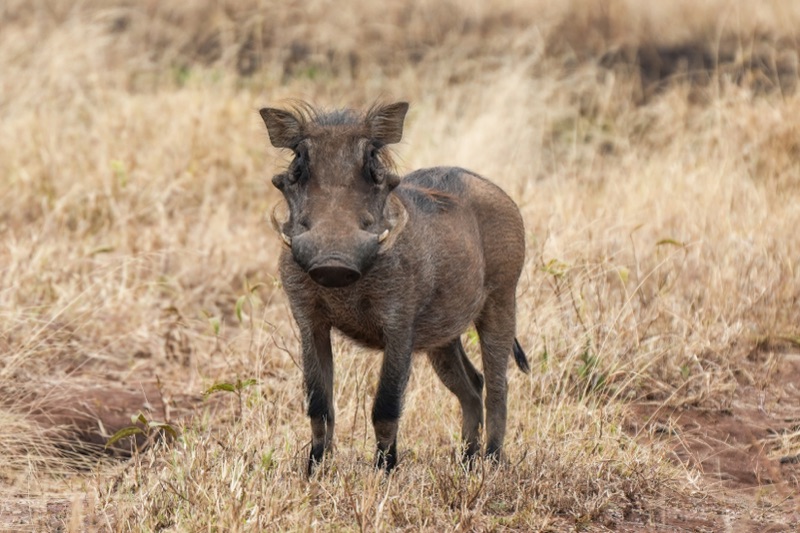
Warthogs have large, flat heads with two pairs of curved tusks and fleshy bumps called warts on their faces. The upper tusks can grow into a long, curving arc up to 60 centimeters (about 2 feet) long, while the shorter lower tusks are razor-sharp and used as weapons. The warts, which are actually thick pads of skin, help protect their faces during fights with other warthogs. Adults stand about 76 centimeters (30 inches) tall at the shoulder and measure up to 150 centimeters (about 5 feet) in body length. Males are larger than females and can weigh as much as 150 kilograms (330 pounds), while females typically weigh between 50 and 75 kilograms (110 to 165 pounds).
Habitat
Warthogs are found throughout the savannas, open bushlands, and light woodlands of sub-Saharan Africa. They tend to avoid dense forests and true deserts, preferring areas with short grass and open ground where they can spot predators from a distance. One of the most interesting things about warthogs is that they do not dig their own burrows. Instead, they move into holes abandoned by aardvarks and other burrowing animals, widening the entrance with their strong bodies. These burrows provide shelter from the heat during the day and a safe place to sleep at night.
Diet and Feeding
Warthogs are omnivores, but most of their diet is made up of plants. During the rainy season, they graze on short grasses, often dropping to their front knees and shuffling forward as they eat. Their knees develop thick, tough calluses from this habit. When the dry season arrives and grass becomes scarce, warthogs switch to digging up bulbs, roots, and rhizomes with their hard snouts. They will also eat bark, fungi, insects, eggs, and even carrion when other food is hard to find.
Social Life
Female warthogs, called sows, are social animals that live in groups known as sounders. A sounder usually contains two to ten members, including mothers and their young, though groups of up to 40 have been observed. The females in a sounder groom each other and huddle together at night inside their burrow for warmth and safety. Male warthogs, called boars, leave their family group as teenagers and may join small bachelor groups for a while. As adults, boars become mostly solitary, only seeking out females during the mating season.
Defending Against Predators
Warthogs face many dangerous predators on the African savanna, including lions, leopards, cheetahs, hyenas, and crocodiles. Their first defense is speed: when threatened, a warthog can sprint at up to 50 kilometers per hour (about 31 miles per hour) with its thin tail sticking straight up like an antenna. If running is not an option, a warthog will back into its burrow rear-end first, leaving its sharp tusks pointed outward at the entrance. This clever strategy makes it very difficult for a predator to follow the warthog inside without facing those dangerous tusks.
Baby Warthogs
A mother warthog gives birth to a litter of two to four piglets after a pregnancy of about five to six months. Newborn piglets are small and vulnerable, so they stay inside the safety of the burrow for the first few weeks of life. Once they are strong enough, they begin following their mother out to forage, staying close to her side. Young warthogs grow quickly and are weaned at around three to four months, though they continue to stay with their mother’s sounder for much longer as they learn to find food and avoid predators.
Lifespan and Conservation
In the wild, warthogs typically live for 7 to 11 years, though they can survive up to 18 years in captivity where they are safe from predators and have a steady food supply. The common warthog is not currently considered endangered, and its populations remain stable across much of Africa. However, warthogs can be affected by habitat loss as grasslands are converted to farmland, and they are hunted for food in some regions. Their ability to adapt to different environments and food sources has helped them remain one of the most widespread wild pigs in Africa.
 OtterKnow Kids Encyclopedia