What They Look Like
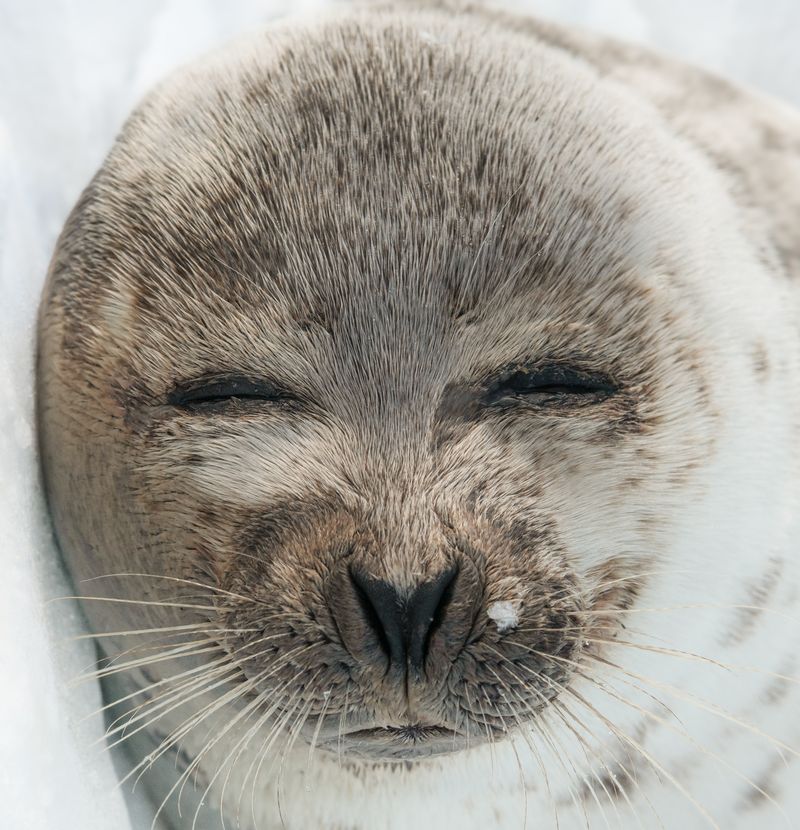
Adult harp seals have silvery-gray fur with a large dark marking on their back that is shaped somewhat like a harp or a wishbone, which is how they got their common name. They are medium-sized seals, typically measuring about 1.7 meters (5.5 feet) long and weighing between 130 and 150 kilograms (roughly 285 to 330 pounds). Their large, dark eyes are well adapted for seeing underwater in dim Arctic light, and their long whiskers, called vibrissae, help them sense vibrations from nearby fish. Harp seals have thick layers of blubber beneath their skin that insulate them in frigid water and serve as an energy reserve when food is scarce. Their front flippers are equipped with strong claws that help them grip slippery ice, while their powerful hind flippers propel them swiftly through the water.
Whitecoats and Growing Up
Harp seal pups are born on pack ice in late February or March, and they arrive wearing a coat of fluffy white fur that has made them one of the most photographed baby animals on the planet. This white coat, which earns them the nickname “whitecoats,” keeps them camouflaged against the snow and traps heat to protect them from the bitter cold. For about 12 days, the mother nurses her pup with milk that is nearly 50 percent fat, one of the richest milks of any mammal. The pup gains roughly 2.2 kilograms (about 5 pounds) per day on this high-fat diet, ballooning from around 11 kilograms at birth to over 35 kilograms by the time it is weaned. After nursing ends, the mother leaves to mate and the pup is on its own, gradually shedding its white fur to reveal a spotted gray coat underneath before eventually developing the distinctive harp-shaped marking as a young adult.
Where They Live
Harp seals are found across the cold waters of the North Atlantic Ocean and the Arctic Ocean. They gather in three main breeding populations: one in the White Sea off the coast of Russia, one near the Norwegian island of Jan Mayen, and the largest group off the coast of Newfoundland, Canada. Outside of the breeding season, harp seals range widely, traveling as far north as the Arctic pack ice in summer to feed in rich polar waters. They are highly migratory animals, swimming thousands of kilometers each year as they follow the seasonal advance and retreat of the sea ice. During these long migrations, they may pass through waters near Greenland, Iceland, and the Barents Sea, sometimes appearing as far south as the coasts of New England or the British Isles when winter storms push them off course.
What They Eat
Harp seals are skilled hunters that feed on a wide variety of fish and invertebrates. Their diet includes capelin, Arctic cod, herring, and various species of shrimp-like crustaceans called krill. They are excellent divers, capable of plunging to depths of over 270 meters (about 885 feet) and holding their breath for up to 16 minutes. When diving, their heart rate slows dramatically and blood flow is redirected to vital organs, an adaptation shared with many marine mammals that allows them to conserve oxygen. Harp seals typically hunt alone, making dozens of dives throughout the day and night as they pursue schools of fish beneath the ice. Young seals learning to hunt start with smaller, slower prey like tiny crustaceans before graduating to faster fish as their diving skills improve.
Life on the Ice
Sea ice is central to almost every part of a harp seal’s life. Females gather in enormous groups on floating pack ice each winter to give birth and nurse their pups, and the ice serves as a safe platform away from ocean predators. After the breeding season, harp seals haul themselves onto ice floes to molt, shedding their old fur and growing a fresh coat in a process that takes several weeks. During the molt, seals spend long hours basking on the ice because they need the warmth of sunlight to help new fur grow in properly. Harp seals are surprisingly social animals and often rest in tightly packed groups of hundreds or even thousands, covering the ice as far as the eye can see. When they are not resting, they spend the vast majority of their time in the water, where they are graceful and agile swimmers despite their clumsy appearance on land.
Predators and Survival
In the wild, harp seals face several formidable predators. Polar bears are among their most dangerous enemies, stalking seal colonies on the ice and using their keen sense of smell to locate pups hidden beneath snowdrifts. Orcas, also known as killer whales, hunt harp seals in open water, working in groups to corral and capture them. Greenland sharks, large sleeper sharks that cruise beneath the Arctic ice, also prey on harp seals, especially young or weakened individuals. To avoid these threats, harp seals rely on their speed in the water, where they can swim at bursts of up to 25 kilometers per hour. Pups depend on their white camouflage for protection during their vulnerable first weeks, lying still on the ice and hoping to go unnoticed.
Conservation
Harp seals were once hunted on a massive scale for their fur, oil, and meat, and the commercial hunt of whitecoat pups drew intense international attention and protest beginning in the 1960s and 1970s. Canada banned the commercial hunting of whitecoat pups in 1987, and the European Union banned the import of seal products from commercial hunts in 2009, which significantly reduced demand. Today, the overall harp seal population is considered healthy and the species is classified as Least Concern by the International Union for Conservation of Nature (IUCN). However, climate change poses a growing threat because harp seals depend on stable pack ice for pupping, and warmer winters have caused ice to form later, break up earlier, and become thinner in key breeding areas. In years with poor ice conditions, pup survival drops sharply because young seals can be swept into the water before they are strong enough to swim. Scientists are closely monitoring how shrinking sea ice may affect harp seal populations in the decades ahead, making the fight against climate change an important part of their future.
 OtterKnow Kids Encyclopedia