What They Look Like
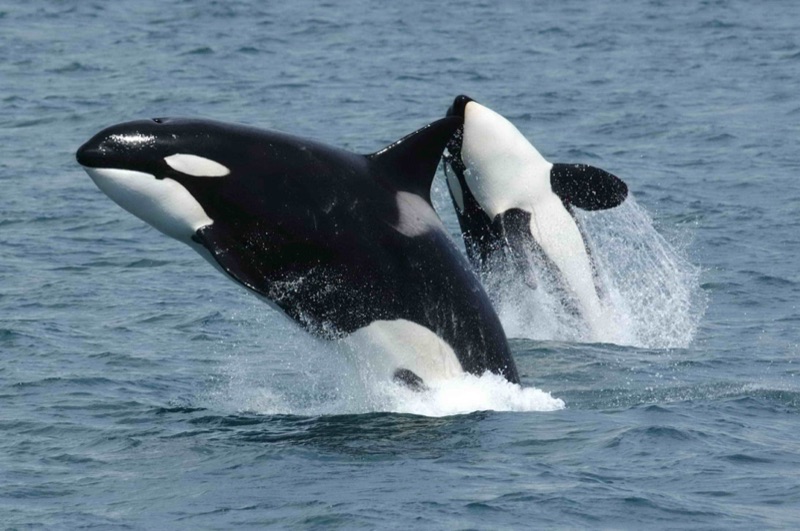
Orcas are easy to recognize thanks to their bold black-and-white coloring. Their backs and sides are jet black, while their bellies and a distinctive patch behind each eye are bright white. Each orca also has a unique gray patch behind its dorsal fin called a saddle patch, which scientists use to tell individual whales apart, much like a fingerprint. Males are larger than females and can grow up to 9 meters (about 30 feet) long and weigh as much as 6,000 kilograms (over 13,000 pounds), roughly the weight of a school bus. A male’s dorsal fin can stand nearly 1.8 meters (6 feet) tall and is straight and triangular, while a female’s fin is shorter and slightly curved.
Echolocation and Communication
Like their dolphin relatives, orcas rely on echolocation to navigate and find prey in the dark ocean. They produce rapid clicking sounds that travel through the water and bounce off objects, sending back echoes that reveal the size, shape, distance, and movement of whatever is ahead. Orcas also have one of the most complex vocal systems of any animal. Each pod has its own set of calls, known as a dialect, that members learn from birth and use throughout their lives. These dialects are so distinct that researchers can identify which pod an orca belongs to just by listening to its calls. Orcas use whistles, pulsed calls, and other sounds to coordinate hunts, keep track of family members, and strengthen social bonds.
Pods and Social Life
Orcas are among the most social animals in the sea, living in groups called pods that are based on family ties. In many populations, a pod is led by the oldest female, called the matriarch, and includes her sons, daughters, and their offspring. These family bonds are remarkably strong, and some orcas stay with their mothers for their entire lives, which can span 50 to 80 years or more. Pods typically range from 5 to 30 members, though several related pods sometimes gather in larger groups called clans or communities. Young orcas learn everything they need to know from their elders, including where to find food, how to hunt, and which calls to use, a process that scientists consider a form of animal culture.
What They Eat
Orcas are versatile predators with a surprisingly varied diet that depends on where they live and what their pod specializes in hunting. Some populations, known as residents, feed almost entirely on fish, with Chinook salmon being a favorite in the Pacific Northwest. Other populations, called transients or Bigg’s orcas, prefer to hunt marine mammals such as harp seals, sea lions, and even other whales, including species much larger than themselves. Offshore orcas, a less-studied group, are known to eat sharks and other deep-water fish. This dietary specialization is so strong that resident and transient orcas living in the same waters rarely interact with each other, almost as if they were separate species. An adult orca needs to eat roughly 100 to 135 kilograms (220 to 300 pounds) of food every day to fuel its massive body.
Hunting Strategies
What truly sets orcas apart from other predators is the intelligence and teamwork behind their hunts. In the Antarctic, orcas have been observed creating waves to wash seals off ice floes, a technique that requires several whales to swim in formation and push water in just the right direction. In Norway and Iceland, orcas use a method called carousel feeding, where they herd schools of herring into a tight ball near the surface and then slap the fish with their powerful tail flukes to stun them. Transient orcas hunting gray whale calves may chase a mother and calf for hours, taking turns to tire them out before separating the calf from its mother. These hunting methods are not instinctive but are learned behaviors, taught by experienced adults and practiced by young orcas over many years.
Intelligence
Orcas have the second-largest brain of any ocean animal, and their intelligence shows in many ways. They are skilled problem-solvers that can adapt their behavior to new situations, and they have been observed inventing entirely new hunting techniques that then spread through their pod. In captivity, orcas quickly learn complex tricks, but their intelligence is far more impressive in the wild, where they must navigate vast ocean territories, remember the locations of seasonal food sources, and cooperate with their pod in intricate group hunts. Orcas also show signs of emotions and self-awareness, such as grieving when a family member dies, with mothers sometimes carrying a dead calf at the surface for days or even weeks. Their ability to pass down knowledge, traditions, and dialects across generations places them in a small group of animals, alongside humans, elephants, and some great apes, that are considered to have true culture.
Where They Live
Although orcas are often associated with cold polar waters, they actually live in every ocean on Earth. They are most common in the nutrient-rich waters of the Arctic, the Antarctic, and the cool temperate regions of the North Atlantic and North Pacific. Different populations, called ecotypes, have adapted to their local environments so thoroughly that they differ in size, coloring, diet, and behavior. In the Pacific Northwest, three distinct communities of orcas share the same coastal waters: southern residents, northern residents, and transients. Orcas are highly mobile and some individuals travel enormous distances, with certain Antarctic orcas recorded swimming over 9,400 kilometers (about 5,800 miles) in just 42 days. They can be found near coastlines, in deep open ocean, and even in sheltered bays and fjords, wherever their preferred prey is abundant.
Conservation
Orcas are currently listed as Data Deficient by the International Union for Conservation of Nature (IUCN) because their many distinct populations have not all been thoroughly studied. Some populations are healthy, but others face serious threats. The southern resident orcas of the Pacific Northwest, for example, are listed as endangered, with only about 73 individuals remaining as of recent counts. Their biggest challenges include a decline in Chinook salmon, their primary food source, as well as pollution from chemicals that build up in their blubber and noise from boat traffic that interferes with their echolocation. Oil spills, climate change, and habitat disturbance also threaten orca populations around the world. Conservation efforts include fishing regulations to protect salmon runs, speed limits for boats near orca habitats, and ongoing research to better understand what orcas need to thrive.
 OtterKnow Kids Encyclopedia