What They Look Like
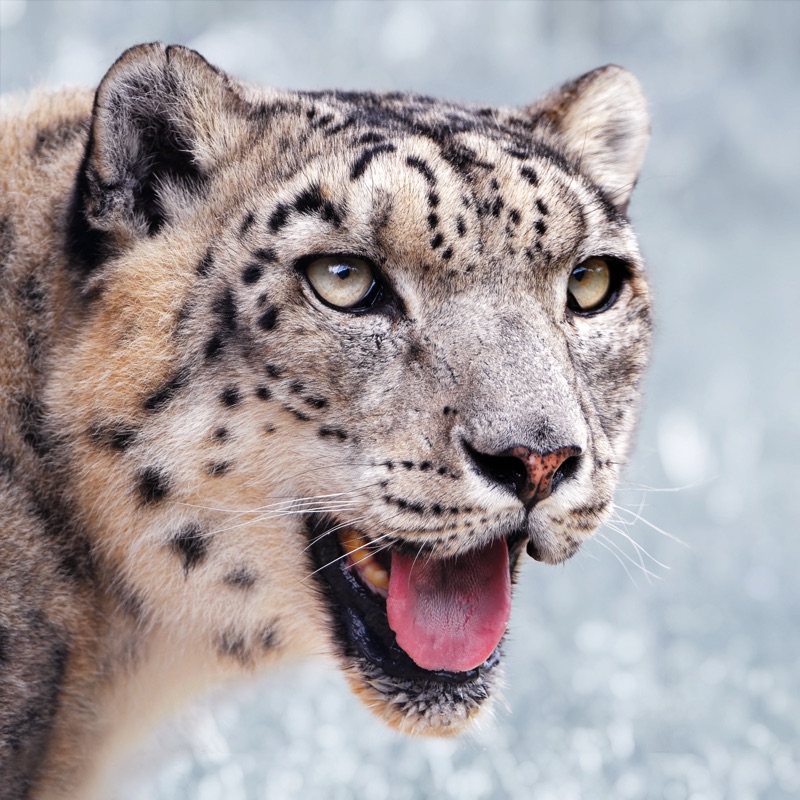
Snow leopards have thick, pale gray or creamy white fur covered in dark rosettes and spots that help them disappear against stone and snow. Their fur is incredibly dense — much thicker than that of other big cats — which keeps them warm in temperatures that can drop far below freezing. A snow leopard’s body is stocky and muscular, typically measuring about 3 to 4.5 feet long, not including its tail. Their wide, fur-covered paws act like natural snowshoes, spreading their weight so they can walk across deep snow without sinking. Perhaps their most striking feature is their extraordinarily long tail, which can be nearly as long as their entire body and helps them balance on steep cliffs.
Built for the Mountains
Almost everything about a snow leopard’s body is designed for life at high altitude. Their large nasal cavities warm the thin, frigid air before it reaches their lungs, and their powerful chest muscles help them breathe where oxygen levels are low. Snow leopards are incredible jumpers, capable of leaping as far as 50 feet in a single bound to cross gaps between rocky ledges. Their long, thick tail serves double duty — it provides balance when navigating narrow mountain paths and can be wrapped around their face and body like a scarf during blizzards. Their short, rounded ears reduce heat loss, and their large eyes give them excellent vision for spotting prey across vast mountain valleys.
Where They Live
Snow leopards live across the mountain ranges of Central and South Asia, including the Himalayas, the Altai Mountains, and the ranges of Mongolia and western China. They are typically found at elevations between 9,000 and 15,000 feet, though they may climb even higher in summer and descend to lower forests in winter following their prey. Their total range spans twelve countries, including India, Nepal, Pakistan, Russia, and Afghanistan. Snow leopards need enormous territories to find enough food — a single cat may roam an area of up to 400 square miles. This vast, rocky habitat is part of what makes them so difficult for researchers to find and study.
Hunting
Snow leopards are ambush predators that rely on stealth and surprise rather than long chases. They stalk their prey by creeping along ridgelines and behind boulders, then launch a sudden attack from above. Their primary prey includes wild sheep called bharal (also known as blue sheep) and ibex, which are wild mountain goats with long curved horns. A snow leopard can take down an animal three times its own weight, which is important because a single large kill can feed one cat for almost two weeks. They also hunt smaller animals like marmots, hares, and pikas when larger prey is scarce.
Solitary Life
Snow leopards are solitary animals that prefer to live and hunt alone. Each cat marks its territory by scraping the ground, spraying scent on rocks, and leaving droppings in visible spots to signal its presence to other snow leopards. Males and females only come together briefly during the mating season, which typically falls between January and March. Despite their fierce reputation as predators, snow leopards are not aggressive toward humans and there are no confirmed cases of a snow leopard attacking a person in the wild. They are most active at dawn and dusk, spending the middle of the day resting on rocky outcrops where their camouflage makes them nearly invisible.
Cubs and Family
Female snow leopards give birth to litters of one to three cubs, usually in a sheltered rocky den lined with the mother’s soft belly fur. The cubs are born blind and helpless, weighing less than a pound, and depend entirely on their mother for warmth and food. By about two months old, the cubs begin eating solid food and start playing outside the den, practicing the pouncing and stalking skills they will need as adults. Young snow leopards stay with their mother for 18 to 22 months, learning how to hunt and survive in the mountains before heading off on their own. This long learning period is essential because mountain hunting requires precision and experience that cannot be gained quickly.
Conservation
Snow leopards are classified as vulnerable, with an estimated 4,000 to 6,500 individuals remaining in the wild. They face several serious threats, including habitat loss as roads and settlements push deeper into mountain regions, and conflict with herders who sometimes kill snow leopards to protect their livestock. Poaching is another danger, as snow leopard fur and bones are illegally traded in some parts of the world. Conservation organizations have worked with local communities to build predator-proof livestock pens and create insurance programs that compensate herders for animals lost to snow leopards. These efforts, along with the creation of protected areas across their range, are helping give these mountain cats a better chance at survival.
 OtterKnow Kids Encyclopedia