What They Look Like
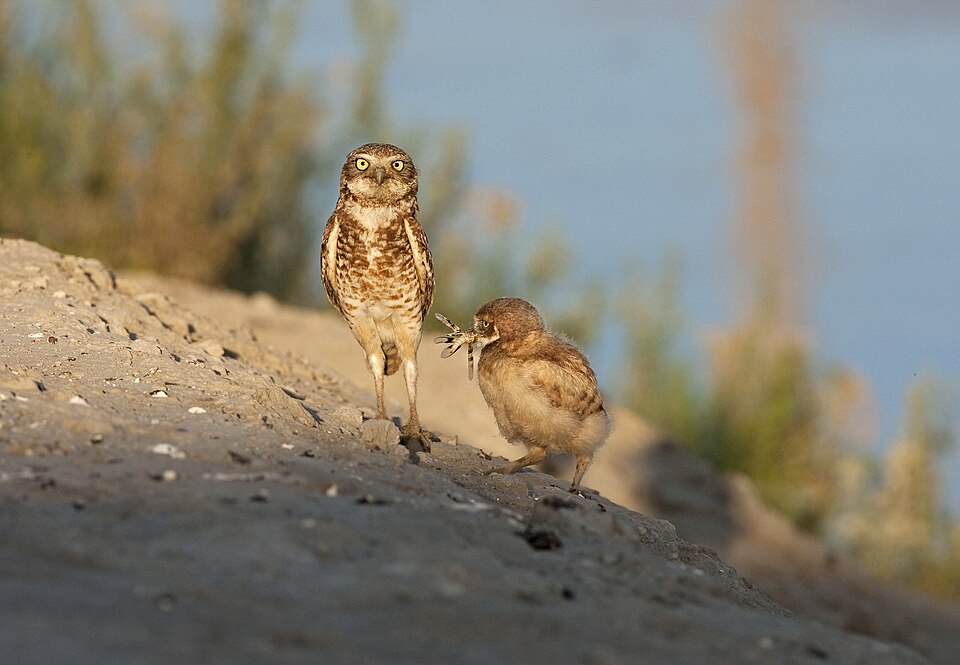
Western burrowing owls stand about 7 to 10 inches tall and weigh between 5 and 8 ounces, making them one of the smaller owl species in North America. They have sandy brown feathers covered with white spots and bars, which provide excellent camouflage against the dry grasslands where they live. Their eyes are bright yellow, and unlike many owls that have prominent ear tufts, burrowing owls have smooth, rounded heads. Their most distinctive feature is their unusually long legs, which are an adaptation for their ground-dwelling lifestyle. These legs help them sprint after insects and stand tall enough to peer over grasses to watch for danger.
Where They Live
Western burrowing owls inhabit open grasslands, prairies, deserts, and agricultural fields across western North America, from southern Canada through the western United States and into Mexico. They require flat, treeless terrain with short vegetation so they can spot approaching predators from a distance. Rather than digging their own burrows, they typically move into holes abandoned by ground squirrels, prairie dogs, badgers, or tortoises. A single burrow can be 4 to 8 feet long and extend 1 to 3 feet underground. The owls often modify the burrow by kicking out dirt and lining the entrance with materials. In urban areas, they sometimes nest in culverts, pipes, or artificial burrows installed by wildlife managers.
Diet and Hunting
Burrowing owls are versatile hunters with a varied diet. Insects make up the majority of their food, especially beetles, grasshoppers, and crickets. They also eat small mammals like mice and voles, as well as lizards, frogs, and small birds. Their hunting methods are equally varied — they may chase insects on foot, hover in the air before swooping down, or catch flying insects in mid-air. One of their cleverest behaviors involves placing animal dung around the entrance to their burrows. Scientists have confirmed that this attracts dung beetles directly to the owl’s doorstep, creating a convenient food source. A family of burrowing owls can consume roughly 7,000 insects during a single nesting season.
Breeding and Family Life
Burrowing owls typically form monogamous pairs that return to the same burrow year after year. Breeding season begins in March or April. The female lays 6 to 12 eggs, which is a large clutch compared to most owl species. She incubates the eggs for about 28 days while the male hunts and brings food to the burrow. After hatching, the chicks stay underground for about two weeks before beginning to appear at the burrow entrance. Both parents feed the young, and the chicks can fly at about six weeks old. Young owls often practice hunting by pouncing on insects and dung beetles near the burrow entrance before venturing farther away.
Threats and Conservation
Western burrowing owls face serious conservation challenges. They are listed as a species of special concern in California and are declining across much of their range. The biggest threat is habitat loss — as grasslands are converted to housing developments, shopping centers, and intensive agriculture, the open spaces burrowing owls depend on disappear. The loss of burrowing mammals like ground squirrels and prairie dogs, which are often controlled as pests, also eliminates the burrows that owls need for nesting. Other threats include vehicle collisions, pesticide exposure that reduces their insect prey, and predation by cats and dogs in urban areas. Conservation efforts include installing artificial burrows, protecting grassland habitats, and monitoring populations. At Shoreline Park in Mountain View, the Santa Clara Valley Audubon Society helps protect one of the last burrowing owl colonies in the Bay Area.
Clever Survival Tricks
Burrowing owls have developed several clever adaptations for survival. When threatened inside their burrow, young owls produce a hissing call that closely mimics the sound of a rattlesnake, which discourages predators like badgers and coyotes from reaching inside. Adults perform a broken-wing display to lure predators away from the nest, pretending to be injured to draw attention to themselves instead of their chicks. Burrowing owls also have a higher tolerance for carbon dioxide than most birds, which helps them breathe in the stale air deep inside their underground homes. Their large yellow eyes are adapted for hunting in low light at dawn and dusk, although they have better daytime vision than most owl species.
 OtterKnow Kids Encyclopedia