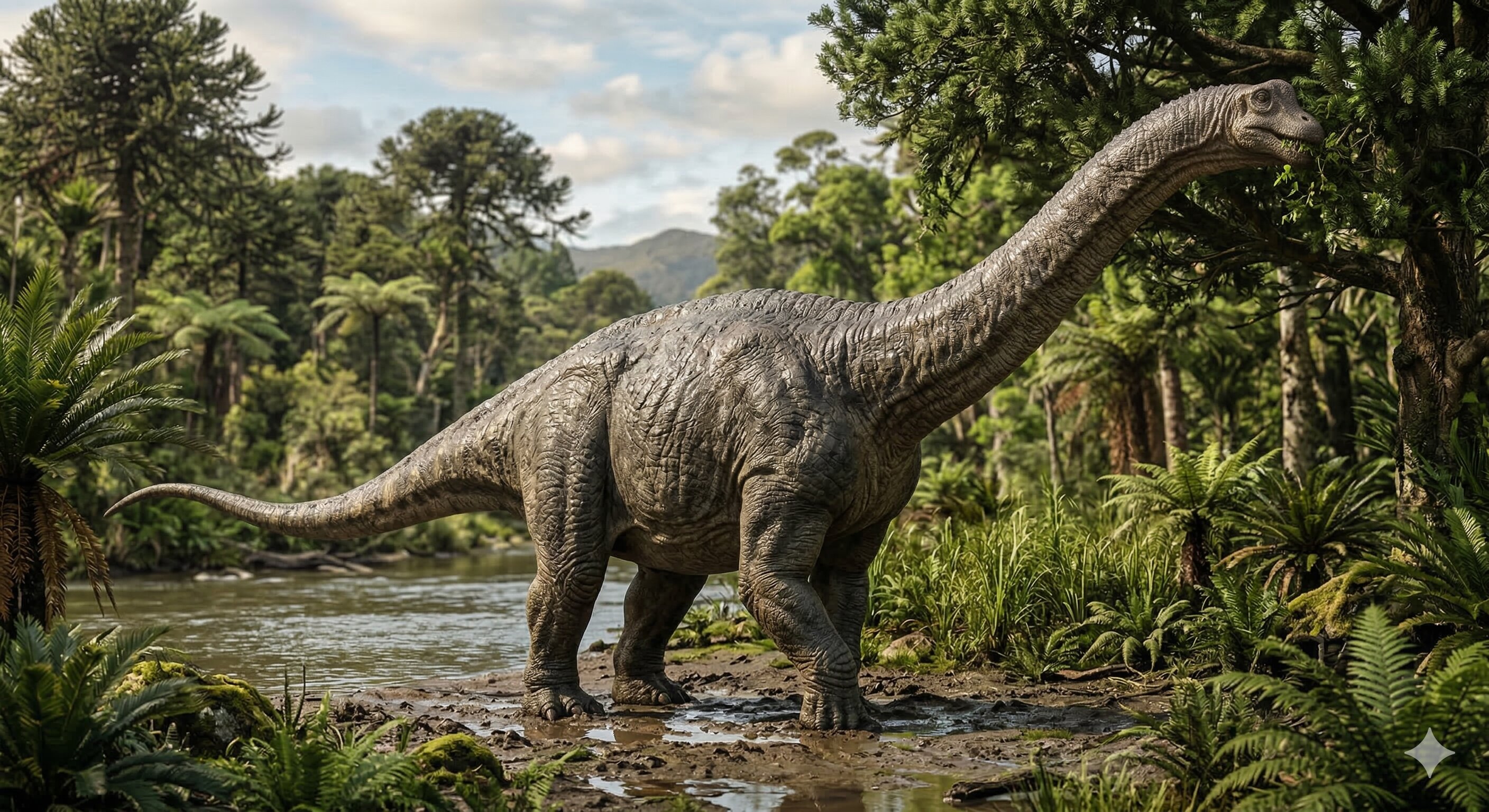
What It Looked Like
Brontosaurus was a towering dinosaur that could reach lengths of about 72 feet from the tip of its snout to the end of its tail — roughly as long as two school buses parked end to end. It stood around 15 feet tall at the hips and may have weighed up to 15 tons, which is heavier than two full-grown African elephants combined. Its body was built like a barrel, supported by four thick, pillar-like legs that held up all that weight. Brontosaurus had a relatively small head compared to the rest of its body, and its long tail tapered to a thin, flexible tip. Its skin was likely tough and scaly, though scientists are still learning about the exact texture and color of sauropod skin.
A Name with a History
The story of Brontosaurus’s name is one of the most famous mix-ups in the history of science. In 1879, the famous fossil hunter Othniel Charles Marsh named a large sauropod skeleton Brontosaurus, and the name quickly captured the public’s imagination. However, in 1903, another scientist argued that Brontosaurus was too similar to a dinosaur called Apatosaurus, which had been named two years earlier. Because Apatosaurus was named first, the rules of scientific naming said that name should be used instead, and Brontosaurus was dropped from official use for over a century. Then, in 2015, a detailed study by a team of European researchers compared hundreds of bones and concluded that Brontosaurus really was different enough from Apatosaurus to deserve its own name after all. Today, many paleontologists accept Brontosaurus as a valid genus once again, though the debate is not entirely settled.
The Long Neck
The long neck of Brontosaurus is one of its most striking features, stretching roughly 20 feet or more. Scientists believe this long neck allowed Brontosaurus to reach vegetation that shorter dinosaurs could not access, giving it an advantage when searching for food. The neck was made up of many large vertebrae that were partly hollow, which kept the neck lighter than solid bone would have been. Air sacs connected to the breathing system filled spaces inside these bones, similar to the way modern birds have lightweight, air-filled skeletons. Despite its length, the neck was not as flexible as you might imagine — Brontosaurus probably swept its head slowly from side to side rather than lifting it high like a giraffe.
What It Ate
Brontosaurus was a dedicated herbivore that spent most of its waking hours eating plants. During the Late Jurassic, the landscape was filled with ferns, cycads, ginkgoes, and conifers, and Brontosaurus likely fed on all of these. Its teeth were shaped like pegs or pencils, which were good for stripping leaves from branches but not for chewing. Instead of chewing its food, Brontosaurus swallowed plant material whole and relied on its massive digestive system to break it down. Some scientists think sauropods may have swallowed stones, called gastroliths, to help grind up tough plant matter inside their stomachs — much like modern birds use grit to digest seeds.
Where It Lived
Fossils of Brontosaurus have been found in the western United States, particularly in states like Wyoming, Utah, and Colorado. During the Late Jurassic period, this region looked very different from the dry, mountainous landscape we see today. It was a broad, flat floodplain crisscrossed by rivers and dotted with lush forests of tall conifers and ferns. Brontosaurus shared this environment with many other well-known dinosaurs, including the armored Stegosaurus, the fierce predator Allosaurus, and the long-necked Diplodocus. This rich ecosystem, preserved in a layer of rock called the Morrison Formation, gives scientists a detailed window into life during the age of the giant sauropods.
How We Know About It
Everything we know about Brontosaurus comes from studying its fossilized bones, which have been preserved in rock for over 150 million years. Paleontologists carefully dig fossils out of the ground using tools ranging from jackhammers to tiny brushes, then transport them to museums and laboratories for study. By examining the size and shape of bones, scientists can figure out how big the animal was, how it moved, and what it ate. CT scans and computer modeling now allow researchers to look inside fossilized bones without breaking them, revealing details about growth rates and internal structure. The 2015 study that brought back the name Brontosaurus used measurements from nearly 500 different anatomical features across dozens of sauropod specimens, showing how modern technology continues to reshape our understanding of ancient life.
Brontosaurus in Culture
Even during the decades when scientists did not consider Brontosaurus a valid name, the thunder lizard never lost its place in popular culture. Brontosaurus appeared on a United States postage stamp in 1989, museum exhibits continued to use the name, and countless books, movies, and cartoons featured its familiar silhouette. The name simply sounded more exciting than Apatosaurus, and people refused to give it up. When the 2015 study restored the name, it made headlines around the world because so many people had grown up loving a dinosaur they had been told did not really exist. Today, Brontosaurus remains one of the first dinosaurs many children learn about, a symbol of just how strange and wonderful life on Earth once was.
 OtterKnow Kids Encyclopedia