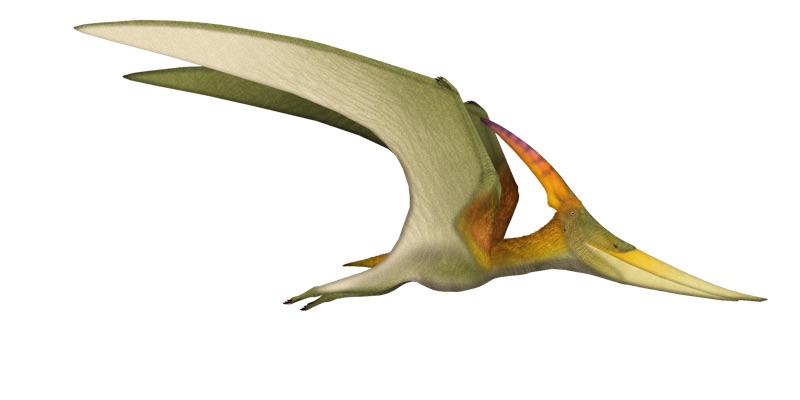
Not a Dinosaur — A Pterosaur
Many people assume Pteranodon was a dinosaur, but it actually belonged to a completely different group of reptiles called pterosaurs. Dinosaurs walked on the ground and had legs positioned directly under their bodies, while pterosaurs were built for flying. Pterosaurs evolved the ability to fly millions of years before birds did, making them the first vertebrates (animals with backbones) to achieve powered flight. Although pterosaurs like Pteranodon lived alongside dinosaurs such as Tyrannosaurus rex and Spinosaurus, they belonged to a separate branch on the reptile family tree. Thinking of Pteranodon as a dinosaur is a bit like calling a dolphin a fish — they may share the same environment, but they are very different animals.
What It Looked Like
Pteranodon had a long, narrow body covered in a thin coat of fuzz-like fibers that may have helped keep it warm. Its most striking feature was its enormous wings, which gave it a wider wingspan than any eagle or albatross alive today. Despite its huge wings, Pteranodon’s body was surprisingly lightweight, with hollow bones that may have weighed as little as 25 kilograms (55 pounds) in total. It had a long, pointed beak with no teeth at all, which made it look quite different from many other prehistoric flying reptiles. Its legs were relatively small compared to its wings, and scientists believe it walked awkwardly on all fours when it was on the ground.
The Crest
One of Pteranodon’s most recognizable features was the bony crest that extended from the back of its skull. The size and shape of this crest varied between individuals — some had tall, sweeping crests while others had much smaller ones. Scientists think the larger crests may have belonged to males, who used them to attract mates, much like a peacock uses its tail feathers. The crest may also have served as a rudder during flight, helping Pteranodon steer and stay stable in the wind. Some researchers have suggested it could have helped regulate body temperature by allowing heat to escape through blood vessels near the surface of the bone.
Wings of Skin
Unlike birds, which fly with feathered wings, Pteranodon flew on wings made of a thin, leathery membrane of skin. This wing membrane stretched from its body all the way out to an incredibly long fourth finger on each hand. The other three fingers on each hand were short and clawed, sticking out at the front edge of the wing. The membrane was reinforced with stiff fibers that helped it keep its shape during flight, somewhat like the ribs of an umbrella. Scientists believe Pteranodon was an excellent glider, using warm air currents rising from the ocean to stay aloft for hours with very little effort, similar to how modern albatrosses soar over the sea.
What It Ate
Pteranodon was a fish eater that hunted over the shallow seas that once covered much of central North America. Its long, toothless beak was perfectly shaped for snatching fish from near the surface of the water, much like a modern pelican. Fossil evidence, including fish bones found in the stomach area of some specimens, confirms that fish made up a major part of its diet. Pteranodon likely spotted its prey from the air, swooped down to grab a fish in its beak, and swallowed it whole. Some scientists think it may have also eaten squid and other small sea creatures that swam close to the surface.
Where It Lived
During Pteranodon’s time, a vast inland sea called the Western Interior Seaway split North America in two, stretching from the Gulf of Mexico all the way to the Arctic Ocean. Most Pteranodon fossils have been found in Kansas, South Dakota, and other states that were once covered by or bordered this ancient sea. The warm, shallow waters of the seaway would have been full of fish, making it an ideal hunting ground. Pteranodon probably nested on rocky coastlines or islands near the sea, where it could easily take off and land. Fossils of Pteranodon have been found far from any ancient shoreline, suggesting these animals could fly long distances over open water.
Pterosaurs and the Sky
Pteranodon belonged to a group of animals that ruled the skies for over 150 million years, from the Late Triassic to the end of the Cretaceous period. Pterosaurs came in many sizes, from small species no bigger than a sparrow to giants like Quetzalcoatlus, which had a wingspan of around 10 meters (33 feet). These creatures were the first backboned animals to evolve true powered flight, beating their wings to take off and climb rather than simply gliding. When a massive asteroid struck Earth about 66 million years ago, pterosaurs went extinct along with the non-avian dinosaurs. Today, birds are the only flying vertebrates left, but the skies once belonged to the incredible pterosaurs — and Pteranodon was among the most impressive of them all.
 OtterKnow Kids Encyclopedia