Not a True Tiger
Even though people call it a “saber-toothed tiger,” Smilodon was not closely related to modern tigers or lions. It belonged to a completely separate branch of the cat family that split off millions of years ago. Scientists classify Smilodon in the subfamily Machairodontinae, while today’s big cats belong to a different subfamily called Pantherinae. Calling it a “saber-toothed cat” is more accurate, and many scientists prefer that name. The confusion comes from the fact that Smilodon was large and powerful like a tiger, but the two animals are about as closely related as a house cat is to a leopard.
What It Looked Like
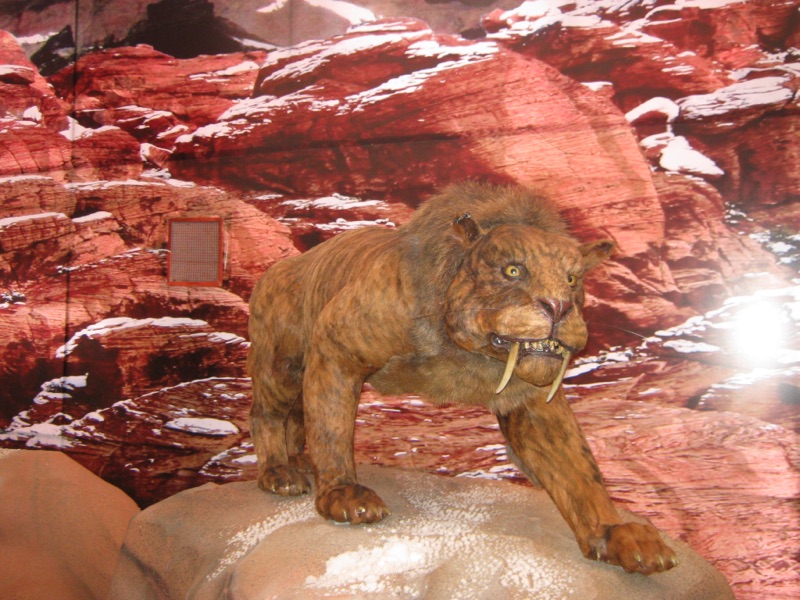
Smilodon was a heavily built predator with a muscular body designed for power rather than speed. It stood about three feet tall at the shoulder and weighed between 350 and 620 pounds, making it roughly the size of a modern lion but much more stocky. Its front legs were especially thick and strong, with large paws that could pin down struggling prey. Unlike the long, sleek body of a modern tiger, Smilodon had a short tail, similar to a bobcat’s. Its jaw could open to a staggering 120 degrees, almost twice as wide as a modern lion’s, which was necessary to use its enormous fangs.
The Saber Teeth
The most striking feature of Smilodon was its pair of long, curved upper canine teeth, which could grow up to seven inches long. These teeth were shaped like curved sabers, which is how the animal got its name. Despite their impressive size, the teeth were actually somewhat fragile because they were flattened from side to side like a blade rather than being thick and round. Scientists believe Smilodon used its powerful neck and front legs to hold prey still before delivering a precise, deep bite to the throat. If Smilodon had bitten into bone, those thin teeth could have snapped, so it had to be a careful and skillful hunter.
Where It Lived
Smilodon lived across a wide range of habitats in North and South America. In North America, its fossils have been found from coast to coast, from California to Florida. About 2.5 million years ago, when a land bridge formed between North and South America, Smilodon migrated south and spread into what is now Argentina, Brazil, and other parts of South America. It thrived in open grasslands, scrubby woodlands, and the edges of forests where large plant-eating animals gathered. Smilodon did not live in Europe, Asia, or Africa, although other types of saber-toothed cats lived on those continents at different times.
What It Ate
Smilodon was a carnivore that hunted large, slow-moving herbivores of the Ice Age. Its diet likely included bison, horses, young mammoths, giant ground sloths, camels, and tapirs. Because of its bulky build and short tail, scientists think Smilodon was an ambush predator that relied on surprise rather than long chases. It probably crouched in tall grass or behind rocks, then exploded forward in a short, powerful rush to tackle its prey. Some researchers believe Smilodon may have hunted in groups, like lions do today, because many fossils found together show healed injuries that suggest other members of the group helped injured hunters survive.
Ice Age World
Smilodon lived during the Pleistocene epoch, a time often called the Ice Age because massive glaciers covered much of the Northern Hemisphere. The climate shifted between freezing cold periods and warmer stretches, and the landscape looked very different from today. Enormous animals called megafauna roamed the plains, including woolly mammoths, mastodons, giant beavers, and dire wolves. Smilodon was one of the top predators in this world, competing with other large hunters for food. Early humans eventually arrived in the Americas toward the end of the Ice Age and shared the land with Smilodon for at least a few thousand years.
Extinction
Smilodon disappeared from the fossil record about 10,000 years ago, at the end of the last Ice Age. Scientists debate exactly why it went extinct, but most agree that a combination of factors was responsible. As the climate warmed, the open grasslands and woodlands where Smilodon hunted shrank, and many of the large herbivores it depended on for food also died out. The arrival of human hunters in the Americas may have added extra pressure by competing for the same prey animals. Without enough large, slow-moving prey to ambush, Smilodon’s specialized hunting style became a disadvantage, and this mighty predator vanished forever.
Fossils and Discovery
More than 2,000 individual Smilodon specimens have been recovered from the La Brea Tar Pits alone, giving scientists a detailed window into this animal’s life. The tar pits acted as natural traps where animals became stuck in thick, sticky asphalt that bubbled up from underground. Predators like Smilodon were lured in by the cries of trapped herbivores and became stuck themselves. These beautifully preserved fossils have taught scientists about Smilodon’s bone injuries, diet, growth patterns, and even possible social behavior. Smilodon is now the official state fossil of California, a fitting honor for one of the most spectacular predators the world has ever known.
 OtterKnow Kids Encyclopedia