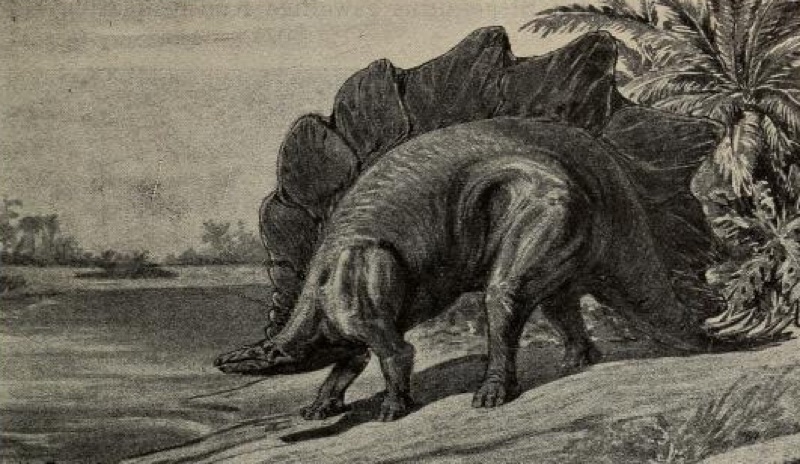
What It Looked Like
Stegosaurus was a large, heavy dinosaur that could grow up to 30 feet long and weigh around 5,000 to 7,000 pounds. It walked on all four legs, but its front legs were much shorter than its back legs, giving its body a distinctive arched shape with the hips standing higher than the shoulders. Its head was small and narrow, held low to the ground, with a beak-like mouth at the front and small, leaf-shaped teeth further back in its jaws. Along its back, two rows of large, flat bony plates stood upright, and its muscular tail ended in a set of long, pointed spikes. Its skin was likely tough and scaly, and its sturdy build helped it move steadily through the forests and floodplains of the Jurassic landscape.
The Plates
The most striking feature of Stegosaurus was the series of 17 bony plates that ran from its neck down to the base of its tail. These plates were not directly attached to the skeleton but were embedded in the skin, and they were made of bone with a thin outer covering. For many years, scientists thought the plates were used as armor to protect Stegosaurus from predators, but most researchers now believe they served a different purpose. The plates were filled with blood vessels, which suggests they helped the dinosaur regulate its body temperature by absorbing heat from the sun or releasing excess warmth into the air. They may also have been used for display, helping Stegosaurus attract mates or appear larger and more intimidating to rivals and predators.
The Thagomizer
While the plates may not have been great weapons, the tail of Stegosaurus certainly was. The tip of its tail bore four long, sharp spikes, each up to three feet in length, arranged in a pattern that could deliver devastating blows to any attacker. Scientists call this spiked tail arrangement a “thagomizer,” a name that actually came from a comic strip by cartoonist Gary Larson before being adopted by paleontologists. Fossil evidence shows that Stegosaurus could swing its flexible tail with enough force to puncture bone, and researchers have found damaged Allosaurus bones that match the size and shape of thagomizer spikes. This tells us that Stegosaurus was far from defenseless and could put up a serious fight when threatened.
What It Ate
Stegosaurus was a herbivore, meaning it ate only plants. With its head positioned low to the ground, it likely fed on ferns, mosses, cycads, and other low-growing vegetation that was common during the Jurassic period. Its beak-like mouth was good for snipping off plant material, but its small, weak teeth were not designed for heavy chewing. Instead, Stegosaurus probably swallowed its food in large pieces and relied on its digestive system to break it down, possibly with the help of swallowed stones called gastroliths. Because it needed to eat large amounts of plant matter to fuel its massive body, Stegosaurus likely spent much of its day foraging and feeding.
Where It Lived
Fossils of Stegosaurus have been found mainly in the western United States, particularly in Colorado, Wyoming, and Utah, in a rock formation known as the Morrison Formation. During the Late Jurassic, this region was a warm, semi-arid landscape dotted with rivers, floodplains, and patches of conifer forest. Stegosaurus shared this environment with a diverse community of dinosaurs, including the long-necked Diplodocus and the armored relatives of Ankylosaurus. Some Stegosaurus fossils have also been found in Portugal, suggesting that these dinosaurs may have crossed land bridges between North America and Europe when the continents were positioned closer together. The variety of fossils from this period gives scientists a detailed picture of the ecosystem where Stegosaurus thrived.
A Very Small Brain
One of the most surprising things about Stegosaurus is just how small its brain was compared to the rest of its body. Its brain was roughly the size of a walnut or a lime, weighing only about 2.8 ounces, which is tiny for an animal that could weigh several tons. For a long time, a popular myth claimed that Stegosaurus had a “second brain” in its hip area to help control its back legs and tail, but scientists have since shown that this space likely held a glycogen body, an energy storage structure found in many animals. Despite its small brain, Stegosaurus survived for millions of years, which means it was well adapted to its environment and lifestyle. Its brain was large enough to handle the tasks it needed, like finding food, avoiding predators, and interacting with other members of its species.
How We Know About It
Almost everything we know about Stegosaurus comes from studying its fossilized bones, which were first described by the famous paleontologist Othniel Charles Marsh in 1877 during a period of intense fossil hunting known as the Bone Wars. Since then, dozens of Stegosaurus specimens have been unearthed, including one of the most complete examples, a fossil nicknamed “Sophie” that is displayed at the Natural History Museum in London. By examining the structure of its bones, the patterns of its plates, and the wear on its teeth, scientists have pieced together how Stegosaurus moved, ate, and defended itself. Modern technology like CT scanning allows researchers to study the inside of fossils without damaging them, revealing details about brain size and blood vessel networks within the plates. Each new discovery adds another piece to the puzzle of how Stegosaurus lived during the age of giants.
 OtterKnow Kids Encyclopedia