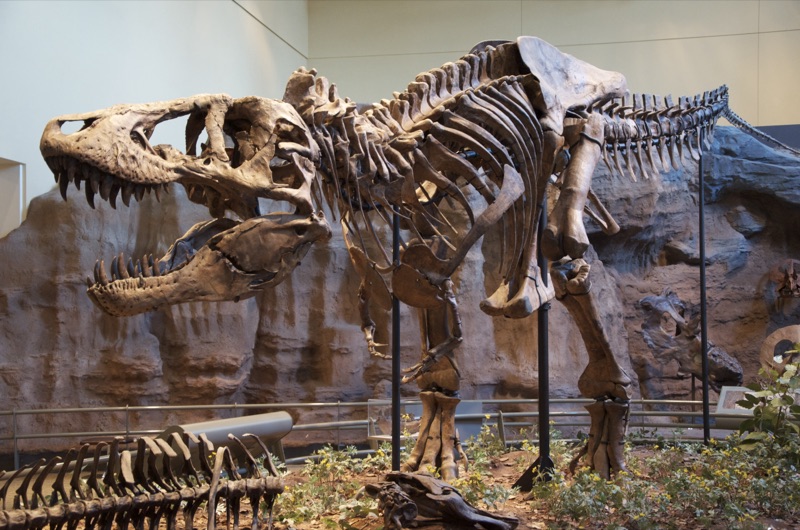
What It Looked Like
A fully grown Tyrannosaurus rex stretched about 40 feet from snout to tail and stood roughly 12 feet tall at the hip, making it one of the largest land predators in Earth’s history. It could weigh as much as 9 tons, which is heavier than most school buses. Its skull alone measured about 5 feet long, with thick bone surrounding powerful jaw muscles. Recent research suggests that T. rex was likely covered in feathers, at least partially, especially when it was young. Close relatives found in China, like Yutyrannus, were clearly feathered, and many scientists now believe T. rex may have kept some feathery covering into adulthood rather than being entirely scaly.
The Jaws and Teeth
The jaws of T. rex were built for crushing. Its bite force has been estimated at around 12,800 pounds, which is the strongest bite of any land animal that has ever lived. T. rex had about 50 to 60 thick, banana-shaped teeth, some measuring over 9 inches long including the root. Unlike the thin, blade-like teeth of many other predatory dinosaurs, T. rex teeth were wide and sturdy, designed to crush through bone rather than simply slice meat. Scientists have found fossils of Triceratops bones with T. rex tooth marks gouged deep into them, proving that this predator could bite clean through solid bone.
The Arms
The tiny arms of T. rex have puzzled scientists for decades, and they are the subject of many jokes. Each arm was only about 3 feet long, which looks ridiculously small on such a massive animal. However, those arms were far from weak. Studies of the arm bones show that each one could curl roughly 430 pounds, which is more than most adult humans can lift with both arms combined. Scientists have proposed many ideas for what the arms were used for, including gripping prey at close range, pushing off the ground when getting up, or holding onto a mate. Whatever their purpose, T. rex arms were muscular tools, not useless leftovers.
How It Moved
Despite its enormous size, T. rex was built to move efficiently. Its long, powerful legs and large hip muscles suggest it could walk at a steady pace and accelerate quickly over short distances. Most scientists estimate its top speed at around 12 to 25 miles per hour, which is fast for an animal that weighed several tons. Modern research suggests that T. rex may have been more of an ambush predator than a long-distance chaser, using cover or surprise rather than outrunning prey over open ground. Its long tail acted as a counterbalance, keeping its heavy head and body stable while walking or lunging forward.
What It Ate
Tyrannosaurus rex was a carnivore that sat at the very top of its food chain. It likely hunted large plant-eating dinosaurs like Triceratops and Edmontosaurus, which shared its habitat. Fossil evidence shows that T. rex was not a picky eater. Coprolites, which are fossilized droppings, contain crushed bone fragments, confirming that T. rex swallowed bones along with meat. Scientists debate whether T. rex was primarily an active hunter or whether it also scavenged dead animals when the opportunity arose. The answer is probably both, since most large modern predators, like lions and grizzly bears, will happily scavenge a free meal when they find one.
Where It Lived
T. rex fossils have been found across what is now the western United States and Canada, in states like Montana, Wyoming, South Dakota, and the Canadian province of Alberta. During the Late Cretaceous, this region looked very different from today. A shallow inland sea split North America in two, and the western half featured warm, humid forests, river floodplains, and coastal swamps. T. rex shared this landscape with a rich community of dinosaurs, including horned ceratopsians, duck-billed hadrosaurs, armored ankylosaurs, and smaller predators like Velociraptor relatives. This ecosystem vanished 66 million years ago when a massive asteroid struck what is now Mexico’s Yucatan Peninsula, ending the age of dinosaurs.
T. Rex in Science
The first partial T. rex skeleton was discovered in 1902 by fossil hunter Barnum Brown in Montana, and paleontologist Henry Fairfield Osborn gave it its famous name in 1905. One of the most important specimens ever found is “Sue,” a remarkably complete skeleton discovered in South Dakota in 1990 and now displayed at the Field Museum in Chicago. Scientists have even extracted soft tissue, including blood vessels, from a T. rex leg bone, opening new doors for studying dinosaur biology at the molecular level. Advances in CT scanning, computer modeling, and biomechanics continue to reveal new details about how T. rex grew, moved, and interacted with its world. Far from being a simple movie monster, T. rex remains one of the most scientifically important animals ever to have existed.
 OtterKnow Kids Encyclopedia