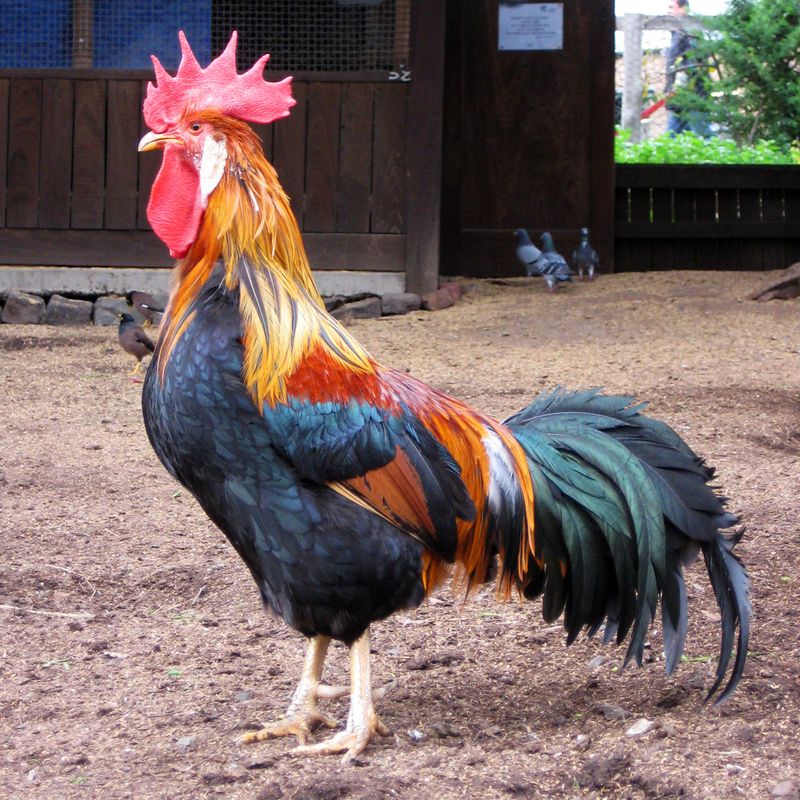
What They Look Like
Roosters are generally larger and more colorful than hens, with longer, more dramatic feathers. Their tail feathers curve gracefully in long, sweeping arcs called sickle feathers, and their neck feathers, known as hackle feathers, are pointed and often shimmer with iridescent greens, blues, and coppers. Roosters also have sharp, curved spurs on the backs of their legs, which are bony growths covered in keratin, the same material that makes up human fingernails. Most roosters weigh between 2.5 and 5.5 kilograms (about 5.5 to 12 pounds), depending on the breed. Their proud posture and vivid plumage make them easy to spot in any flock.
The Crow
The rooster’s crow is one of the most famous sounds in the animal kingdom, but it is not triggered only by the sunrise, as many people believe. Scientists in Japan discovered in 2013 that roosters have a strong internal clock, or circadian rhythm, that causes them to begin crowing roughly two hours before dawn, even in total darkness. A rooster crows throughout the day to announce its territory, respond to other roosters, and react to disturbances. The sound can reach an astonishing 130 decibels, which is louder than a chainsaw and close to the threshold of pain for human ears. Remarkably, roosters protect their own hearing by tilting their heads when they crow so that their ear canal is partially covered, acting like a built-in earplug.
Comb and Wattles
The fleshy red comb on top of a rooster’s head and the dangling wattles beneath its beak are not just for show. These structures are packed with tiny blood vessels and help the rooster regulate its body temperature by releasing excess heat into the air, much like a radiator. In hot weather, blood flows to the comb and wattles, allowing heat to escape, while in cold weather, blood flow decreases to conserve warmth. The size and color of a rooster’s comb can also signal health and fitness to hens: a large, bright red comb is a sign of a strong, well-nourished bird. There are several different comb shapes, including the single comb, rose comb, and pea comb, and the type depends on the breed.
Protecting the Flock
One of the rooster’s most important jobs is keeping the flock safe from predators. Roosters are constantly on the lookout for threats such as hawks, foxes, raccoons, and snakes, and they use different alarm calls depending on whether danger is coming from the sky or the ground. When a rooster spots a hawk overhead, it gives a high-pitched aerial alarm call that sends hens running for cover, but when it sees a ground predator, it uses a different, lower-pitched call. If a predator gets too close, a rooster will stand its ground, puffing up its feathers and using its sharp spurs to fight. This bravery makes roosters essential guardians for free-range flocks, and many farmers keep at least one rooster specifically for protection.
Courtship and Tidbitting
When a rooster finds a tasty morsel of food, it often performs a behavior called tidbitting to attract hens. During this display, the rooster picks up and drops the food repeatedly while making a rapid series of clucking sounds and bobbing its head up and down. This is not generosity for its own sake: tidbitting is a courtship behavior designed to impress hens and show that the rooster is a good provider. Roosters also perform a dramatic courtship dance called wing-dragging, in which they lower one wing to the ground and circle around a hen in a shuffling sideways walk. Research has shown that hens prefer roosters who tidbit frequently and who have larger, brighter combs, suggesting that these displays are honest signals of quality.
Roosters in Culture
Roosters have held a special place in human culture for thousands of years. In many countries, the crowing rooster is a symbol of dawn, wakefulness, and courage. The rooster is one of the twelve animals in the Chinese zodiac, and people born in the Year of the Rooster are said to be hardworking and confident. In France, the rooster (le coq gaulois) has been a national symbol since the Middle Ages, appearing on sports jerseys, coins, and government seals. Weather vanes shaped like roosters, called weathercocks, have sat atop churches and barns across Europe and America since the 800s, originally placed there to remind people to be watchful. Even today, the rooster’s image appears on everything from cereal boxes to national flags.
Roosters Around the World
While roosters are found on farms in virtually every country, different breeds have developed to suit different climates and cultures. The Ayam Cemani from Indonesia is strikingly unusual because its feathers, skin, bones, and even internal organs are jet black due to a genetic condition called fibromelanosis. In the Mediterranean, breeds like the Leghorn are known for being active, alert, and excellent at foraging on their own. Large, sturdy breeds such as the Brahma, which originated in Asia, were once nicknamed the “King of Chickens” because roosters can weigh over 8 kilograms (about 18 pounds). In parts of rural Asia, Africa, and Latin America, roosters still roam freely through villages, serving as natural alarm clocks and flock protectors. Wherever people raise chickens, roosters remain at the heart of flock life.
 OtterKnow Kids Encyclopedia