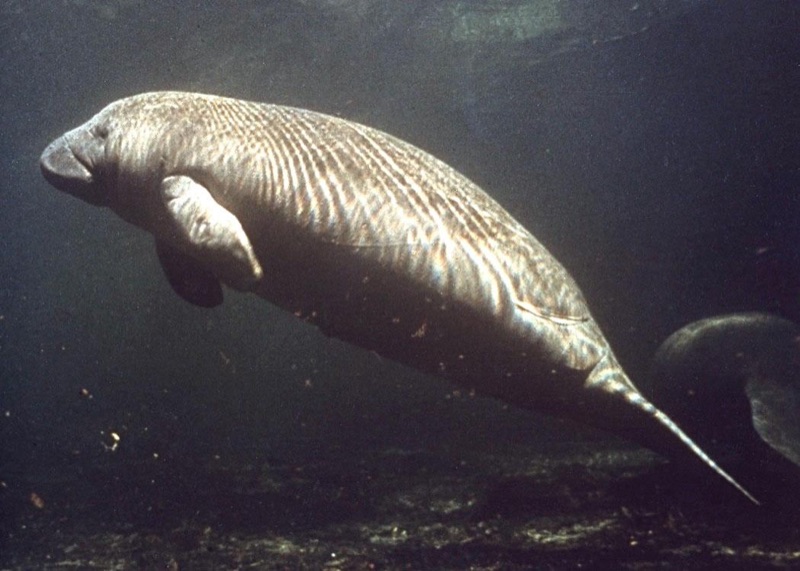
What They Look Like
Manatees have large, rounded bodies covered in thick, wrinkled grayish-brown skin. An adult West Indian manatee typically grows to about 3 meters (10 feet) long and weighs between 400 and 600 kilograms (900 to 1,300 pounds), though some individuals can weigh over 900 kilograms (nearly 2,000 pounds). Their bodies end in a wide, flat, paddle-shaped tail that they move slowly up and down to glide through the water. Manatees have two small front flippers, each with three to four fingernails at the tip, which they use to steer, crawl along the bottom, and even bring food to their mouths. Their faces are covered in stiff whiskers called vibrissae, which help them sense nearby objects and find food in murky water.
Surprising Relatives
One of the most surprising facts about manatees is that their closest living relative is not a whale, a dolphin, or a seal, but the elephant. Scientists have found that manatees and elephants share a common ancestor that lived roughly 60 million years ago, long before the modern forms of either animal appeared. You can still see clues to this connection today: manatees have thick, tough skin similar to an elephant’s, and the small nails on their flippers resemble the toenails on an elephant’s feet. Manatees also replace their teeth in an unusual way that is more like elephants than any other marine mammal. Another close relative is the hyrax, a small furry animal about the size of a rabbit that lives in Africa and the Middle East, which also shares that ancient common ancestor.
Where They Live
Manatees need warm water to survive and can become seriously ill or die if water temperatures drop below about 20 degrees Celsius (68 degrees Fahrenheit). In the United States, West Indian manatees spend winters gathered around natural warm springs and power plant outflows in Florida, where heated water provides a safe refuge from the cold. During the warmer months, they spread out along the coastlines of the Gulf of Mexico and the Atlantic, sometimes traveling as far north as Virginia or the Carolinas. Unlike many ocean animals, manatees move easily between saltwater, freshwater, and brackish water, visiting rivers, estuaries, bays, and canals throughout the year. Amazonian manatees are the only species that lives exclusively in freshwater, never entering the ocean at all.
Eating and Digestion
Manatees are dedicated herbivores that can eat a remarkable amount of vegetation every single day. A full-grown manatee consumes roughly 10 percent of its body weight in aquatic plants daily, which means a 450-kilogram manatee eats about 45 kilograms (100 pounds) of food each day. They graze on a wide variety of plants, including seagrass, water hyacinth, hydrilla, and mangrove leaves, spending six to eight hours a day feeding. To handle all that tough, gritty plant material, manatees have a special dental system called “marching molars.” Their teeth wear down from the sandy plants they chew, but new molars constantly grow in at the back of the jaw and slowly push forward to replace the worn-out ones at the front, ensuring they always have fresh grinding surfaces.
Gentle Giants
Manatees are famously calm, curious animals with no natural predators in most of their range. They spend their days drifting slowly through warm, shallow waters at speeds of about 5 to 8 kilometers per hour (3 to 5 miles per hour), though they can swim in short bursts of up to 30 kilometers per hour (19 miles per hour) when startled. Because they are mammals, manatees must surface to breathe, typically coming up for air every three to five minutes, though they can hold their breath for up to 20 minutes while resting. Manatees are known for approaching boats, docks, and even swimmers out of pure curiosity, sometimes nuzzling divers or rolling over playfully. Despite their size, they are completely harmless to people and have earned a reputation as one of the gentlest large animals in the world.
Calves and Family Life
Female manatees usually give birth to a single calf after a pregnancy that lasts about 12 to 13 months. Newborn calves are roughly 1.2 meters (4 feet) long and weigh about 30 kilograms (66 pounds), and they can swim to the surface on their own within minutes of being born. A mother manatee nurses her calf for one to two years, during which time the young manatee stays close to her side and learns where to find food, warm water, and safe resting spots. Calves begin nibbling on plants within a few weeks of birth, but they rely on their mother’s milk as their main source of nutrition for many months. Manatees can live 50 to 60 years in the wild, but they reproduce slowly, with females typically having one calf only every two to five years.
Conservation
All three species of manatee are considered at risk, and the West Indian manatee is listed as Threatened under the United States Endangered Species Act. One of the biggest dangers manatees face is being struck by boats and personal watercraft, because these slow-moving animals often rest or feed just below the surface in busy waterways. Many manatees carry scars from boat propellers on their backs and tails, and researchers actually use these scar patterns to identify individual animals. Loss of warm-water habitat and declines in seagrass, their primary food source, also threaten manatee populations, especially in Florida where large seagrass die-offs have led to starvation events in recent years. Conservation efforts, including speed zones in manatee areas, protected warm-water refuges, and habitat restoration projects, have helped the population recover from a few hundred animals in the 1970s to around 8,000 West Indian manatees in Florida today, but continued protection is essential to keep these gentle giants safe.
 OtterKnow Kids Encyclopedia