What They Look Like
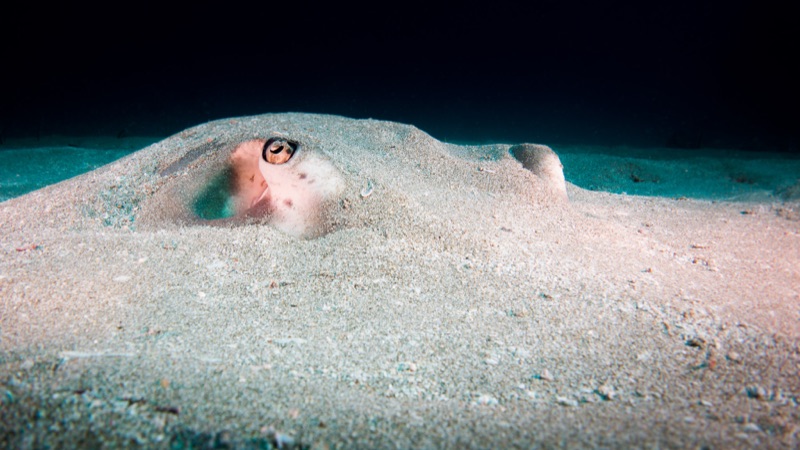
A stingray’s body is dramatically flattened from top to bottom, giving it a disc-like or diamond-shaped outline that sets it apart from most other fish. Its pectoral fins are fused to the sides of its head and body, forming the broad, wing-like shape that allows it to ripple and glide smoothly through the water or across the seafloor. Most stingrays are brown, gray, or olive-colored on top to match the sandy bottom where they rest, while their undersides are pale or white. Their eyes sit on the top of their head, and just behind each eye is a small opening called a spiracle, which the stingray uses to draw in water for breathing even while it is buried in sand. A long, whip-like tail extends from the back of the body, and on many species this tail carries one or more sharp, barbed spines that the ray uses only for self-defense.
Relatives of the Shark
Stingrays may not look much like sharks, but the two groups are actually close relatives that share some important features. Like sharks, stingrays are cartilaginous fish, which means their entire skeleton is made of cartilage rather than hard bone. Cartilage is the same flexible, lightweight material that gives shape to your nose and ears, and it makes these fish more buoyant and agile in the water than heavy-boned fish would be. Stingrays and sharks both have rough, sandpaper-like skin covered in tiny tooth-like structures called dermal denticles, and neither group has a swim bladder, the gas-filled organ that bony fish use to control their depth. Scientists believe that stingrays evolved from shark-like ancestors that gradually became flattened over millions of years as they adapted to life on the ocean floor.
Electroreception
One of the stingray’s most unusual abilities is electroreception, a sixth sense that allows it to detect the weak electrical fields produced by other living creatures. Every animal generates tiny electrical signals when its muscles contract or its nerves fire, and stingrays can pick up these signals using special gel-filled pores on the underside of their snout called the ampullae of Lorenzini. This sense is so precise that a stingray can locate a clam, worm, or small crab buried completely out of sight beneath the sand. Electroreception works even in murky water or total darkness, giving stingrays a hunting advantage that eyes and ears alone could never provide. Sharks share this same electrical sense, which is one more piece of evidence linking these two groups of cartilaginous fish as close relatives.
The Defensive Barb
The stingray’s tail spine, or barb, is its most well-known feature and the source of its name, but it is strictly a defensive weapon, never used for hunting. The barb is a modified scale made of the same material as the denticles on the ray’s skin, and it is coated in a thin layer of venomous tissue that can cause intense pain and swelling if it punctures skin. When a stingray feels threatened, such as when it is accidentally stepped on by a wading swimmer, it whips its tail upward in a reflex action and may drive the barb into the threat. Stingrays would much rather flee than fight, and most injuries to humans happen simply because someone did not see the ray lying camouflaged on the bottom. In 2006, the world was shocked when Australian wildlife expert Steve Irwin was fatally struck by a stingray barb while filming a documentary, though such incidents are extraordinarily rare and stingrays are not considered aggressive animals.
What They Eat
Stingrays are bottom feeders that hunt for prey hiding in or on the sandy and muddy ocean floor. Their diet consists mainly of small creatures such as clams, mussels, shrimp, crabs, worms, and small fish, which they locate using their keen sense of electroreception and smell. To eat, a stingray settles over its prey and uses its flat body like a suction cup, trapping the food against the bottom before crushing it with rows of flat, plate-like teeth designed for grinding rather than tearing. Some larger species also eat snails, oysters, and even small squid. Stingrays play an important role in their ecosystems by controlling populations of bottom-dwelling invertebrates and by stirring up the seafloor as they feed, which helps recycle nutrients back into the water.
Where They Live
Stingrays are found in warm and temperate waters all around the world, from shallow coastal bays to deeper offshore waters. Many species prefer sandy or muddy bottoms near coral reefs, seagrass beds, or estuaries where rivers meet the sea, because these areas are rich in the small creatures they eat. While most stingrays are ocean dwellers, some species live entirely in freshwater. The rivers of South America are home to several species of freshwater stingrays that have adapted to life far from the sea, and freshwater rays also inhabit rivers in Southeast Asia and Africa. Stingrays often bury themselves in sand or mud during the day and become more active at night, cruising along the bottom in search of food. Some species, like the cownose ray, are highly social and migrate in large groups numbering in the hundreds or even thousands.
Reproduction
Unlike most fish, which release eggs into the water, stingrays give birth to live young called pups. After mating, the fertilized eggs develop inside the mother’s body, where the embryos are nourished first by a yolk sac and later by a nutrient-rich fluid produced by the mother, somewhat like milk. A typical litter ranges from two to six pups depending on the species, and the gestation period can last anywhere from a few months to nearly a year. When the pups are born, they emerge as fully formed miniature versions of their parents, complete with functioning barbs, and are ready to swim and hunt on their own almost immediately. This method of reproduction means that stingrays produce far fewer offspring than egg-laying fish, which makes their populations more vulnerable to overfishing and habitat loss.
Stingrays and People
Stingrays have a long and mostly peaceful history with humans, and in many tropical destinations tourists can swim alongside them in shallow, clear water. In the Cayman Islands and other Caribbean locations, “stingray cities” attract visitors who wade into the shallows to feed and touch wild southern stingrays that have grown accustomed to people. Swimmers and waders can avoid stingray injuries by doing the “stingray shuffle,” sliding their feet along the bottom rather than stepping down, which gives a buried ray the chance to swim away before it is startled. In some cultures, stingray skin has been used for centuries to make leather goods, tool grips, and decorative objects because its denticle-covered surface is extremely tough and durable. Like their shark relatives, stingrays face threats from overfishing, bycatch, and habitat destruction, and several species are now listed as vulnerable or endangered. Protecting the shallow coastal waters and river systems where stingrays live is essential for keeping these flat fish thriving in the future.
 OtterKnow Kids Encyclopedia