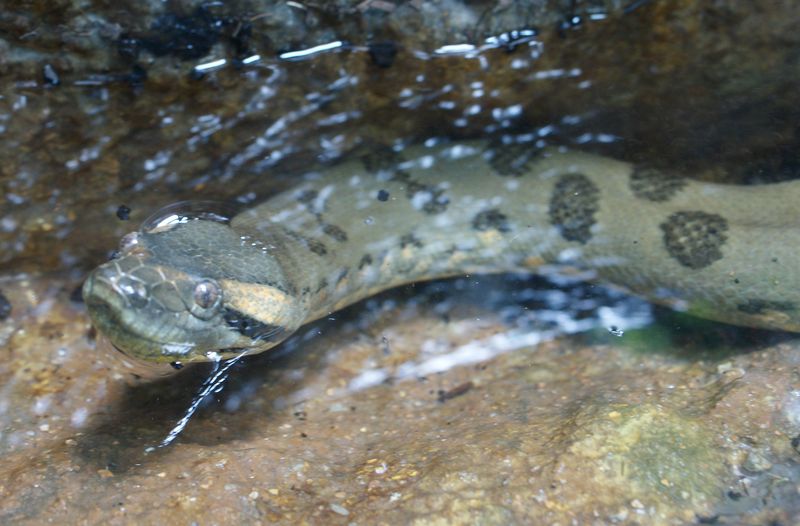
The World’s Heaviest Snake
The green anaconda is the heaviest snake on Earth, with large females weighing up to 250 kilograms (about 550 pounds) and stretching over 5 meters (17 feet) long. Some individuals have been measured at nearly 9 meters (30 feet), though such giants are rare. While the reticulated python can grow slightly longer, no snake comes close to matching the anaconda’s massive bulk. A fully grown green anaconda can be as thick as a grown adult’s waist, making it look more like a fallen tree trunk than a living animal. The yellow anaconda is considerably smaller, usually reaching around 3 meters (10 feet) in length, but it is still one of the larger snakes in South America.
What They Look Like
Green anacondas have dark olive-green skin covered with black oval-shaped spots, or blotches, that run along their backs and sides. This coloring works as camouflage, helping the snake blend into the murky, plant-filled waters where it spends most of its time. Their eyes and nostrils sit on top of their heads, much like a crocodile’s, so they can see and breathe while the rest of their body stays hidden underwater. Yellow anacondas have a lighter yellowish-tan base color with dark brown or black markings. Both species have smooth, glossy scales that feel dry to the touch, not slimy as many people assume.
How Constriction Works
Anacondas are constrictors, which means they squeeze their prey instead of using venom. When an anaconda strikes, it wraps its muscular coils around the animal and tightens each time the prey breathes out, making it impossible to inhale again. Scientists once believed that constrictors suffocated their prey, but recent research suggests the squeezing actually cuts off blood flow, causing the animal to lose consciousness within seconds. This method is extremely effective, and an anaconda’s grip is so powerful that even large animals cannot escape once the coils tighten. After the prey stops moving, the snake begins the slow process of swallowing it whole.
A Semi-Aquatic Life
Unlike many snakes that prefer dry land, anacondas are semi-aquatic and spend a large part of their lives in or near water. They are excellent swimmers and can move through rivers, swamps, and flooded forests with surprising speed and grace. On land, their enormous weight makes them slow and clumsy, but in water they become agile hunters, gliding silently just below the surface. Anacondas often rest in shallow water or drape themselves over low branches near riverbanks, waiting patiently for prey to wander close. The warm, slow-moving waters of tropical wetlands provide the perfect environment for these cold-blooded reptiles to regulate their body temperature.
What They Eat
Anacondas are ambush predators that wait quietly for prey to come within striking distance. Their diet includes fish, birds, turtles, capybaras, caimans, and even deer. Because anacondas have a jaw connected by stretchy ligaments rather than a fused bone, they can open their mouths wide enough to swallow animals much larger than their own head. Digesting a large meal takes an enormous amount of energy, so anacondas have an extremely slow metabolism. After eating a big animal, an anaconda may not need to eat again for weeks or even several months, spending its time resting quietly while its body processes the meal.
Live Birth
Most snakes lay eggs, but anacondas give birth to live young in a process called ovoviviparity. The mother carries the developing embryos inside her body for about six to seven months before giving birth. A single litter can include anywhere from 20 to 40 baby anacondas, though some large females have produced more than 80 at once. Each newborn is about 60 to 90 centimeters (2 to 3 feet) long and must fend for itself from the moment it is born, since the mother provides no care after birth. Young anacondas face many dangers, including predators like caimans, jaguars, and large birds of prey, so only a small fraction survive to adulthood.
Where They Live
Green anacondas are found throughout much of tropical South America, including the Amazon and Orinoco river basins. They thrive in swamps, marshes, slow-moving streams, and seasonally flooded grasslands. Yellow anacondas live farther south, mainly in the wetlands of Paraguay, Bolivia, Argentina, and southern Brazil. Both species depend on warm, wet habitats and are rarely found far from a water source. As wetlands face pressure from farming, development, and climate change, protecting these habitats is important for ensuring that anacondas and the many other species that share their environment continue to survive.
Anacondas and People
Anacondas have fascinated and frightened people for centuries, inspiring countless legends about monstrous snakes lurking in jungle rivers. In reality, anacondas are shy animals that almost always avoid humans when given the chance. Attacks on people are extremely rare, and most encounters happen when someone accidentally steps near a resting snake. Indigenous communities in South America have long respected the anaconda as a powerful symbol of the natural world. Today, the biggest threats anacondas face are not from hunters but from habitat loss as forests and wetlands are cleared for agriculture and development.
 OtterKnow Kids Encyclopedia