What They Look Like
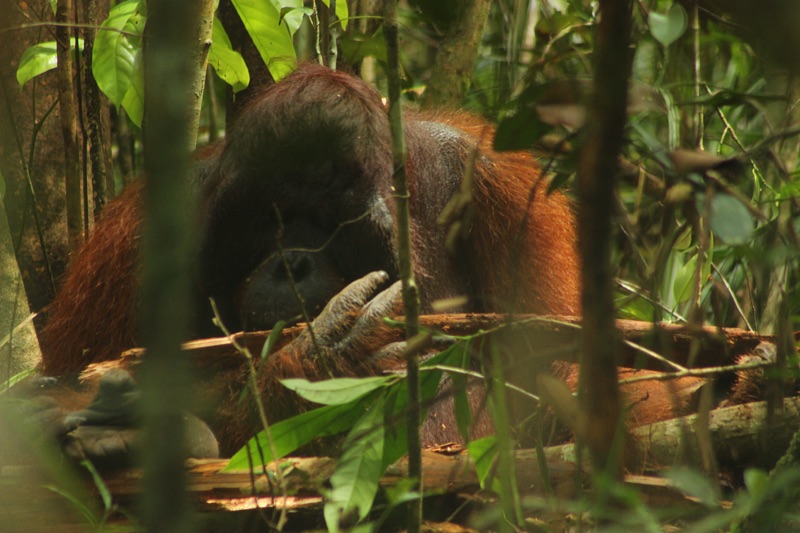
Orangutans are large, powerful animals covered in long, shaggy reddish-brown hair that helps rain slide off their bodies in the wet tropical forest. Adult males can weigh up to 200 pounds and stand about 4.5 feet tall, making them the largest tree-dwelling animals in the world. One of the most striking features of adult male orangutans is their wide, flat cheek pads called flanges, which frame their face like a disk and signal their dominance to other males. Males also develop a large throat pouch that helps them produce loud, booming calls that can be heard up to a mile away through the dense forest. Females are much smaller, typically weighing around 80 to 100 pounds, and they lack the prominent cheek pads and throat pouches of the males.
A Solitary Life
Unlike most other great apes, orangutans are remarkably solitary creatures. While chimpanzees and gorillas live in social groups, adult orangutans usually travel and forage alone through the forest canopy. Scientists believe this solitary lifestyle developed because their favorite foods, like ripe fruit, are spread thinly across the forest, making it difficult for large groups to find enough to eat in one area. Adult males are especially independent, roaming large territories and only seeking out females during mating season. However, orangutans are not completely antisocial — females sometimes feed near each other, and younger orangutans may travel together for short periods before going their separate ways.
Orangutans are among the most intelligent animals on the planet, and their problem-solving abilities continue to amaze scientists. In the wild, they use sticks to extract insects and honey from tree holes, and they fashion large leaves into umbrellas to shield themselves from rain. What makes their tool use especially interesting is that different populations of orangutans use different tools and techniques, a trait scientists call cultural transmission. This means that young orangutans learn specific skills by watching their mothers, much the way human children learn from their parents. In captivity, orangutans have learned to use sign language, solve complex puzzles, and even figure out how to pick locks — earning them a reputation as the great escape artists of the zoo world.
Where They Live
Orangutans are found only on two large islands in Southeast Asia: Borneo and Sumatra, both of which are part of Indonesia (Borneo is also shared with Malaysia and Brunei). They live in tropical and subtropical rainforests, spending the vast majority of their time in the tree canopy, sometimes over 100 feet above the ground. Each evening, orangutans build a fresh sleeping nest by weaving together branches and leaves high in a tree, and they sometimes even add a roof of leaves if rain is expected. Bornean orangutans inhabit the forests of Borneo, Sumatran orangutans live in the northern part of Sumatra, and the Tapanuli orangutan is restricted to a tiny area of forest south of Lake Toba in Sumatra. The Tapanuli orangutan’s range covers fewer than 400 square miles, making it one of the most geographically limited great apes in the world.
What They Eat
Orangutans are omnivores, but fruit makes up the largest part of their diet, sometimes accounting for more than 60 percent of what they eat. They have a special fondness for durian, a large, spiky fruit famous for its powerful smell, which many humans find unbearable but orangutans devour eagerly. When fruit is scarce during certain seasons, orangutans switch to eating bark, leaves, insects, and even bird eggs to get the nutrition they need. Their powerful jaws and teeth allow them to crack open tough nuts and chew through woody plants that most other animals cannot eat. Orangutans play an important role in their ecosystem as seed dispersers — when they eat fruit and travel through the forest, they spread seeds to new locations, helping the rainforest grow and regenerate.
A Long Childhood
Orangutans have the longest childhood of any animal besides humans, spending about seven to eight years with their mothers before becoming independent. During this time, young orangutans learn everything they need to survive in the forest: which of the hundreds of fruit species are safe to eat, how to build sleeping nests, how to move safely through the treetops, and how to use tools. Mothers carry their infants constantly for the first two years of life, and the bond between mother and child is one of the strongest in the animal kingdom. Because of this extended parenting, female orangutans typically give birth only once every seven to nine years, one of the slowest reproductive rates of any mammal. This slow rate of reproduction means that orangutan populations take a very long time to recover when their numbers decline.
Conservation
All three species of orangutan are critically endangered, and their survival is one of the most urgent conservation challenges in the world today. The greatest threat they face is the destruction of their rainforest habitat, largely driven by the expansion of palm oil plantations, logging, and mining. Palm oil is found in roughly half of all packaged products in supermarkets — from snack foods to shampoo — and the demand for it has led to vast areas of orangutan habitat being cleared and burned. It is estimated that over the past century, Bornean orangutan populations have dropped by more than 50 percent, and fewer than 800 Tapanuli orangutans remain in the wild. Conservation organizations are working to protect remaining forests, rescue orphaned orangutans, and encourage consumers to choose products made with sustainably sourced palm oil, giving these apes a chance at a future.
 OtterKnow Kids Encyclopedia