What They Look Like
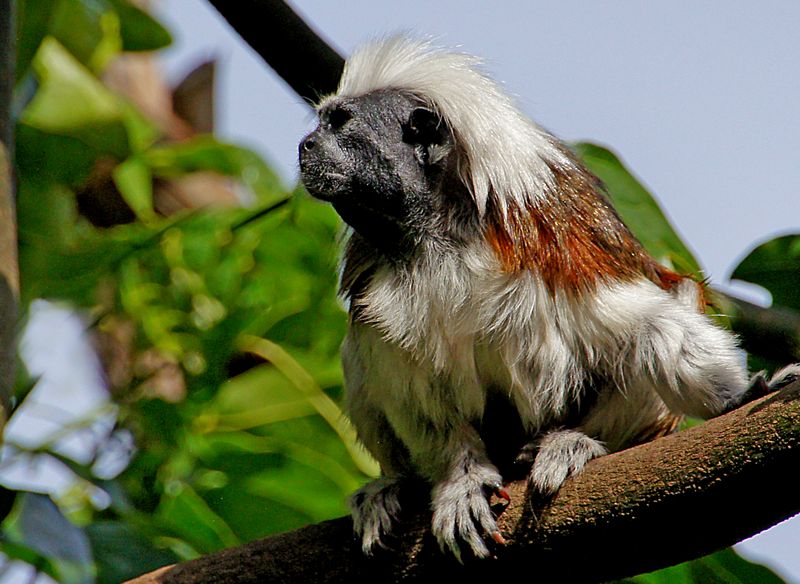
Tamarins are among the smallest monkeys in the world, weighing only about 150 to 900 grams — roughly the weight of a hamster to a small squirrel. Their bodies are typically 15 to 30 centimeters long, but their tails can be even longer than their bodies, helping them balance as they race along branches. Unlike most other primates, tamarins have claw-like nails called tegulae on all of their fingers and toes except for the big toe, which has a flat nail. These tiny claws help them grip tree bark and cling to the sides of trunks the way a squirrel does. Different species show off wildly different looks — the cotton-top tamarin has a crest of white hair that fans out like a punk hairstyle, while the black-mantled tamarin has a sleek, dark coat.
Cooperative Families
One of the most unusual things about tamarins is the way their families work together. They live in groups of about 3 to 15 members, and every member of the group pitches in to care for the young. When babies are born, the father usually becomes the primary carrier, hauling the infants on his back for most of the day. Older siblings, aunts, uncles, and even unrelated group members take turns carrying, grooming, and watching over the little ones. Scientists call this cooperative breeding, and it is one of the reasons tamarins are so successful despite their small size.
Where They Live
Tamarins are found in the tropical forests of Central and South America, from southern Mexico all the way down to the Amazon Basin in Brazil. They prefer the lower and middle levels of the forest canopy, where tangles of vines and branches provide plenty of pathways. Some species, like the golden lion tamarin, live only in a very small patch of Atlantic coastal forest in southeastern Brazil, making them extremely vulnerable to habitat loss. Others, like the saddleback tamarin, range across wide stretches of the Amazon rainforest. Tamarins generally stick to a home territory that the group defends together, using scent marks and calls to warn rival groups away.
What They Eat
Tamarins are omnivores, which means they eat both plants and animals. Their diet includes ripe fruits, flower nectar, tree sap, insects, spiders, and even small lizards or frogs when they can catch them. Those claw-like nails come in handy for gouging holes in tree bark to reach the gummy sap underneath — a favorite food for many tamarin species. By eating fruit and then traveling through the forest, tamarins help spread seeds to new areas, acting as tiny gardeners for their ecosystem. A single group may visit dozens of fruit trees in a day, covering a territory of 30 to 100 acres.
Communication
Tamarins are noisy little monkeys that use a variety of high-pitched calls to stay in touch with their group. They produce trills, whistles, and chirps that can carry through the dense forest, helping group members find each other among the leaves. Different calls have different meanings — a sharp, loud cry warns of a predator like a hawk or a snake, while softer contact calls simply say “I’m over here.” Tamarins also communicate through facial expressions, body postures, and scent marking. They have scent glands that they rub on branches to leave chemical messages for other tamarins about who has been there and when.
Twins and Parenting
Unlike most primates, tamarins almost always give birth to twins. Carrying two babies at once is a big job for such a small monkey, which is why the whole group helps out. Newborn tamarins cling tightly to a caretaker’s fur and are carried everywhere for the first few weeks of life. After about two to three months, the young tamarins start exploring on their own, but they stay close to the group and continue nursing for several more weeks. Growing up in a cooperative family gives young tamarins plenty of role models — by watching older group members, they learn how to find food, avoid predators, and eventually care for babies of their own.
Conservation
Several tamarin species are in serious trouble. The golden lion tamarin was once down to just a few hundred individuals in the wild, though decades of conservation work have helped their numbers climb back above 3,000. The cotton-top tamarin is critically endangered, with fewer than 7,000 left, largely because the Colombian forests where it lives have been cut down for farming and development. Habitat destruction, the illegal pet trade, and climate change all threaten tamarin populations. The good news is that breeding programs in zoos around the world, along with forest restoration projects, are giving these tiny monkeys a fighting chance. Groups like the chimpanzee and gorilla also face habitat threats, showing that protecting forests benefits primates everywhere.
 OtterKnow Kids Encyclopedia