What They Look Like
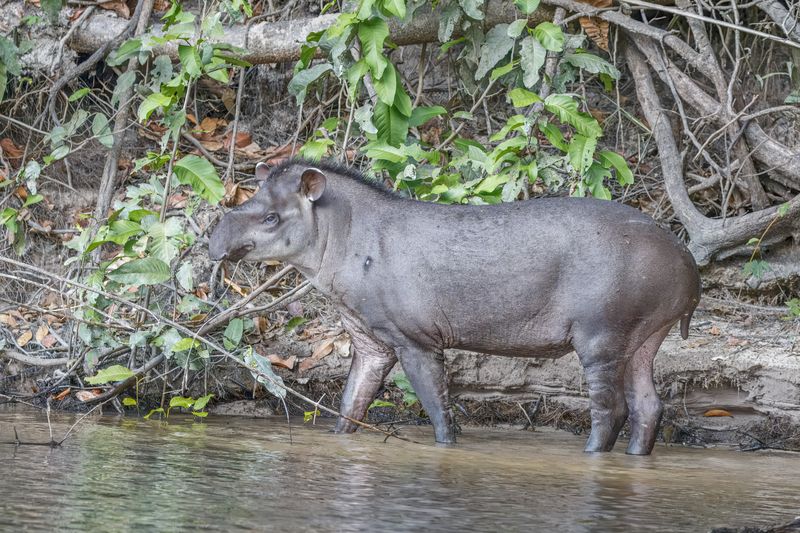
Tapirs are large, heavy animals that can weigh anywhere from 150 to 400 kilograms (about 330 to 880 pounds), depending on the species. Their bodies are oval-shaped and covered in short, tough skin that helps protect them from thorny plants and the bites of predators. The most distinctive feature of any tapir is its short, flexible proboscis — a nose and upper lip fused together into a trunk-like snout that can wiggle and grasp, almost like a finger. The Malayan tapir stands out from the other species because of its bold black-and-white coloring, with a large white patch across its back and sides that breaks up its outline in the moonlit forest. Baby tapirs of all four species are born with beautiful reddish-brown coats covered in white stripes and spots, a pattern that provides excellent camouflage on the dappled forest floor and fades away after about six months.
The Prehensile Snout
A tapir’s proboscis may be short compared to an elephant’s trunk, but it is remarkably useful. The snout is prehensile, meaning the tapir can curl and wrap it around leaves, branches, and fruits to pull them toward its mouth — the same way you might use your fingers to pluck a berry from a bush. Tapirs also use their flexible noses to sniff the air for danger and to explore the muddy ground for fallen fruit that might be hidden under leaves. When swimming, a tapir can hold its snout above the surface like a snorkel, allowing it to breathe while the rest of its body stays underwater. This odd little trunk is packed with muscles and nerve endings, making it one of the most sensitive and versatile noses in the animal kingdom.
An Ancient Animal
Tapirs belong to one of the oldest groups of mammals still alive today, with fossil ancestors dating back roughly 55 million years to the Eocene epoch. During that distant era, early tapir relatives roamed across North America, Europe, and Asia in a world that looked very different from the one we know. Over millions of years, most of these early forms went extinct, but the tapirs that survived have changed remarkably little, earning them the nickname “living fossils.” Their body plan — the sturdy legs, the rounded shape, the flexible snout — has proven so effective for life in dense forests that evolution has had little reason to change it. By comparison, the modern horse evolved dramatically from a small, multi-toed forest animal into the tall, single-hoofed runner we recognize today, while the tapir’s distant cousin stayed much the same.
Where They Live
Each of the four tapir species occupies a different part of the world, but all of them depend on thick forest cover and access to water. The South American tapir has the widest range, living in rainforests, wetlands, and grasslands from Venezuela south to Argentina and Brazil. Baird’s tapir inhabits the tropical forests of Mexico, Central America, and a small part of northwestern South America, making it the largest native land mammal in Central America. High in the cloud forests of the Andes Mountains, the mountain tapir survives at elevations above 2,000 meters, where the air is cool and misty. Across the ocean, the Malayan tapir roams the rainforests of Thailand, Malaysia, Myanmar, and the Indonesian island of Sumatra, making it the only tapir species found outside of the Americas.
What They Eat
Tapirs are herbivores that feed on a wide variety of leaves, fruits, berries, twigs, and aquatic plants. They use their prehensile snouts to strip leaves from low branches and to pluck fruit that other ground-dwelling animals might miss. Because tapirs are most active at night, they rely heavily on their excellent senses of smell and hearing to locate food in the darkness of the forest. A single tapir can eat more than 30 kilograms (about 66 pounds) of plant material in a day, browsing slowly along well-worn trails that they use night after night. Tapirs are also drawn to natural mineral licks — patches of salty, mineral-rich soil — where they lick the ground to get nutrients that their leafy diet does not provide.
Gardeners of the Forest
Scientists sometimes call tapirs the “gardeners of the forest” because of the extraordinary role they play in spreading seeds. When a tapir eats fruit, the seeds pass through its digestive system and are deposited far from the parent tree in the tapir’s droppings, often in a completely different part of the forest. Many tropical tree species depend on this kind of seed dispersal to colonize new areas, and some seeds actually germinate better after passing through a tapir’s gut. Because tapirs roam over large distances and follow winding paths through the jungle, they scatter seeds across a much wider area than smaller animals can. Researchers have found that tapirs disperse the seeds of hundreds of different plant species, making them one of the single most important seed-spreading animals in the tropical forests of Central and South America.
Excellent Swimmers
Despite their bulky appearance, tapirs are powerful and graceful swimmers that spend a surprising amount of time in the water. They wade into rivers, ponds, and swamps to cool off, escape biting insects, and flee from predators such as jaguars and anacondas. Tapirs can walk along the bottoms of rivers and lakes, fully submerged, using their snouts as snorkels to breathe at the surface. They are also capable of diving to feed on aquatic vegetation growing on the riverbed, staying underwater for several minutes at a time. In the flooded forests of the Amazon, where seasonal rains turn the landscape into a vast shallow lake, this swimming ability gives tapirs access to food and escape routes that would be impossible for a land-bound animal.
Conservation
All four species of tapir are threatened with extinction, and the IUCN Red List classifies the Baird’s tapir, Malayan tapir, and mountain tapir as Endangered, while the South American tapir is listed as Vulnerable. The biggest threat they face is habitat loss, as tropical forests around the world are cleared for farming, logging, and cattle ranching at an alarming rate. Tapirs are also hunted for their meat and hides in many parts of their range, and because they reproduce slowly — a mother tapir carries her baby for about 13 months and usually gives birth to just one calf at a time — their populations are very slow to recover from losses. Conservation groups are working to protect tapir habitat by establishing wildlife corridors and national parks, and some organizations run breeding programs in zoos to help maintain healthy populations. Protecting tapirs matters not only for the animals themselves but for the entire forest ecosystem, because without these gentle gardeners, hundreds of tree species could lose one of their most important seed dispersers.
 OtterKnow Kids Encyclopedia