Alligator vs. Crocodile
People often mix up alligators and crocodiles, but once you know what to look for, telling them apart is straightforward. The easiest clue is the shape of the snout: alligators have a wide, rounded, U-shaped snout, while crocodiles have a narrower, pointed, V-shaped one. Another difference shows up when they close their mouths — a crocodile’s large fourth tooth on the lower jaw sticks up and remains visible, but an alligator’s teeth are mostly hidden because the upper jaw is wider than the lower jaw. Alligators also prefer freshwater habitats like swamps, marshes, and lakes, whereas many crocodile species can tolerate saltwater thanks to special salt-excreting glands. Finally, alligators tend to be less aggressive toward humans than crocodiles, though both animals deserve caution and respect.
What They Look Like
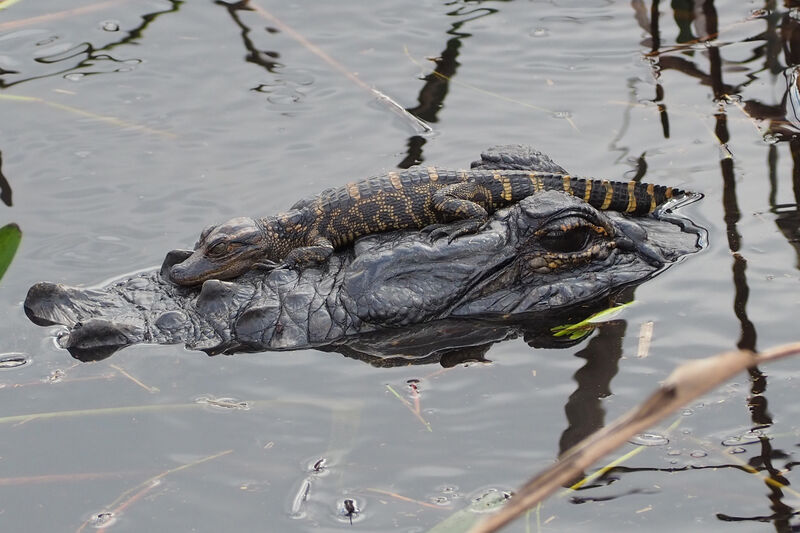
An alligator’s body is built for life in the water. Its dark olive or black skin is covered in tough, bony plates called scutes that act like armor, protecting it from injuries. A long, muscular tail makes up about half of the alligator’s total length and powers it through the water with surprising speed. Its eyes and nostrils sit on top of its head, so it can see and breathe while the rest of its body stays hidden below the surface. Short, sturdy legs with webbed back feet help it walk on land and steer while swimming.
The Bite
Alligators possess one of the most powerful bites in the animal kingdom, with a jaw force that can exceed 2,000 pounds per square inch. That crushing power lets them crack open turtle shells and hold onto struggling prey. An alligator’s mouth contains about 80 cone-shaped teeth, and when a tooth wears out or breaks, a new one grows in to replace it — an alligator may go through 2,000 to 3,000 teeth in its lifetime. Interestingly, while the muscles that snap the jaws shut are extremely strong, the muscles that open them are surprisingly weak. This is why wildlife handlers can hold an alligator’s mouth closed with just their hands or a strip of tape, though approaching a wild alligator is never safe.
Ambush Hunters
Alligators are patient ambush predators that prefer to wait for a meal to come to them rather than chase it down. They float just below the water’s surface, looking like a harmless log, until an unsuspecting fish, bird, turtle, or mammal wanders close enough. Then they strike with a sudden lunge, using their powerful tail to launch forward. Younger alligators eat insects, snails, and small fish, while adults take on larger prey like raccoons, deer, and wading birds. Alligators cannot chew their food, so they swallow smaller prey whole and use a technique called a “death roll” — spinning rapidly in the water — to tear larger prey into manageable pieces.
Where They Live
American alligators are found across the southeastern United States, from North Carolina down to Florida and west to Texas. They thrive in freshwater environments such as swamps, marshes, rivers, ponds, and lakes, though they sometimes venture into brackish water near the coast. One of the most remarkable things alligators do for their habitat is dig “gator holes” — large depressions in the mud that fill with water. During dry seasons, these holes become critical water sources for fish, turtles, birds, and other wildlife, making the alligator an important ecosystem engineer. The Chinese alligator, by contrast, lives only in a small region along the Yangtze River valley and is critically endangered, with fewer than 150 individuals remaining in the wild.
Nesting and Young
Female alligators are devoted mothers in the reptile world. In late spring, a mother alligator builds a large nest mound out of mud, leaves, and other vegetation, then lays 20 to 50 eggs inside it. As the plant material in the nest decays, it produces heat that keeps the eggs warm during the roughly 65-day incubation period. Remarkably, the temperature inside the nest determines whether the babies will be male or female — warmer temperatures around 93°F produce males, while cooler temperatures produce females. When the babies are ready to hatch, they make high-pitched chirping sounds from inside their eggs, and the mother digs them out and gently carries them to the water in her mouth. She stays nearby to protect her young for up to two years, guarding them from predators like raccoons, large birds, and even other alligators.
Conservation Success Story
The American alligator is one of the greatest wildlife conservation success stories in history. By the 1960s, hunting for their valuable hides and the draining of wetland habitats had pushed alligators to the brink of extinction. In 1967, the American alligator was listed as an endangered species, and strong legal protections were put in place to ban hunting and preserve their habitats. The species responded remarkably well, and by 1987, it was removed from the endangered species list after populations had fully recovered. Today, more than five million American alligators live in the wild, and carefully managed hunting seasons help keep populations in balance. The alligator’s recovery showed the world that with the right protections, even a species on the edge of disappearing can make a dramatic comeback.
Living with Alligators
As cities and suburbs expand into alligator territory across the southeastern United States, people and alligators increasingly share the same spaces. Alligators sometimes turn up in backyard swimming pools, golf course ponds, and drainage ditches, which can be startling but is usually not dangerous if people keep their distance. Wildlife agencies relocate alligators that wander into populated areas, though very large or aggressive individuals may need to be removed permanently. The most important rule for living safely near alligators is simple: never feed them, because an alligator that associates humans with food loses its natural fear and becomes genuinely dangerous. Communities in alligator country have learned to coexist with these ancient reptiles by respecting their space and understanding their behavior.
 OtterKnow Kids Encyclopedia