What They Look Like
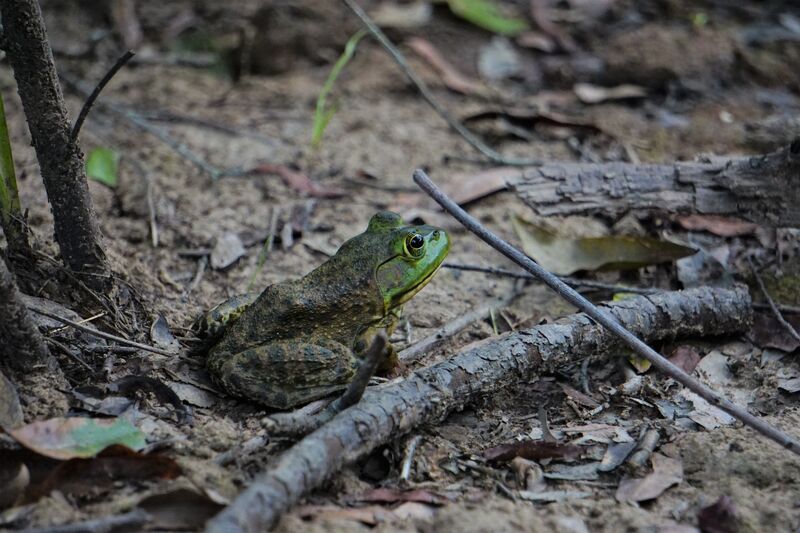
Bullfrogs have smooth, moist skin that can range from olive green to brownish-green on top, often with darker blotches or spots across their backs and legs. Their bellies are whitish or pale yellow, and some males develop a bright yellow throat during the breeding season. One of their most noticeable features is the large, round tympanum — an external eardrum — located just behind each eye. Bullfrogs have long, muscular hind legs built for powerful leaps and fast swimming. Their webbed back feet act like flippers in the water, making them excellent swimmers that can escape predators or chase down prey with surprising speed.
The Deep Call
The bullfrog’s call is one of the most recognizable sounds in North American wetlands. Males produce a deep, rumbling “jug-o-rum, jug-o-rum” that can carry over half a mile across still water. They make this sound by pushing air back and forth over their vocal cords while inflating a large vocal sac under their chin. Males call loudly to attract females and to warn rival males to stay out of their territory. During the peak of breeding season in late spring and early summer, a pond full of calling bullfrogs can sound like a chorus of bass drums.
Where They Live
Bullfrogs are native to the eastern half of North America, from southern Canada down through the eastern United States and into northeastern Mexico. They prefer permanent bodies of still or slow-moving water such as ponds, lakes, marshes, and the calm edges of rivers. Thick vegetation along the water’s edge provides them with hiding spots and hunting grounds. Bullfrogs are rarely found far from water because their skin must stay moist to help them breathe. In colder regions, they survive winter by burrowing into the mud at the bottom of ponds, where they enter a dormant state until spring arrives.
Voracious Predators
Bullfrogs are among the most aggressive hunters in the amphibian world, and they will eat almost anything they can fit into their wide mouths. Their diet includes insects, crayfish, small fish, other frogs, and even small snakes, birds, and mice. They are sit-and-wait predators, staying perfectly still at the water’s edge until prey wanders close enough to grab. When the moment is right, a bullfrog lunges forward and uses its sticky tongue to snatch the prey in a fraction of a second. Unlike many smaller frogs such as tree frogs or poison dart frogs, bullfrogs rely on their large size and powerful jaws rather than speed or toxins to overpower their meals.
Life Cycle
A female bullfrog can lay up to 20,000 eggs at a time, spreading them in a thin, jelly-like film across the surface of the water. The eggs hatch into tiny tadpoles within a few days, and this is where the bullfrog’s life cycle gets unusual — bullfrog tadpoles can take one to three years to fully transform into adult frogs, much longer than most other frog species. During this time, the large, greenish-brown tadpoles feed on algae, aquatic plants, and small invertebrates. The process of changing from a tadpole into a frog is called metamorphosis, and it involves growing legs, absorbing the tail, and developing lungs for breathing air. Once they become adults, bullfrogs can live for seven to ten years in the wild, though some in captivity have lived even longer.
Telling Males from Females
There are a few reliable ways to tell a male bullfrog from a female, even from a distance. The easiest method is to look at the tympanum — in males, the eardrum is noticeably larger than the eye, while in females it is about the same size as the eye or slightly smaller. Males also tend to have bright yellow throats, especially during breeding season, whereas females usually have white or cream-colored throats. Male bullfrogs are generally slightly smaller than females in body length, but their front legs are thicker and more muscular. These strong front legs help males wrestle with each other over territory and grip onto females during mating.
Bullfrogs as Invasive Species
While bullfrogs are a natural part of ecosystems in eastern North America, they have become a serious problem in places where they do not belong. People have introduced bullfrogs to the western United States, parts of Europe, South America, and Asia — sometimes for frog leg farming, sometimes as released pets, and sometimes by accident. In these new environments, bullfrogs have no natural predators large enough to control their numbers, and their enormous appetites allow them to wipe out native frogs, salamanders, fish, and insects. Scientists consider the American bullfrog one of the most harmful invasive amphibian species on the planet. Efforts to remove bullfrogs from sensitive habitats are ongoing, but their fast reproduction and adaptability make them extremely difficult to control once they are established.
Why Bullfrogs Matter
Bullfrogs play an important role in the food webs of the wetlands where they naturally live. As both predators and prey, they help control insect populations and provide food for herons, raccoons, large fish, and snakes. Studying bullfrogs has also taught scientists a great deal about amphibian biology, metamorphosis, and how animals adapt to different environments. At the same time, the spread of bullfrogs into non-native habitats shows how moving a species to a new place can throw entire ecosystems out of balance. Understanding and respecting where bullfrogs belong helps protect the wide variety of life found in freshwater habitats around the world.
 OtterKnow Kids Encyclopedia