Color Change — Mood, Not Camouflage
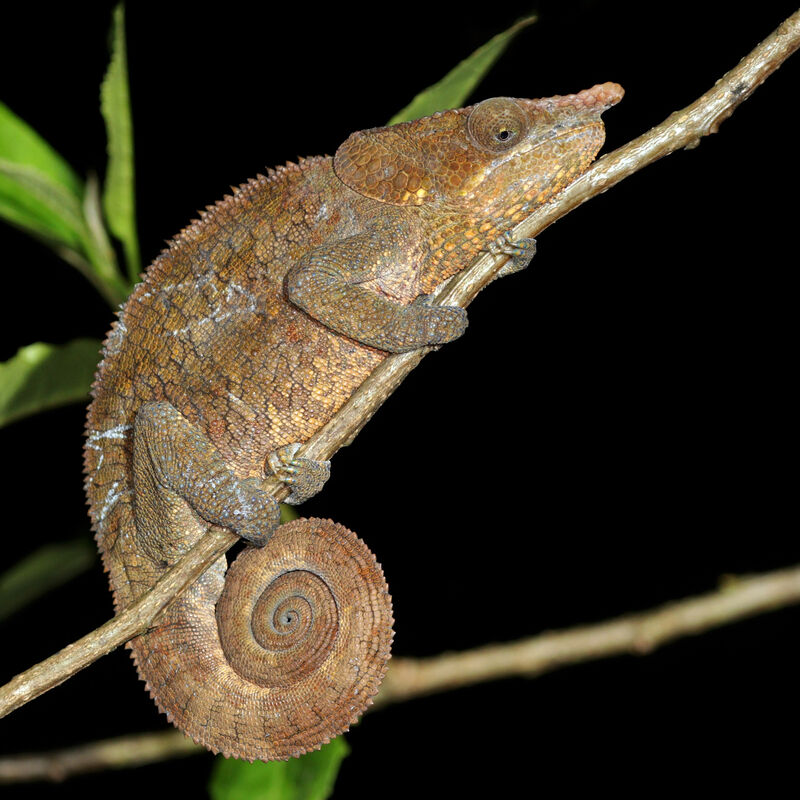
Many people believe that chameleons change color to blend in with their surroundings, but this is actually a myth. While their natural green and brown tones do help them stay hidden among leaves and branches, their dramatic color shifts serve a completely different purpose. Chameleons change color mainly to communicate with other chameleons — a male might flash bright colors to warn a rival to stay away, or a female might darken her skin to signal that she is not interested in mating. Temperature also plays a big role: a chameleon may turn darker in the morning to absorb more heat from the sun and lighter during the hottest part of the day to reflect sunlight and stay cool. Stress, excitement, and health can also trigger color changes, making a chameleon’s skin almost like a mood ring that broadcasts how it is feeling.
The Science of Color Change
The way chameleons change color is surprisingly different from how other color-changing animals work. Beneath a chameleon’s outer skin lie special cells called iridophores, which contain tiny crystals arranged in a lattice pattern. When the chameleon relaxes or tightens the skin around these cells, the spacing between the crystals changes, which alters the wavelengths of light that bounce off them. For example, when the crystals are packed closely together, they reflect shorter wavelengths like blue, and when they spread apart, they reflect longer wavelengths like red and yellow. Chameleons also have deeper layers of pigment-containing cells called chromatophores, which work with the iridophores to produce a wide palette of greens, browns, oranges, and even turquoise.
Eyes Like No Other
A chameleon’s eyes are unlike those of almost any other animal. Each eye sits in a cone-shaped turret that can rotate independently, meaning a chameleon can look forward with one eye and backward with the other at the same time. This gives them nearly 360 degrees of vision without moving their head, which is incredibly useful for spotting both predators and prey. When a chameleon does lock onto an insect, both eyes snap forward to focus on the target together, giving the chameleon depth perception to judge exactly how far away the meal is. Their eyes can also focus very quickly and see fine detail, acting almost like a pair of tiny, high-powered binoculars mounted on swivels.
The Ballistic Tongue
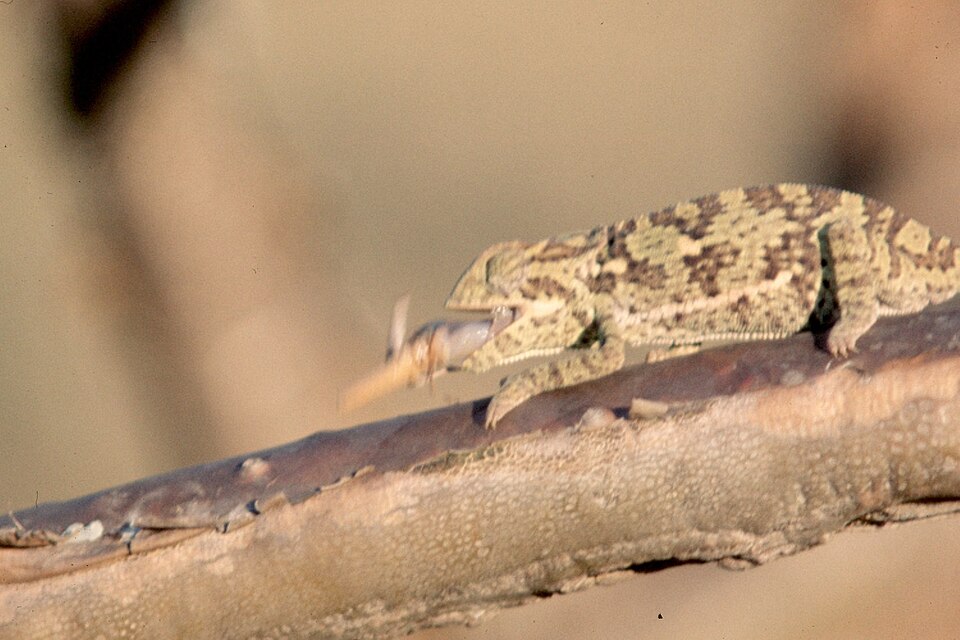
If a chameleon’s eyes are its targeting system, its tongue is the weapon. A chameleon’s tongue can shoot out of its mouth and snag an insect in as little as 0.07 seconds — faster than you can blink. The tongue can extend to roughly one and a half to two times the length of the chameleon’s entire body, powered by a special accelerator muscle that works like a compressed spring being released. The tip of the tongue is club-shaped and covered in sticky mucus, which grabs onto prey with a grip strong enough to haul back insects, and sometimes even small birds or lizards. Scientists have measured the tongue’s acceleration at over 40 g-forces, making it one of the fastest movements of any vertebrate on the planet.
Zygodactyl Feet
Look closely at a chameleon’s feet and you will notice something unusual — their toes are fused together into two opposing groups, creating what scientists call zygodactyl feet. On the front feet, two toes point inward and three point outward, while on the back feet the arrangement is reversed. This design gives chameleons an incredibly strong, pincer-like grip on branches, allowing them to hold on tightly even in strong winds. Combined with their prehensile tail, which can wrap around branches like a fifth hand, chameleons are expert climbers that move slowly and deliberately through the trees. Their careful, swaying walk even mimics the movement of a leaf blowing in the breeze, which helps them avoid being noticed by predators.
Reproduction
Chameleons have two different strategies when it comes to having babies. Most species are oviparous, meaning the female digs a hole in the ground and buries a clutch of eggs that can number anywhere from a handful to over 80, depending on the species. The eggs incubate in the warm soil for several months — and in some species, such as the Parson’s chameleon, the eggs can take over a year to hatch. However, some chameleon species, particularly those living in cooler mountain environments, are viviparous, meaning the mother carries the developing young inside her body and gives birth to live babies. Whether hatched or live-born, baby chameleons are fully independent from the moment they arrive, immediately able to hunt, climb, and change color on their own.
Chameleons in the Wild
Chameleons face a number of challenges in the wild, and many species are considered threatened or endangered. Habitat loss from deforestation is the biggest danger, especially in Madagascar, where more than half of the world’s chameleon species live and forests are being rapidly cleared for farming. Because many chameleon species exist only in very small geographic areas, losing even a patch of forest can threaten an entire species. Climate change also poses risks by shifting the temperature and rainfall patterns that chameleons depend on. Conservation groups are working to protect critical chameleon habitats and to study lesser-known species before they disappear, since scientists believe there may still be undiscovered species hiding in remote forests.
Chameleons as Pets
Chameleons are popular in the pet trade, but they are not easy animals to care for. Unlike a dog or a cat, chameleons require very specific conditions to stay healthy, including precise temperature and humidity levels, UV lighting, and a diet of live insects dusted with vitamin supplements. They are also solitary animals that become stressed when handled too often or housed with other chameleons. Veiled chameleons and panther chameleons are the species most commonly kept as pets because they tend to be hardier than other species, but even these require experienced reptile keepers. If you are interested in chameleons, visiting a reputable zoo or reptile sanctuary is a wonderful way to observe these animals up close without the challenges of keeping one at home.
 OtterKnow Kids Encyclopedia