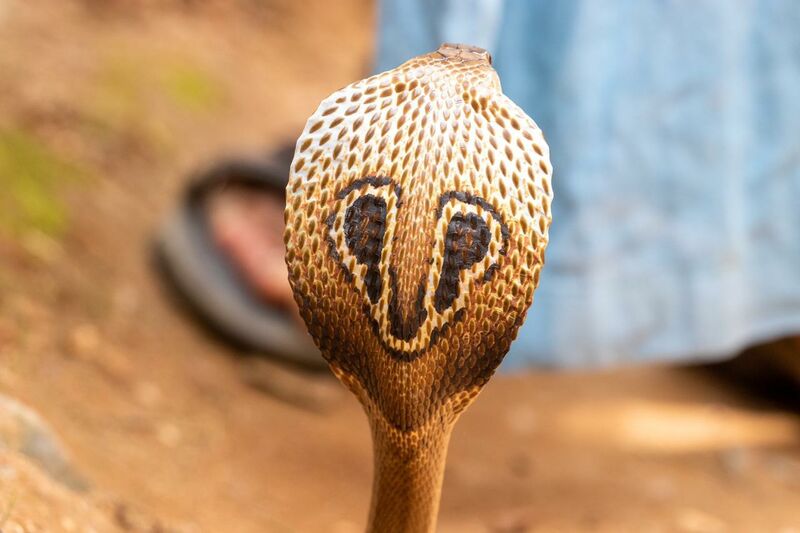
The Famous Hood
A cobra’s hood is one of the most recognizable features in the animal kingdom. When a cobra feels threatened, it raises the front part of its body off the ground and spreads special elongated ribs in its neck outward, stretching the loose skin between them into a wide, flat shape. This makes the snake look much larger and more intimidating to predators. Some species, like the Indian cobra, have distinctive markings on the back of their hood that resemble a pair of eyes, which may help scare off attackers even when the snake is facing away. When the cobra relaxes, the ribs fold back in and the hood disappears, making the snake look like any other slender serpent.
Types of Cobras
Scientists recognize about 30 species of true cobras, and they live in a wide range of habitats across Africa and Asia. The Indian cobra is found throughout the Indian subcontinent, often near farms and villages where it hunts rodents. The Egyptian cobra, one of the largest African species, is believed to be the snake associated with Cleopatra in ancient history. The Cape cobra of southern Africa is considered one of the most dangerous snakes on the continent because of its highly potent venom. The forest cobra of Central Africa is the largest true cobra, sometimes reaching lengths of nearly three meters, and it is an excellent swimmer that hunts fish and frogs near rivers.
Venom
Cobras produce neurotoxic venom, which means it attacks the nervous system of their prey. When a cobra bites, the venom travels through the bloodstream and can cause the muscles that control breathing to stop working, which is what makes cobra bites so dangerous to humans. A single bite from some species contains enough venom to kill several people if left untreated. Fortunately, antivenoms have been developed for most cobra species, and hospitals in regions where cobras live usually keep supplies on hand. Cobra venom is also being studied by scientists who believe its unique chemical compounds might one day be used to develop new medicines for pain and heart disease.
Spitting Cobras
Some cobras have developed an especially unusual defense — they can spit their venom at an attacker’s eyes from up to two meters away. There are several species of spitting cobras found in both Africa and Asia, and they have specially modified fangs with forward-facing openings that allow them to spray venom with remarkable accuracy. The venom does not cause harm if it lands on unbroken skin, but if it reaches the eyes, it causes intense pain and can lead to permanent blindness if not washed out quickly. Spitting cobras usually aim for the eyes by tracking the movement of a threat’s face. They can still deliver venom through a traditional bite as well, making them doubly dangerous.
The King Cobra
The king cobra holds the title of the world’s longest venomous snake, with some individuals reaching lengths of over five meters. Despite its name, the king cobra is not actually a true cobra — it belongs to its own genus, Ophiophagus, which means “snake eater.” True to its name, the king cobra feeds almost entirely on other snakes, including other venomous species and even smaller cobras. King cobras are also unusual because they are one of the very few snake species that build nests for their eggs, with the female guarding the nest fiercely until the eggs hatch. They live in the forests of Southeast Asia and India, and while their venom is not the most potent drop for drop, they deliver such a large quantity in a single bite that it can be fatal to even an elephant.
What They Eat
Cobras are carnivores that eat a variety of small animals depending on their species and habitat. Most true cobras feed primarily on rodents like rats and mice, which is actually one reason they are often found near human settlements where these animals are plentiful. They also eat frogs, toads, lizards, birds, and bird eggs. Cobras are not constrictors — they rely on their venom to subdue prey rather than squeezing it. Like all snakes, cobras swallow their food whole, using their flexible jaws to stretch around animals that are larger than their own heads. After a large meal, a cobra may not need to eat again for several weeks.
Cobras and People
Cobras have a long and complicated relationship with humans. In India, the cobra is considered sacred and is associated with powerful gods in Hindu mythology, yet thousands of people are bitten by cobras each year. The tradition of snake charming, in which a person appears to control a cobra with music from a flute-like instrument called a pungi, has fascinated people for centuries. In reality, cobras are nearly deaf and cannot hear the music at all — they follow the swaying movement of the instrument and the charmer’s body. The practice has declined in recent years as many countries have passed laws to protect cobras and other wildlife. Conservation efforts are important because cobras play a vital role in controlling rodent populations, and the mongoose, their most famous natural predator, has been celebrated in stories like Rudyard Kipling’s tale of Rikki-Tikki-Tavi.
Survival and Reproduction
Cobras are oviparous, meaning they lay eggs that hatch outside the mother’s body. Most true cobras lay between 10 and 30 eggs in a hidden spot such as a hollow log, a termite mound, or a pile of rotting leaves that generates warmth as it decomposes. The eggs typically take 50 to 80 days to hatch, and the baby cobras emerge fully independent, already equipped with venom and a working hood. Young cobras face many predators, including birds of prey, mongooses, and larger snakes, so only a small number survive to adulthood. Adult cobras can live for 20 years or more in the wild, and their main threats today include habitat loss, road traffic, and being killed by people who fear them.
 OtterKnow Kids Encyclopedia