Sticky Feet — The Science
One of the most famous things about geckos is their ability to walk straight up walls and even across ceilings. For a long time, people thought geckos used tiny suction cups or some kind of glue on their feet, but the real answer is even more amazing. The bottom of each gecko toe is covered with millions of microscopic hair-like structures called setae, and each seta splits into hundreds of even tinier tips. These tips get so close to a surface that a weak attraction between molecules — known as van der Waals forces — holds the gecko in place. The combined pull of billions of these tiny contact points is strong enough to support the gecko’s entire body weight, yet the gecko can peel its toes away effortlessly by curling them upward.
What They Look Like
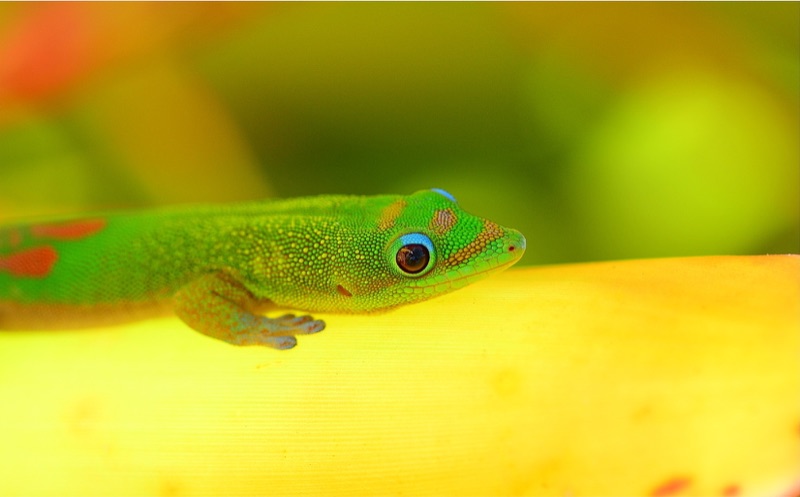
Geckos come in a huge variety of shapes, sizes, and colors. Many species have soft, velvety skin rather than the hard, rough scales found on other lizards like iguanas. Some geckos are bright green or electric blue, while others wear patterns of brown and tan that help them blend into tree bark or desert sand. The leaf-tailed geckos of Madagascar have flat, leaf-shaped tails and fringed skin along their sides that makes them nearly invisible against branches. Most geckos have wide, flat heads, large eyes, and plump toes, giving them a friendly appearance that many people find charming.
Eyes and Licking
If you watch a gecko closely, you might notice something unusual — it licks its own eyeballs. Most gecko species do not have movable eyelids the way humans do. Instead, their eyes are covered by a clear, fixed scale called a spectacle that protects the eye like a built-in goggle. Because they cannot blink, geckos use their long tongues to wipe dust and moisture across their eyes and keep them clean. Their eyes are also extremely powerful, especially in species that are active at night — a nocturnal gecko’s eyes can be up to 350 times more sensitive to light than human eyes, allowing them to hunt insects in near-total darkness.
Voices in the Night
Unlike most lizards, which are usually silent, geckos are well known for the sounds they make. Many species chirp, click, bark, or even produce loud calls to defend their territory or attract a mate. The tokay gecko of Southeast Asia is one of the loudest, repeating a two-note call that sounds like “to-KAY, to-KAY” — which is how it got its name. In many parts of the world, people recognize geckos by their voices before they ever see them. Scientists believe geckos evolved their vocalizations because many species are nocturnal, making sound a more reliable way to communicate than visual signals in the dark.
Tail Loss and Regeneration
When a predator grabs a gecko by the tail, something dramatic happens — the tail snaps off and keeps wriggling on the ground. This defense strategy, called autotomy, distracts the predator long enough for the gecko to escape. Special fracture points built into the tail vertebrae make this break clean and quick, and muscles in the severed tail keep it moving for several minutes. Over the following weeks and months, the gecko slowly grows a replacement tail, although the new one is usually shorter, smoother, and supported by cartilage instead of bone. Some geckos store fat in their tails, so losing one means giving up an important energy reserve — a real sacrifice for survival.
Where They Live
Geckos live on every continent except Antarctica, thriving in tropical rainforests, rocky deserts, coastal scrublands, and even high mountain regions. The greatest variety of species is found in warm, humid areas near the equator, but some hardy geckos survive in surprisingly harsh environments. Many species are arboreal, spending their lives high in the forest canopy, while others are ground-dwellers that hide under rocks and logs during the day. Several gecko species have adapted well to living alongside humans, hunting insects attracted to porch lights and streetlamps in towns and villages across the tropics. Because most geckos are nocturnal, they emerge after sunset when temperatures drop and insect prey is plentiful.
Geckos and People
Humans have had a long and mostly friendly relationship with geckos. In many cultures across Asia and the Pacific Islands, geckos living inside homes are considered good luck because they eat mosquitoes, moths, and other pest insects. The leopard gecko, a ground-dwelling species from the deserts of Pakistan and India, is one of the most popular pet reptiles in the world because it is calm, easy to care for, and comes in many color varieties bred by enthusiasts. Scientists study geckos closely too — engineers have designed adhesive materials and climbing robots inspired by the microscopic structures on gecko feet. From ancient folklore to cutting-edge technology, these small lizards have captured human imagination for centuries.
 OtterKnow Kids Encyclopedia