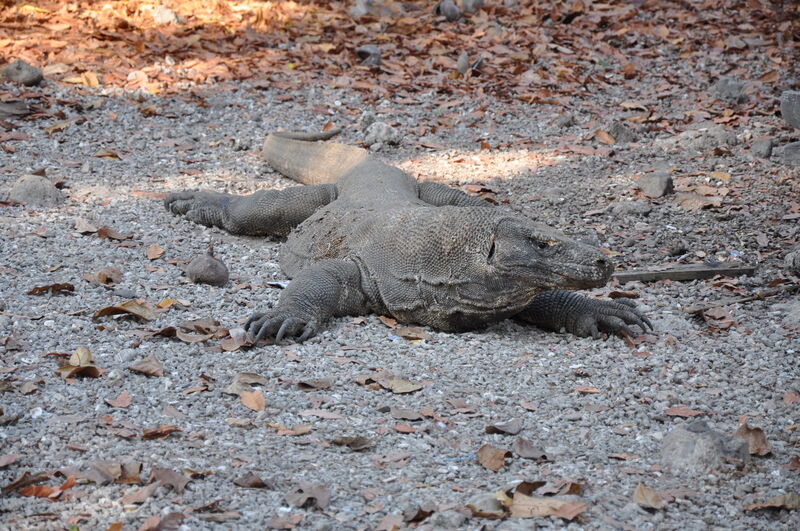
The World’s Largest Lizard
An adult Komodo dragon can grow up to 3 meters (about 10 feet) long and weigh around 70 kilograms (over 150 pounds), making it far bigger than any other lizard alive today. Males tend to be larger than females, and the biggest individuals can weigh even more. Their heavy, muscular bodies are covered in rough, scaly skin that ranges from dark gray to brown or olive green. Despite their bulky appearance, Komodo dragons are surprisingly athletic — they can run in short bursts at speeds up to 20 kilometers per hour and are strong swimmers who cross between islands through open ocean water.
The Forked Tongue
Like snakes and many other reptiles, Komodo dragons have a long, yellow, deeply forked tongue that they flick in and out of their mouths constantly. This tongue is their most important tool for finding food. When a Komodo dragon flicks its tongue, it picks up tiny scent particles from the air and the ground. The dragon then presses the two tips of its tongue against a special organ on the roof of its mouth called the Jacobson’s organ, which analyzes the chemicals and tells the dragon what direction a smell is coming from. This powerful sense of “smell” allows a Komodo dragon to detect the scent of a dead or dying animal from as far as 11 kilometers (nearly 7 miles) away.
Venom
For many years, people believed that Komodo dragon bites were deadly because of harmful bacteria living in their mouths. However, in 2009, a team of scientists led by Bryan Fry discovered that Komodo dragons actually produce venom from glands in their lower jaws. This venom contains proteins that prevent blood from clotting and cause a sharp drop in blood pressure, sending bitten prey into shock. A Komodo dragon’s bite delivers the venom through grooves between its serrated, shark-like teeth. The combination of deep wounds, blood loss, and venom makes even a single bite extremely dangerous to large prey animals.
Hunting and Feeding
Komodo dragons are patient and opportunistic hunters that eat almost anything they can catch. They often lie in wait along trails used by deer, wild boar, and water buffalo, then launch a sudden ambush with a powerful lunge. If the first strike does not bring the prey down immediately, the dragon may follow the injured animal for days, waiting for the venom and blood loss to weaken it. Komodo dragons have flexible skulls and loosely connected jaw bones that allow them to swallow enormous chunks of meat, and they can consume up to 80 percent of their own body weight in a single meal. They eat nearly every part of their prey, including bones, hooves, and hide, and groups of dragons sometimes feed together on a large carcass.
Where They Live
Komodo dragons are found in the wild only in southeastern Indonesia, mainly on the islands of Komodo, Rinca, Flores, and Gili Motang in the Lesser Sunda Islands. These volcanic islands have hot, dry grasslands, open savannas, and patches of tropical forest that provide the dragons with both hunting grounds and shaded resting spots. Komodo National Park, established in 1980, protects the core habitat of these animals and is a UNESCO World Heritage Site. Young Komodo dragons spend much of their early life in trees to avoid being eaten by larger dragons, coming down to live on the ground once they are big enough to defend themselves.
Reproduction
Female Komodo dragons usually lay around 20 eggs in a nest dug into the ground, often using the mound of a megapode bird as an incubation site because the decomposing plant material inside keeps the eggs warm. The eggs take about 7 to 8 months to hatch, and the mother may guard the nest during the early weeks. Komodo dragons have another unusual trait: females can reproduce through parthenogenesis — a process in which a female produces offspring without mating with a male. Scientists first confirmed this ability in captive Komodo dragons in 2006, and it may help small, isolated populations survive when males are scarce.
Conservation
The Komodo dragon is classified as endangered, with only about 1,400 mature adults estimated to remain in the wild. Their limited range across just a few islands makes them especially vulnerable to habitat loss, poaching of their prey animals, and the increasing effects of climate change. Rising sea levels could shrink the already small islands where they live, and more frequent wildfires threaten their grassland habitats. Conservation efforts focus on protecting land within Komodo National Park, limiting tourism to reduce disturbance, and breeding programs in zoos around the world. Indonesian authorities have taken steps to restrict visitor numbers on Komodo Island to help ensure these reptiles survive into the future.
 OtterKnow Kids Encyclopedia