Warning Colors
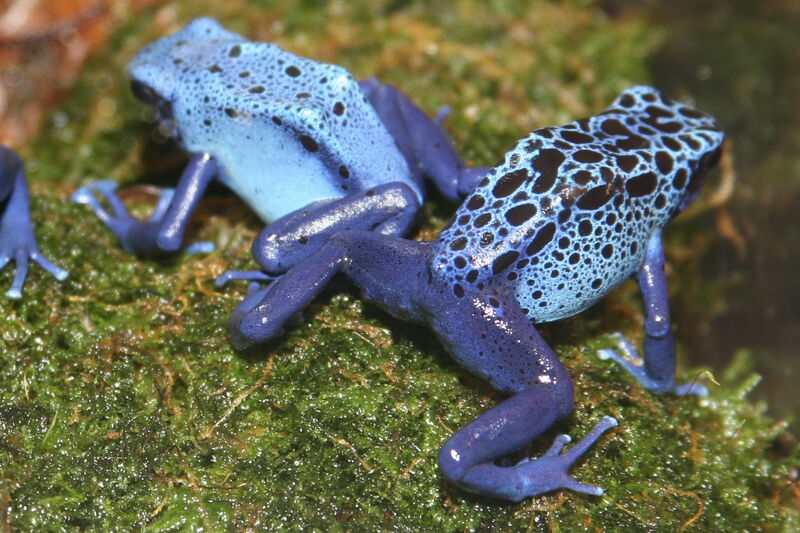
One of the first things you notice about a poison dart frog is its brilliant color. These frogs come in vivid shades of blue, red, orange, yellow, and green — sometimes with bold stripes or spots. Scientists call this strategy aposematism, which means using bright colors as a warning signal. The colors tell predators like snakes and birds, “Don’t eat me — I’m dangerous!” This is the opposite of camouflage, where animals try to blend in. Because predators learn to avoid these bright patterns, poison dart frogs can move around during the day without hiding, unlike many other frogs that are active mostly at night.
Where the Poison Comes From
One of the most surprising things about poison dart frogs is that they do not actually produce their own toxins from scratch. The toxins in a poison dart frog’s skin come from what it eats. In the wild, these frogs feed on tiny insects like ants, termites, mites, and beetles that contain special chemicals. The frog’s body absorbs these chemicals and stores them in glands in its skin. The golden poison frog (Phyllobates terribilis) of Colombia carries enough toxin to be lethal to several adult humans, making it one of the most poisonous animals ever discovered. For centuries, indigenous peoples of the Chocó region used the secretions of this frog to coat the tips of blowgun darts for hunting, which is how these frogs earned their common name. Interestingly, poison dart frogs raised in captivity on a diet of fruit flies and crickets are not toxic at all, which proved to scientists that the poison comes from their diet.
Species Diversity
There are more than 200 known species of poison dart frogs, and scientists continue to discover new ones in remote rainforest areas. They range in size from less than 1.5 centimeters to about 6 centimeters long. Not all species are equally toxic — only a handful produce poison strong enough to be dangerous to humans, and many are only mildly poisonous or completely harmless. The strawberry poison dart frog is famous for its bright red body and blue legs, while the dyeing poison dart frog displays a striking pattern of blue and yellow. Some species, like the green-and-black poison dart frog, are popular in the pet trade because their toxin levels are relatively low compared to their more dangerous relatives.
Parental Care
Poison dart frogs are unusual among amphibians because many species are devoted parents. The female typically lays a small clutch of eggs — sometimes fewer than ten — on a moist leaf or in the leaf litter on the forest floor. One or both parents guard the eggs and keep them moist until they hatch into tadpoles. In many species, one parent — often the father — then carries the tadpoles on its back to a small pool of water, such as the water that collects in a bromeliad plant high in the trees. The mother strawberry poison dart frog goes even further — she returns regularly to lay unfertilized eggs in the water as food for her growing tadpoles. This level of parental investment is rare in the amphibian world and is quite different from bullfrogs, which may lay thousands of eggs and leave them to develop on their own.
Amphibian Life Cycle
Like other amphibians, poison dart frogs go through a process called metamorphosis. They begin life as eggs, which hatch into aquatic tadpoles with tails and gills for breathing underwater. Over several weeks, the tadpoles gradually grow legs, absorb their tails, and develop lungs for breathing air. By the time metamorphosis is complete, the young frog looks like a miniature version of the adult and is ready to live on land. This transformation from a water-dwelling larva to a land-living adult is one of the defining features of amphibians, a trait shared by salamanders and other frogs. Poison dart frog tadpoles are often raised in very small bodies of water, so their development is adapted to these tiny, isolated pools.
Where They Live
Poison dart frogs are found in the humid tropical rainforests of Central and South America, from Nicaragua south through Colombia, Ecuador, Peru, and Brazil. They live on or near the forest floor, among the thick layer of fallen leaves, mossy logs, and low-growing plants. These frogs need warm temperatures and high humidity to keep their skin moist, since amphibians absorb water and even oxygen through their skin rather than just by drinking. Most species live on or near the ground, though some climb into the canopy to find bromeliad pools for their young. Some species have adapted to live at higher elevations in cloud forests, where fog and mist keep the air damp. Their small territories usually center around a reliable water source, even if it is just a tiny pool inside a curled leaf.
Conservation
Many poison dart frog species face serious threats in the wild and are threatened by habitat loss as tropical rainforests are cleared for farming, logging, and development. Because these frogs depend on very specific conditions — warm temperatures, high humidity, and particular food sources — even small changes to their environment can be devastating. Climate change is also altering temperature and rainfall patterns in tropical regions, which can dry out the moist habitats these frogs need. A fungal disease called chytridiomycosis, caused by the chytrid fungus, has also been wiping out amphibian populations around the world, and poison dart frogs are not immune to its effects. Several species are now listed as endangered or critically endangered by the International Union for Conservation of Nature. Conservation efforts include protecting rainforest habitat, breeding programs in zoos and research centers, and studying the chytrid fungus to find ways to fight it. Protecting poison dart frogs matters not only for the frogs themselves but also for medical research, since scientists are studying their toxins for potential use in developing new painkillers and medicines.
 OtterKnow Kids Encyclopedia