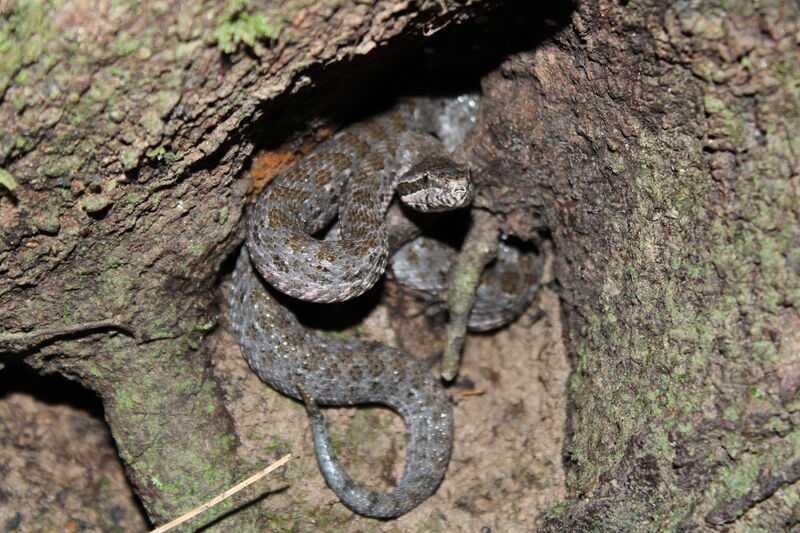
The Famous Rattle
The rattle at the end of a rattlesnake’s tail is made of keratin, the same tough protein found in your fingernails and hair. Each time the snake sheds its skin, a new hollow segment is added to the rattle. When the snake vibrates its tail muscles — up to 50 times per second — the loose segments click against each other, producing that distinctive buzzing sound. Many people believe that rattlesnakes always warn before they strike, but this is a myth. A rattlesnake can strike without rattling at all, especially if it is startled or feels cornered.
Fangs and Venom
Rattlesnakes have long, hinged fangs that fold flat against the roof of their mouth when not in use. When the snake opens its jaws to strike, the fangs swing forward like pocket knives, ready to inject venom deep into prey. Most rattlesnake venom is hemotoxic, meaning it attacks blood cells and tissues to begin breaking down prey from the inside. Remarkably, rattlesnakes can control exactly how much venom they inject with each bite, and they sometimes deliver “dry bites” with no venom at all. Their venom evolved primarily as a hunting tool to subdue prey rather than as a weapon for self-defense.
Heat-Sensing Pits
Between each eye and nostril, rattlesnakes have a pair of small openings called pit organs, which is why they belong to a group called pit vipers. These pits contain a thin membrane packed with heat-sensitive nerve endings that can detect infrared radiation given off by warm-blooded animals. The pits are so sensitive that a rattlesnake can detect a temperature difference as small as 0.003 degrees Celsius. This allows rattlesnakes to hunt in complete darkness, building a thermal image of their surroundings much like an infrared camera. Combined with their flickering tongue, which picks up chemical scent trails, rattlesnakes are extraordinarily effective nighttime predators.
Where They Live
Rattlesnakes are found in a wide variety of habitats across the Americas, from the dry, rocky landscapes of the desert Southwest to the swamps of the southeastern United States. Some species, like the timber rattlesnake, live in deciduous forests and mountainous areas of the eastern United States. Others, like the sidewinder, have adapted to life in sandy deserts by moving in a unique sideways motion that keeps most of their body off the scorching ground. During cold winters, rattlesnakes gather together in underground dens called hibernacula, where dozens or even hundreds of snakes may brumate together to survive freezing temperatures. In spring, they emerge and spread out across the landscape to hunt and find mates.
Hunting and Diet
Rattlesnakes are ambush predators, meaning they lie in wait rather than actively chasing their food. They coil up beside a rodent trail and remain perfectly still — sometimes for days — until a mouse, rat, or ground squirrel passes within striking distance. The strike itself is blindingly fast, taking less than half a second from start to finish. After biting its prey, the rattlesnake often lets it go and then follows the scent trail until the animal collapses from the venom. Rattlesnakes swallow their prey whole, starting with the head, and their flexible jaws allow them to eat animals much wider than their own body.
Life Cycle
Unlike many reptiles that lay eggs, rattlesnakes give birth to live young. The mother carries developing eggs inside her body, where the babies grow surrounded by a thin membrane and nourished by the egg yolk. A typical litter contains between 4 and 12 baby rattlesnakes, though some species can have more. Newborn rattlesnakes are about 20 to 30 centimeters long, already equipped with fangs and venom, and have just a single button on their tail instead of a full rattle. Young rattlesnakes must fend for themselves from the moment they are born, and they begin hunting small lizards and baby mice within their first few days of life.
Rattlesnakes and People
Rattlesnakes are far more afraid of people than people are of them. When a rattlesnake encounters a human, its first instinct is to stay hidden or slither away quietly. Bites usually happen only when someone accidentally steps on or reaches near a rattlesnake without seeing it. If you ever encounter a rattlesnake in the wild, the safest thing to do is calmly back away and give it plenty of space. Scientists are now finding valuable uses for rattlesnake venom in medicine, including developing treatments for blood clots, high blood pressure, and even some types of cancer, proving that these misunderstood reptiles have much more to offer than fear.
 OtterKnow Kids Encyclopedia