What They Look Like
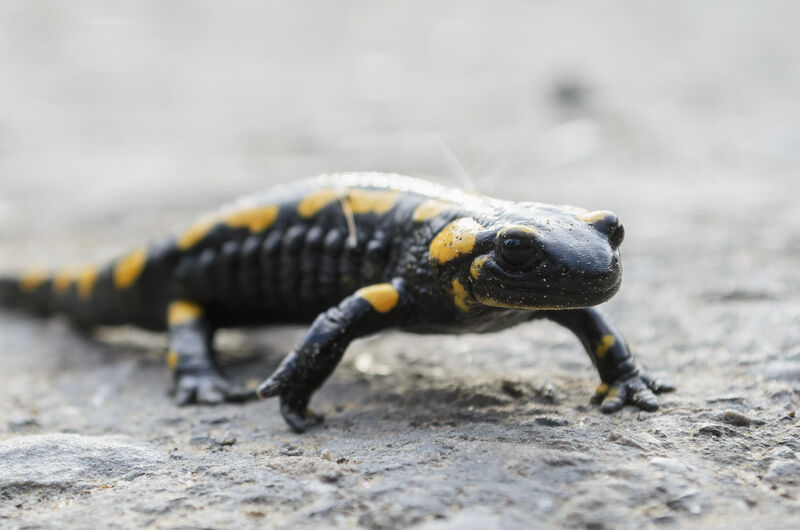
Most salamanders have four short legs, a long tail, and moist, shiny skin that can be brightly colored or dull and camouflaged. Some species, like the fire salamander, have bold yellow and black patterns that warn predators they are toxic. Others, like the red-backed salamander, blend in perfectly with the leaf litter on the forest floor. Aquatic species such as the axolotl have feathery external gills that branch out from the sides of their heads, giving them a striking appearance. Unlike reptiles, salamanders never have scales, claws, or dry skin.
Amphibian Life Cycle
Like other amphibians, many salamanders begin life as eggs laid in water or very moist places. The eggs hatch into larvae that breathe through gills and swim using a flattened tail, much like tadpoles. Over weeks or months, most larvae go through metamorphosis — they lose their gills, develop lungs or absorb oxygen through their skin, and move onto land. However, some species are neotenic, which means they keep their larval features even as adults. The axolotl is a famous example: it keeps its feathery gills and stays in the water for its entire life, never completing the typical transformation.
Moist Skin and Breathing
A salamander’s skin is thin, smooth, and must stay moist at all times because it plays a vital role in how they breathe. Many salamanders absorb oxygen directly through their skin in a process called cutaneous respiration. In fact, the largest family of salamanders — the lungless salamanders — have no lungs at all and rely entirely on their skin and the lining of their mouth to take in oxygen. This is why you almost always find salamanders in damp, shady habitats where their skin will not dry out. Some species also produce toxic or foul-tasting secretions through their skin glands, which helps protect them from hungry predators.
Where They Live
Salamanders are found on every continent except Antarctica and Australia, but the greatest diversity of species lives in North America. They prefer cool, moist environments such as forest floors covered in fallen leaves, the banks of streams, caves, and rotting logs. Some species are fully aquatic, spending their entire lives in ponds, streams, or underground rivers. Others are terrestrial and only return to water to lay their eggs. A few remarkable species, like certain tropical climbing salamanders, live high up in trees in cloud forests where the air is constantly misty.
What They Eat
Salamanders are carnivores that hunt small invertebrates like insects, worms, slugs, and spiders. They locate their prey mainly by sight and smell, and many species have a sticky tongue they can flick out rapidly to snatch a passing bug. Larger salamanders, such as the hellbender, may also eat crayfish, small fish, and even other salamanders. Most salamanders hunt at night when the air is cool and humid, which keeps their skin from drying out while they search for food. Because they are small and eat so many insects and larvae, salamanders play an important role in keeping forest ecosystems balanced.
Amazing Regeneration
Salamanders have an ability that most other animals do not: they can regenerate lost body parts. If a salamander loses a leg, a tail, or even parts of its eye or heart, it can regrow the missing tissue completely, often without any scarring. The axolotl is especially famous for this talent and is widely studied by scientists who hope to understand how regeneration works at the cellular level. Unlike a lizard that can only regrow a simple tail, a salamander can rebuild complex structures including bones, muscles, nerves, and blood vessels. Researchers believe that studying salamander regeneration could one day lead to medical breakthroughs for humans.
Conservation
Many salamander species around the world are in serious trouble due to habitat loss, pollution, climate change, and a deadly fungal disease called chytrid. Because salamanders need clean water and moist environments, they are especially sensitive to changes in their habitat, making them important indicator species for ecosystem health. The axolotl, once abundant in the lakes near Mexico City, is now critically endangered in the wild due to water pollution and invasive species. Conservation efforts include protecting wetlands and forests, breeding programs in zoos and research labs, and reducing pollution in waterways. By learning about salamanders and supporting their habitats, people of all ages can help ensure these amphibians survive into the future.
 OtterKnow Kids Encyclopedia