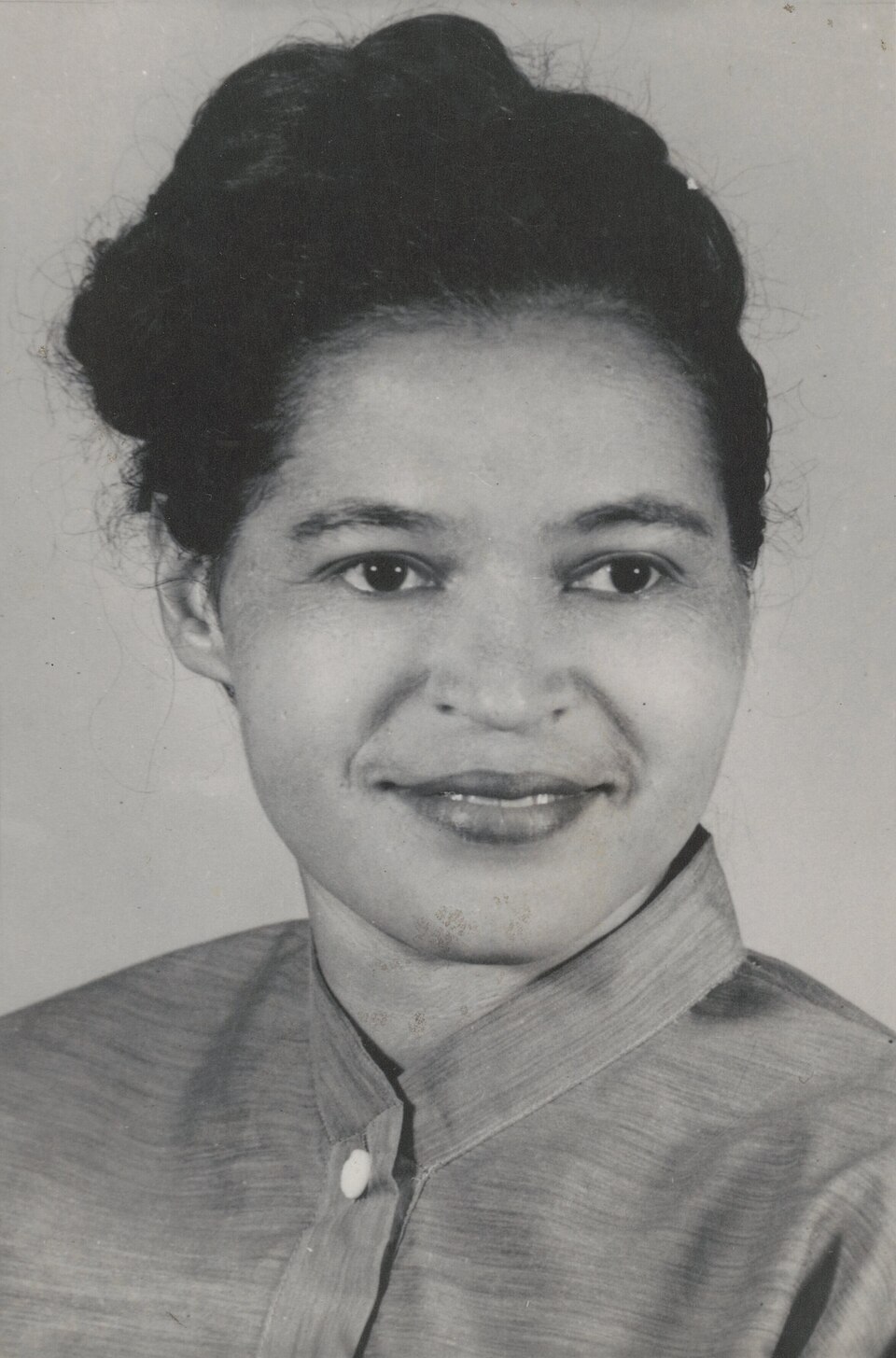
Early Life
Rosa Louise McCauley was born on February 4, 1913, in Tuskegee, Alabama. She grew up in a time when laws in the South kept Black and white people separated in schools, restaurants, buses, and many other public places. These unfair rules, known as Jim Crow laws, made life very difficult for Black Americans. Rosa attended school when she could, but had to drop out to care for her sick grandmother and mother. She later finished high school with the encouragement of her husband, Raymond Parks, whom she married in 1932.
Civil Rights Work
Long before her famous bus protest, Rosa Parks was already working hard to fight for civil rights. She joined the NAACP, the National Association for the Advancement of Colored People, in 1943 and served as the secretary of the Montgomery, Alabama, chapter. Through the NAACP, she investigated cases where Black people were treated unfairly or harmed because of their race. In the summer of 1955, she attended a training workshop at the Highlander Folk School in Tennessee, where she learned strategies for fighting segregation. Rosa Parks was a dedicated and experienced activist, not someone who simply acted on a whim.
The Montgomery Bus Boycott
On December 1, 1955, Rosa Parks boarded a city bus in Montgomery, Alabama, after a long day of work. When the bus filled up, the driver ordered her to give her seat to a white passenger, as the law required. Parks calmly refused and was arrested by police. Her arrest angered the Black community in Montgomery, and civil rights leaders organized a boycott, urging Black residents to stop riding the city buses. The Montgomery Bus Boycott lasted 381 days, with tens of thousands of people walking, carpooling, or finding other ways to get around instead of riding the buses. The boycott ended when the United States Supreme Court ruled that segregation on public buses was unconstitutional.
Awards and Honors
Rosa Parks received many honors for her bravery and her contributions to civil rights. In 1996, President Bill Clinton awarded her the Presidential Medal of Freedom, one of the highest honors an American civilian can receive. In 1999, she was also awarded the Congressional Gold Medal, making her one of the few people in history to receive both awards. Parks moved to Detroit, Michigan, in 1957, where she continued to work for civil rights and served on the staff of Congressman John Conyers for many years. She also founded the Rosa and Raymond Parks Institute for Self Development, which offered programs to help young people learn about the civil rights movement.
Legacy
Rosa Parks passed away on October 24, 2005, at the age of 92. After her death, she became the first woman to lie in honor in the United States Capitol Rotunda, a tribute usually reserved for presidents and war heroes. Her act of defiance on that Montgomery bus showed that one person’s courage can help change an entire nation. Parks proved that standing up for what is right, even when it is frightening, can inspire millions of others to do the same. She remains one of the most admired figures in American history and a lasting symbol of the fight for equality.
 OtterKnow Kids Encyclopedia