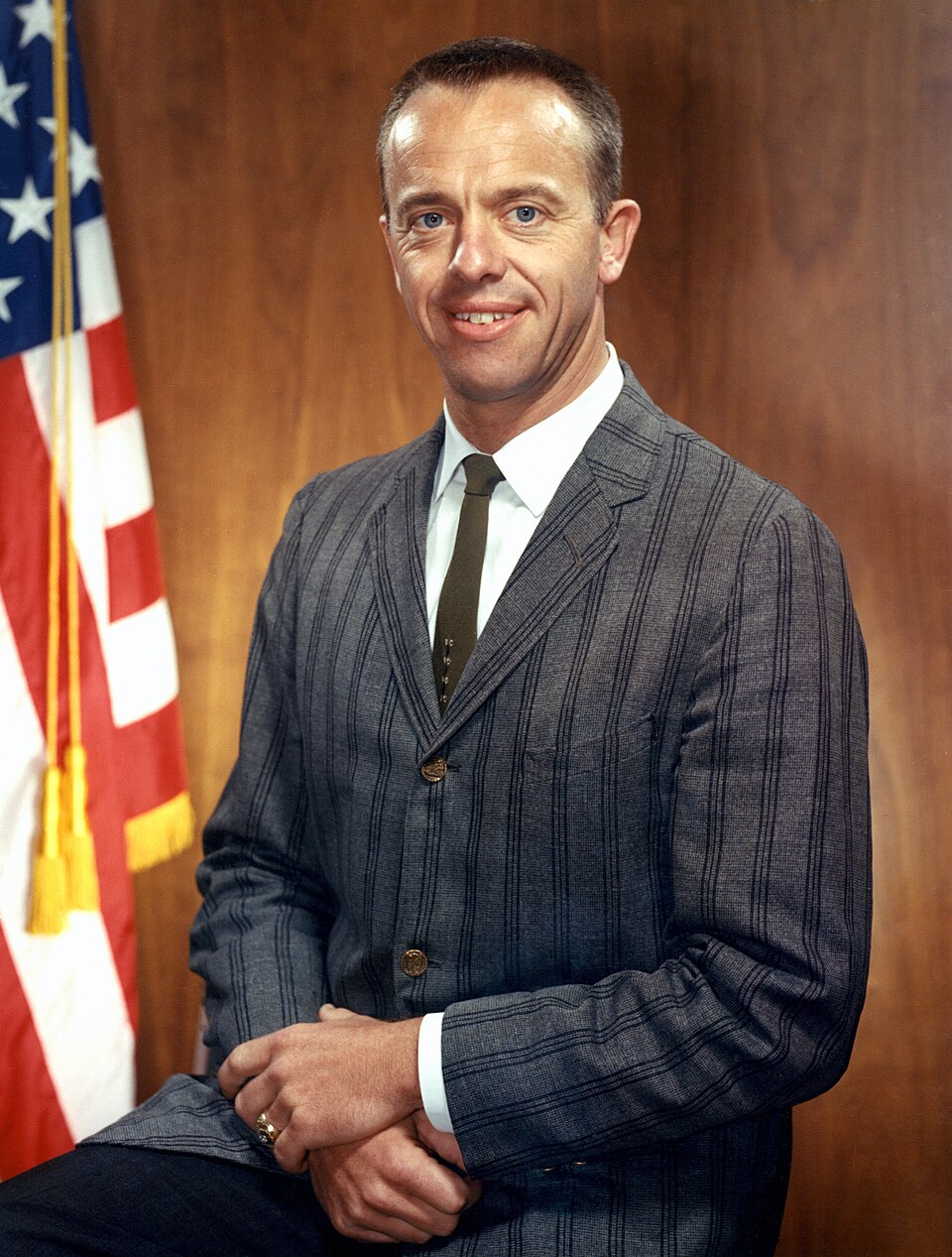
Becoming a Test Pilot
After graduating from the Naval Academy, Shepard served on a destroyer in the Pacific Ocean during the final year of World War II. He then earned his pilot’s wings and became a Navy test pilot, flying some of the fastest and most experimental jets of the era. Test pilots had to be brave and highly skilled because they flew aircraft that had never been fully tested before. His talent and cool nerves in the cockpit helped him stand out among hundreds of other military pilots.
The Mercury Seven
In 1959, NASA selected seven military pilots to become America’s first astronauts, and Shepard was one of them. This group became known as the Mercury Seven, and they were treated like heroes even before they flew into space. The astronauts trained hard, practicing in simulators and learning how to handle the tiny Mercury capsule. Out of all seven, Shepard was chosen to be the first American to ride a rocket into space.
First American in Space
On May 5, 1961, Alan Shepard climbed into a small capsule called Freedom 7 and blasted off from Cape Canaveral, Florida. His flight was suborbital, meaning he went up into space and came back down without circling the Earth, and it lasted about 15 minutes. Even though the Soviet cosmonaut Yuri Gagarin had orbited Earth a few weeks earlier, Shepard’s flight was a proud moment for the United States. Millions of Americans watched on television as he splashed down safely in the Atlantic Ocean.
Grounded by Illness
After his famous flight, Shepard hoped to fly in space again, but he developed a condition called Meniere’s disease that affected his inner ear. The disease caused dizziness and problems with balance, which meant NASA would not allow him to fly. For several years, Shepard worked behind a desk at NASA, helping to manage the astronaut program. He never gave up hope that he might return to space someday.
Walking on the Moon
In 1969, Shepard had surgery that corrected his inner ear problem, and NASA cleared him to fly again. He was assigned to command Apollo 14, which launched on January 31, 1971, and landed in the hilly Fra Mauro region of the Moon. Shepard became the fifth person to walk on the lunar surface and the only one of the original Mercury Seven astronauts to set foot on the Moon. In a lighthearted moment, he attached a golf club head to a sample tool handle and hit two golf balls across the Moon’s dusty ground.
Legacy
Alan Shepard returned from the Moon as one of America’s most celebrated astronauts. He later served as a rear admiral in the United States Navy and worked in private business after retiring from NASA. Shepard received many honors, including the Congressional Space Medal of Honor and the NASA Distinguished Service Medal. He passed away on July 21, 1998, but he is remembered as a pioneer who showed Americans that they could reach for the stars.
 OtterKnow Kids Encyclopedia