Breaking Barriers at NASA
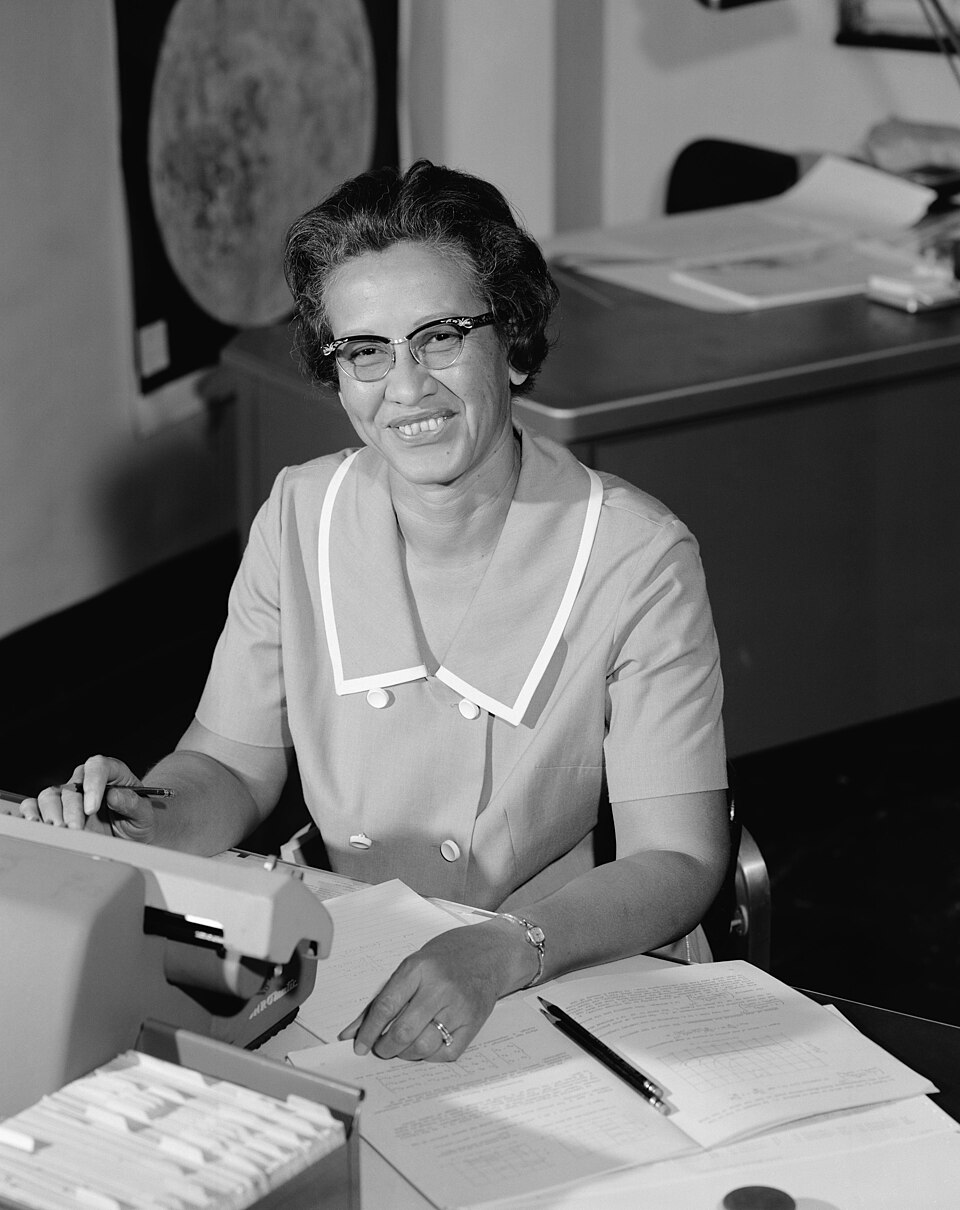
In 1953, Katherine joined the National Advisory Committee for Aeronautics, which later became NASA. She was one of the first Black women to work there as a “human computer,” a person who solved difficult math problems by hand. At the time, Black employees had to use separate bathrooms and dining areas, but Katherine refused to let unfair rules stop her. She pushed her way into important meetings that women were normally not allowed to attend and asked questions that impressed the engineers. Her brilliance and determination helped break down barriers of both race and gender at the space agency.
Calculating the Path to Space
Katherine’s most famous work involved calculating the flight paths, called trajectories, for America’s earliest space missions. She figured out the math that sent astronaut Alan Shepard on the first American spaceflight in 1961. When NASA began using electronic computers to plan John Glenn’s orbit around Earth in 1962, Glenn did not fully trust the machines. He asked engineers to “get the girl to check the numbers,” meaning Katherine, and he refused to fly until she personally verified that the computer’s calculations were correct. Her math was so precise that the mission was a complete success.
The Moon and Beyond
Katherine went on to calculate trajectories for the Apollo 11 mission in 1969, helping send the first humans to the Moon. She also worked on plans for a mission to Mars and helped develop the Space Shuttle program. Throughout her long career at NASA, she co-authored twenty-six scientific research papers. Katherine once said that she was simply doing her job and that she loved every single day of it. Her work touched nearly every major space program the United States carried out during her thirty-three years at the agency.
Honors and Legacy
In 2015, President Barack Obama awarded Katherine the Presidential Medal of Freedom, the highest honor a civilian can receive in the United States. Her story reached millions of people through the 2016 book and movie “Hidden Figures,” which told the tale of Black women mathematicians at NASA. In 2017, NASA named a building at the Langley Research Center in her honor. Katherine Johnson passed away on February 24, 2020, at the age of 101. She inspired countless young people, especially girls and students of color, to pursue careers in science, technology, engineering, and mathematics.
 OtterKnow Kids Encyclopedia