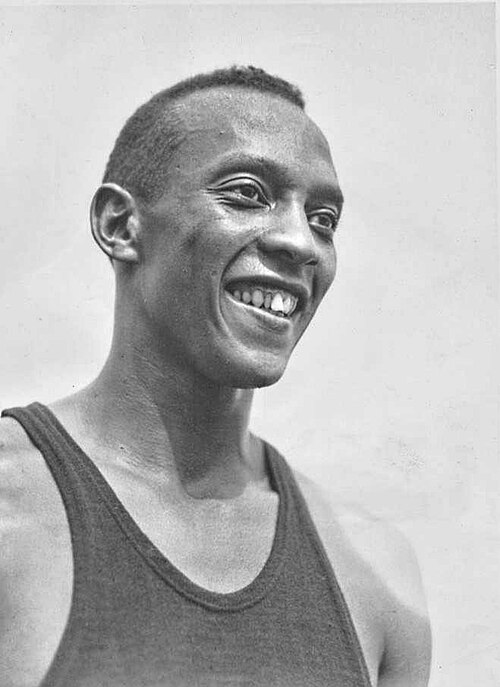
The Day of Days at Ohio State
Jesse Owens attended Ohio State University, but because he was Black, he was not allowed to live on campus or eat with white students. Despite this unfair treatment, he became one of the greatest college athletes in history. On May 25, 1935, at a track meet in Ann Arbor, Michigan, Jesse accomplished something that may never be matched: in just 45 minutes, he set three world records and tied a fourth. He tied the world record in the 100-yard dash, then broke records in the long jump, the 220-yard dash, and the 220-yard low hurdles. Sportswriters called it the greatest single-day performance in athletic history.
Triumph at the 1936 Berlin Olympics
The 1936 Summer Olympics were held in Berlin, Germany, where Adolf Hitler and the Nazi Party were in power. Hitler wanted to use the Games to prove that white, or “Aryan,” athletes were superior to all others. Jesse Owens shattered that idea by winning four gold medals: in the 100 meters, 200 meters, long jump, and 4x100 meter relay. His long jump record of 26 feet 5 inches stood unbroken for an incredible 25 years. Jesse became the most celebrated athlete at the Games, cheered by huge crowds in the Olympic stadium, and his victories showed the world that talent and determination have nothing to do with the color of a person’s skin.
Life After the Olympics
Despite his Olympic fame, Jesse Owens returned to an America that still treated Black people unfairly. President Franklin Roosevelt never invited him to the White House or sent him a telegram of congratulations. To support his family, Jesse had to take odd jobs, including racing against horses and motorcycles at entertainment events. Over time, he became a successful public speaker, traveling the country to inspire young people with his story of perseverance. He also worked with youth sports programs and served as a goodwill ambassador for the United States.
Legacy
Jesse Owens passed away on March 31, 1980, in Tucson, Arizona, at the age of 66. In 1976, President Gerald Ford awarded him the Presidential Medal of Freedom, the highest honor a civilian can receive. After his death, President George H. W. Bush posthumously awarded him the Congressional Gold Medal in 1990. His four gold medals in Berlin remain one of the greatest achievements in Olympic history, and he is remembered as a hero who used athletic greatness to challenge racism. The Jesse Owens Award is still given each year to the best track and field athlete in America.
 OtterKnow Kids Encyclopedia