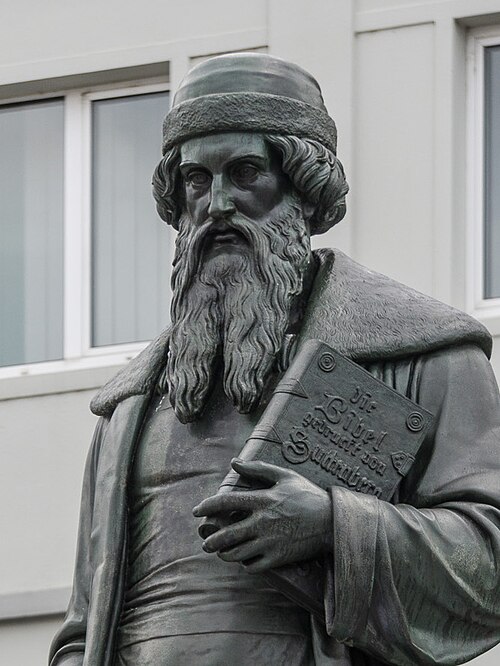
Early Life
Not much is known about Gutenberg’s childhood because very few records from that time have survived. Historians believe he was born into a wealthy family that was involved in the goldsmithing trade in Mainz. As a young man, he likely learned metalworking skills such as casting, polishing, and engraving, which would later prove essential for building his press. At some point, his family moved to the city of Strasbourg, where Gutenberg began experimenting with new ways to produce printed text. He kept his work secret for years, worried that others might steal his ideas.
How the Press Worked
Gutenberg’s key innovation was movable type, a system of individual metal letters that could be rearranged and reused to print different pages. Each tiny letter was cast from a mold using a special metal alloy that was durable enough to withstand thousands of impressions. A printer would arrange the letters into words and sentences on a flat bed, ink them, and then press a sheet of paper against them using a large wooden screw press adapted from the ones used to crush grapes for wine. Once a page was finished, the letters could be taken apart and reassembled to print an entirely new page. This made printing far faster and more flexible than carving entire pages from single blocks of wood, which was the method used before.
The Gutenberg Bible
Gutenberg’s most famous printed work is the Gutenberg Bible, completed around 1455 in Mainz. It is believed that he printed about 180 copies, with roughly 135 on paper and 45 on more expensive vellum, which is made from animal skin. The books were so beautifully made that many people at first could not tell them apart from hand-copied manuscripts. Each copy had about 1,282 pages arranged in two columns of 42 lines each, which is why the book is sometimes called the “42-Line Bible.” Today, only 49 copies or substantial portions are known to survive, and they are among the most valuable books in the world.
Challenges and Setbacks
Despite creating one of the greatest inventions in history, Gutenberg faced serious financial problems. To fund his printing workshop, he borrowed a large sum of money from a businessman named Johann Fust. When Gutenberg could not repay the loan on time, Fust sued him and won control of the printing press and much of the equipment. Fust then went on to run a successful printing business with Gutenberg’s former assistant, Peter Schoffer. Gutenberg spent his later years in relative obscurity, though the Archbishop of Mainz eventually gave him a small pension in recognition of his achievements.
Movable Type Before Gutenberg
It is important to note that Gutenberg did not invent the concept of movable type from scratch. Chinese inventor Bi Sheng created movable type using baked clay pieces around the year 1040, roughly 400 years before Gutenberg. Korean printers later developed metal movable type in the 13th century. However, these earlier systems were designed for languages with thousands of characters, making them less practical for rapid printing. Gutenberg’s version worked especially well with the Latin alphabet’s small set of letters and was combined with innovations like oil-based ink and the adapted screw press, which together made mass printing possible in Europe.
Impact on the World
Gutenberg’s printing press sparked a revolution in how information was shared. Within 50 years of his first Bible, printing presses had spread across Europe, and an estimated 20 million volumes had been produced. Books became affordable enough for merchants, students, and ordinary families to own. The ability to print quickly and widely helped fuel the Renaissance, the Protestant Reformation, and the Scientific Revolution by allowing new ideas to reach huge audiences almost overnight. Many historians consider the printing press one of the most transformative inventions of the last thousand years, right alongside the internet.
 OtterKnow Kids Encyclopedia