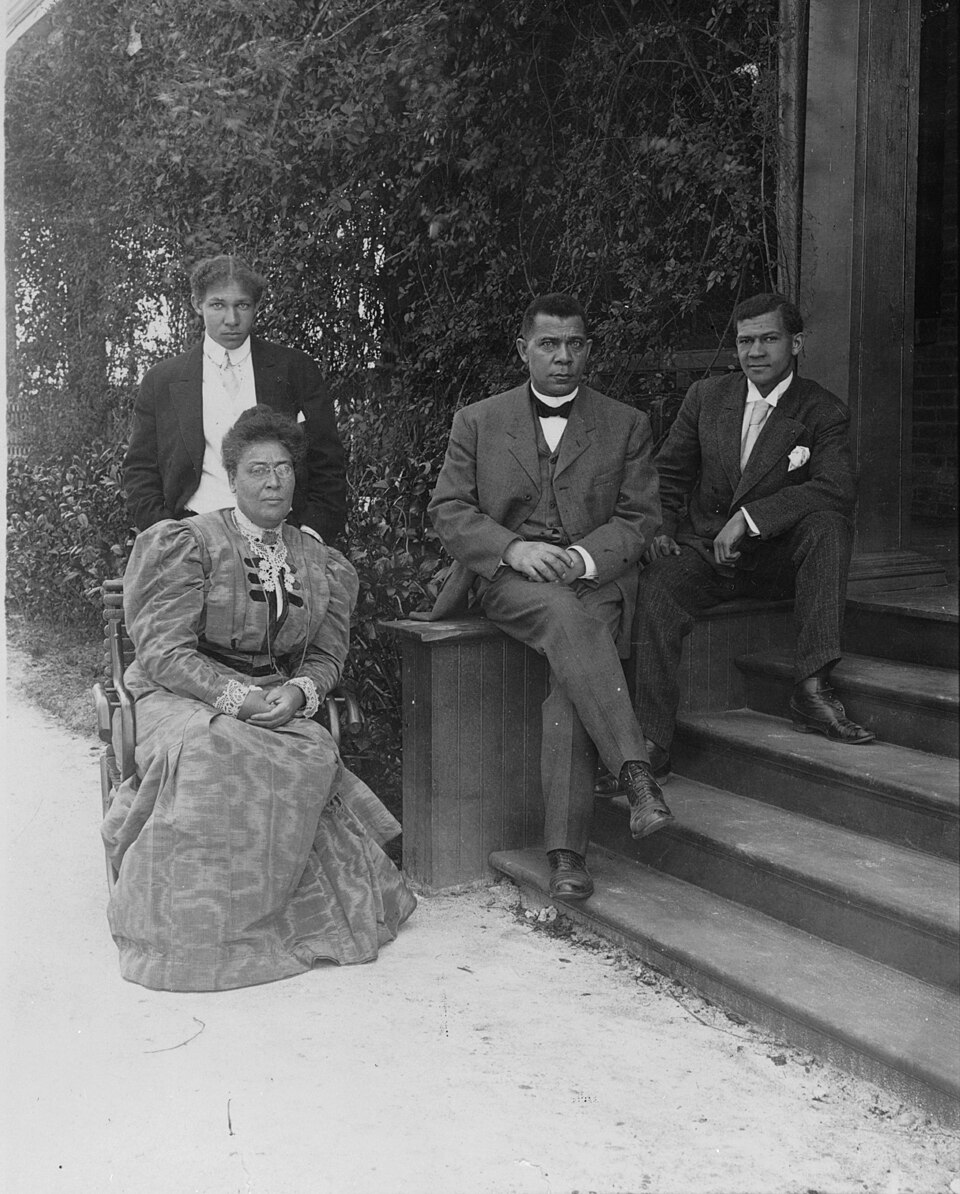
A Hunger for Education
After gaining his freedom, young Booker desperately wanted to learn to read and write. His family moved to Malden, West Virginia, where he worked in salt furnaces and coal mines as a child to help support them. He taught himself the alphabet and attended school whenever he could, often studying late into the night after long days of hard labor. When Booker heard about the Hampton Normal and Agricultural Institute in Virginia, a school for Black students, he was determined to go. He walked nearly 500 miles to get there and worked as a janitor to pay his tuition.
Founding Tuskegee Institute
In 1881, at just 25 years old, Booker T. Washington was chosen to lead a new school for Black students in Tuskegee, Alabama. He started with almost nothing: no land, no buildings, and only $2,000 from the state government. Washington and his students built the school’s buildings themselves, making bricks by hand and constructing classrooms from the ground up. The Tuskegee Normal and Industrial Institute grew quickly, teaching students practical skills like farming, carpentry, and teaching. Within a few years, it became one of the most important Black educational institutions in the United States.
George Washington Carver and Tuskegee
One of Booker T. Washington’s smartest decisions was hiring the brilliant scientist George Washington Carver to teach at Tuskegee in 1896. Carver became famous for his research on peanuts, sweet potatoes, and other crops that could help Southern farmers. Together, Washington and Carver made Tuskegee a center of both practical education and scientific discovery. Carver stayed at Tuskegee for 47 years, and his work brought national attention to the school. The partnership between these two great men showed the power of education and hard work.
The Atlanta Compromise Speech
On September 18, 1895, Booker T. Washington delivered a speech at the Cotton States and International Exposition in Atlanta, Georgia, that made him famous across the country. In this speech, which became known as the “Atlanta Compromise,” he argued that Black Americans should focus on building economic success through vocational training and hard work rather than fighting for immediate social equality. The speech was praised by many white leaders and made Washington the most well-known Black leader in America. However, some Black leaders, including W. E. B. Du Bois, disagreed and felt that Washington was asking Black people to accept unfair treatment. This debate about the best path forward for Black Americans continued for many years.
Dining at the White House
In 1901, President Theodore Roosevelt invited Booker T. Washington to dinner at the White House, making him the first Black American known to dine there as a guest of the president. The dinner caused an uproar among many white Southerners who were furious that a Black man had been treated as an equal at the president’s table. Despite the angry backlash, Roosevelt and Washington continued their friendship, and the president often asked Washington for advice on political appointments. This moment showed both how far Washington had come and how much racial prejudice still existed in America. Washington used his influence to quietly support legal challenges to unfair laws, even as he publicly urged patience.
Up from Slavery
In 1901, Booker T. Washington published his autobiography, “Up from Slavery,” which told the story of his journey from an enslaved child to one of the most powerful men in America. The book became an international bestseller, translated into many languages, and inspired countless readers around the world. In it, Washington described his belief that education, self-reliance, and dignity were the keys to progress. The book remains widely read today and is considered one of the great American autobiographies. Through his writing, Washington reached millions of people who would never visit Tuskegee or hear him speak.
Legacy and Impact
Booker T. Washington died on November 14, 1915, at the age of 59. By the time of his death, Tuskegee had grown to over 100 buildings, 1,500 students, and a faculty of nearly 200 instructors. Washington had become the most influential Black American leader of his era, advising presidents and raising millions of dollars for education. While historians still debate whether his approach of accommodation was the right strategy, no one doubts that he transformed the lives of thousands of Black students through education. His story of rising from slavery to national leadership remains one of the most inspiring in American history.
 OtterKnow Kids Encyclopedia