A Very Old Civilization
China is home to one of the world’s oldest civilizations, with a recorded history stretching back more than 4,000 years. Ancient Chinese people developed many ideas and technologies that changed the world, including paper, printing, gunpowder, and the magnetic compass. These are sometimes called the “Four Great Inventions” because of how deeply they shaped human history. China was ruled by a series of dynasties, or royal families, for thousands of years before becoming a republic in 1912. Today, the country is officially known as the People’s Republic of China and is governed as a one-party state.
The Great Wall
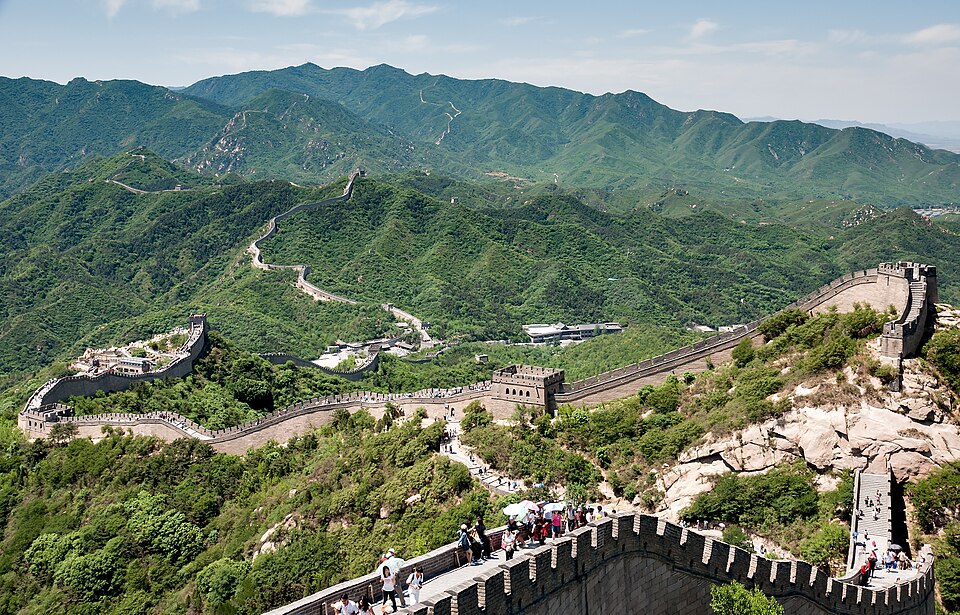
The Great Wall of China is one of the most famous structures ever built. Stretching over 21,000 kilometers across northern China, it was constructed over many centuries to protect against invasions from the north. The oldest sections date back more than 2,000 years, while much of the wall that visitors see today was built during the Ming Dynasty (1368–1644). The wall winds through mountains, deserts, and grasslands, and it is wide enough in some places for several people to walk side by side. It is a UNESCO World Heritage Site and one of the most visited landmarks in the world.
Land and Geography
China’s landscape is remarkably diverse, ranging from towering mountains to flat plains and dry deserts. The Yangtze River, the longest river in Asia, flows over 6,300 kilometers from the mountains of western China to the East China Sea. In the north lies the Gobi Desert, a huge stretch of rocky and sandy land that extends into Mongolia. The Tibetan Plateau in the west is often called the “Roof of the World” because it sits at an average elevation of over 4,500 meters above sea level. China also has long coastlines along the Pacific Ocean, with thousands of islands offshore.
Wildlife
China is home to many unique animals that are found nowhere else on Earth. The giant panda, which lives in the bamboo forests of central China, is one of the world’s most beloved and recognizable animals. Other notable species include the golden snub-nosed monkey, the South China tiger, and the Chinese alligator. The country has set up hundreds of nature reserves to protect endangered plants and animals. Conservation efforts have helped the giant panda population grow, and the species was reclassified from “endangered” to “vulnerable” in 2016.
Culture and Daily Life
Chinese culture has influenced art, food, philosophy, and traditions across Asia and the world. Celebrations like Chinese New Year, also called the Spring Festival, are among the biggest holidays in the country and feature dragon dances, fireworks, and family feasts. Chinese cuisine varies widely by region, from spicy dishes in Sichuan to delicate dim sum in Guangdong. Calligraphy, the art of beautiful writing, has been practiced in China for thousands of years. Martial arts such as kung fu and tai chi also have deep roots in Chinese history and philosophy.
Modern China
Today, China has the world’s second-largest economy and is a major force in global trade and manufacturing. The country hosted the Summer Olympic Games in Beijing in 2008 and the Winter Olympics there in 2022, becoming the first city to host both. China has also made great strides in science and technology, including launching astronauts into space and building one of the world’s fastest high-speed rail networks. Major cities like Shanghai and Shenzhen are known for their dramatic skylines and rapid growth. With its blend of ancient heritage and modern ambition, China continues to play a leading role on the world stage.
 OtterKnow Kids Encyclopedia