The Nile River
The Nile River is the lifeblood of Egypt, flowing northward through the country for about 1,500 kilometers before emptying into the Mediterranean Sea. Without the Nile, much of Egypt would be uninhabitable desert, since the river provides water for drinking, farming, and transportation. Each year in ancient times, the Nile flooded its banks and deposited rich, fertile soil across the Nile Delta in the north, allowing crops to grow in an otherwise dry land. This predictable cycle of flooding made it possible for one of the world’s greatest civilizations to develop along its shores. Today, the Aswan High Dam, completed in 1970, controls the river’s flow and generates electricity for millions of Egyptians.
Ancient Egypt
Ancient Egypt was one of the most powerful civilizations in human history, lasting for more than 3,000 years. The ancient Egyptians built enormous temples, developed advanced mathematics, and created one of the world’s first writing systems called hieroglyphics. They were ruled by pharaohs, powerful kings and queens who were considered living gods. The ancient Egyptians also made great advances in medicine, architecture, and astronomy. Their influence can still be seen today in art, language, and building design around the world.
The Pyramids and Monuments
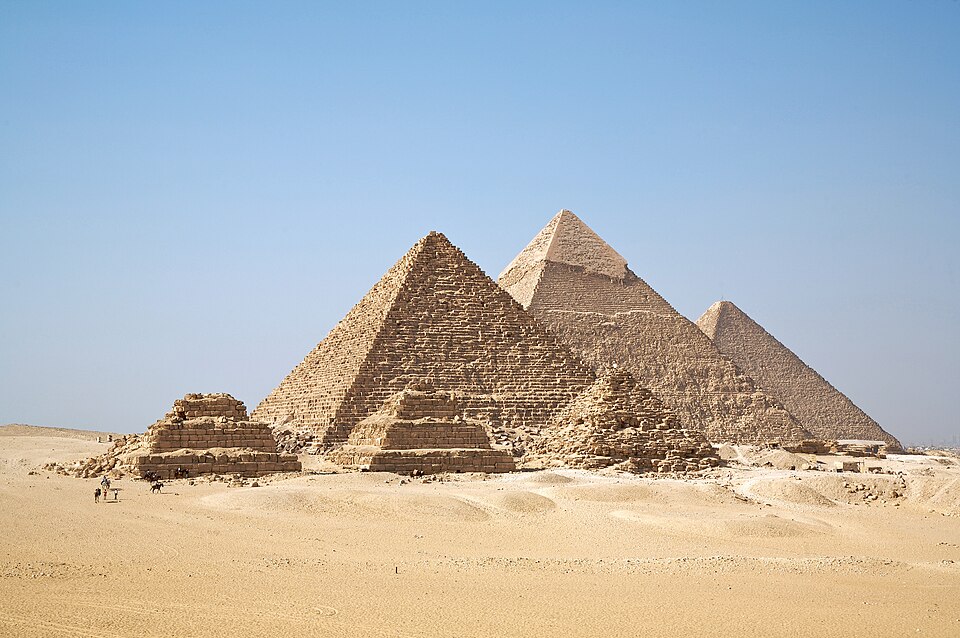
The Pyramids of Giza are among the most famous structures ever built and the only surviving Wonder of the Ancient World. The Great Pyramid, built for the pharaoh Khufu around 2560 BCE, stood as the tallest human-made structure in the world for nearly 4,000 years. Nearby sits the Great Sphinx, a massive limestone statue with the body of a lion and the head of a human. Egypt is also home to the Valley of the Kings, where dozens of pharaohs were buried in elaborate underground tombs. These ancient monuments attract millions of visitors from around the world every year.
Land and Geography
Most of Egypt is covered by the vast Sahara Desert, and about 95 percent of the population lives along the narrow Nile River valley and delta. The Sinai Peninsula in the east features rugged mountains, including Mount Sinai, which rises to about 2,285 meters. Egypt’s coastline stretches along both the Mediterranean Sea to the north and the Red Sea to the east, offering beaches and coral reefs. The Western Desert and the Eastern Desert together make up the majority of the country’s land area. Despite being mostly arid, Egypt’s geography has deeply shaped its history and way of life.
The Suez Canal
The Suez Canal is one of the most important waterways in the world, connecting the Mediterranean Sea to the Red Sea. Opened in 1869 after ten years of construction, the canal allows ships to travel between Europe and Asia without sailing all the way around Africa. It stretches about 193 kilometers across the narrow Isthmus of Suez in northeastern Egypt. The canal was expanded in 2015 to allow more and larger ships to pass through. Today, thousands of vessels transit the canal each year, making it a vital artery for international trade.
Culture and Daily Life
Egyptian culture mixes ancient traditions with modern influences. Family is central to Egyptian life, and large family gatherings are common during holidays and celebrations. Traditional Egyptian food includes dishes like koshari, a mixture of rice, pasta, and lentils, and ful medames, a stew of fava beans often eaten for breakfast. Music and dance have long been important parts of Egyptian culture, and Cairo is known as a center for Arabic film and television. Islam is the most widely practiced religion, and the call to prayer can be heard from mosques across the country five times a day.
Modern Egypt
Today, Egypt is a constitutional republic with a president and an elected parliament. Tourism is a major part of the economy, as millions of people travel to see the pyramids, temples, and other ancient sites each year. Agriculture along the Nile remains important, with farmers growing cotton, wheat, and sugarcane. Egypt also plays a significant role in regional politics and diplomacy in the Middle East and Africa. With its deep roots in the ancient past and a young, growing population, Egypt continues to be one of the most influential countries in the region.
 OtterKnow Kids Encyclopedia