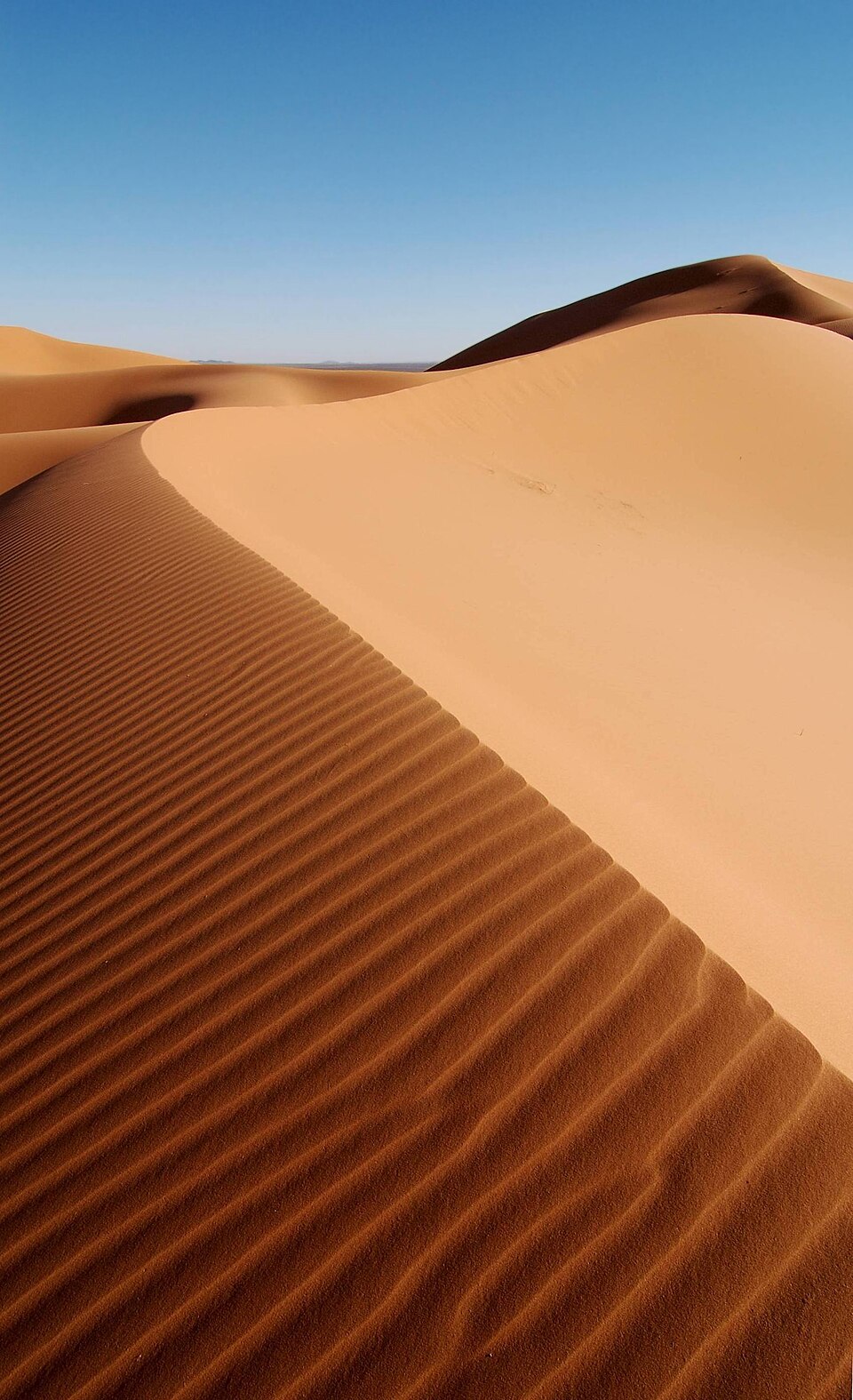
Landscape and Geography
Many people picture the Sahara as endless rolling sand dunes, but only about 25 percent of the desert is actually covered in sand. These sandy areas are called ergs, and the rest of the Sahara is made up of rocky plateaus, gravel plains, dry valleys, and even mountains. The highest point in the Sahara is Emi Koussi, a volcanic peak in Chad that rises to 3,415 meters (11,204 feet). The Sahara also contains the Nile River, which carries water from central Africa all the way through the desert to the Mediterranean Sea. Scattered throughout the desert are oases, green areas where underground water reaches the surface and supports plant life.
Extreme Climate
The Sahara is famous for its extreme temperatures. During the day, the sand and rock can heat up to over 50 degrees Celsius (122 degrees Fahrenheit), and some of the highest air temperatures ever recorded on Earth have come from the Sahara region. However, the desert can also be surprisingly cold at night, with temperatures sometimes dropping close to freezing. This dramatic swing happens because dry desert air does not hold heat well after the sun goes down. Rain is very rare in most of the Sahara, with some areas receiving less than 25 millimeters (1 inch) of rainfall per year.
The Green Sahara
The Sahara has not always been a desert. Between about 11,000 and 5,000 years ago, during a period scientists call the African Humid Period or “Green Sahara,” the region looked completely different. Ancient rock art found across the Sahara shows pictures of hippos, crocodiles, and cattle, proving that lakes, rivers, and grasslands once covered the area. Scientists believe that shifts in Earth’s orbit changed wind and rain patterns, gradually turning the green landscape into the desert we see today. Researchers have found fossils of fish and other water animals in places that are now bone-dry sand.
Wildlife and Adaptations
Despite the harsh conditions, many animals have adapted to life in the Sahara. The dromedary camel, with its single hump storing fat for energy, can go for days without drinking water. The fennec fox, the smallest fox in the world, has oversized ears that help release body heat and keep it cool. Saharan cheetahs are extremely rare and have pale coats that blend with the sandy landscape. Addax antelopes get most of their water from the plants they eat and can survive without drinking for months. Even in the driest parts of the desert, scorpions, lizards, and beetles have found ways to survive.
People of the Sahara
About 2.5 million people live in the Sahara Desert, and humans have inhabited this region for thousands of years. The Tuareg people are among the most well-known Saharan groups, traditionally living as nomads who travel by camel across the desert. Many Saharan communities have historically settled near oases, where they grow date palms and other crops using ancient irrigation methods. Trade routes once crossed the Sahara, connecting West Africa to North Africa and carrying goods like gold, salt, and ivory. Today, some Saharan cities have grown into modern centers with airports and universities, though life in remote areas remains closely tied to traditional practices.
Resources and Modern Challenges
The Sahara holds valuable natural resources beneath its surface. Large deposits of oil and natural gas are found in Algeria and Libya, and the desert also contains reserves of iron, copper, and phosphates. Solar energy is another resource with enormous potential, since the Sahara receives some of the most intense sunlight on the planet. However, the desert faces environmental challenges, including desertification, which is the process of the Sahara expanding into surrounding grasslands. Climate change and overgrazing contribute to this expansion, threatening communities and farmland along the desert’s edges.
Fun Facts
The Sahara occasionally experiences snowfall in its northern mountain regions, most recently in the town of Ain Sefra, Algeria. Sand from the Sahara is regularly carried by wind across the Atlantic Ocean, sometimes reaching as far as the Amazon rainforest in South America, where it provides nutrients for the soil. The Sahara contains the Richat Structure, also called the “Eye of the Sahara,” a mysterious circular rock formation about 40 kilometers (25 miles) across that is visible from space. Despite being one of the driest places on Earth, the Sahara sits on top of huge underground aquifers that hold ancient water from the time of the Green Sahara.
 OtterKnow Kids Encyclopedia