History and Origins
Mumbai was originally a group of seven islands inhabited by fishing communities called the Koli people, who have lived in the area for centuries. In the 1500s, the Portuguese controlled the islands before giving them to the British as part of a marriage agreement in 1661. Over the following centuries, the British connected the seven islands through massive land reclamation projects, filling in the water between them to create one continuous landmass. The city grew rapidly as a major trading port during the 1800s, becoming one of the most important commercial centers in the British Empire. After India gained independence in 1947, Mumbai continued to grow and became the economic powerhouse of the new nation.
Famous Landmarks
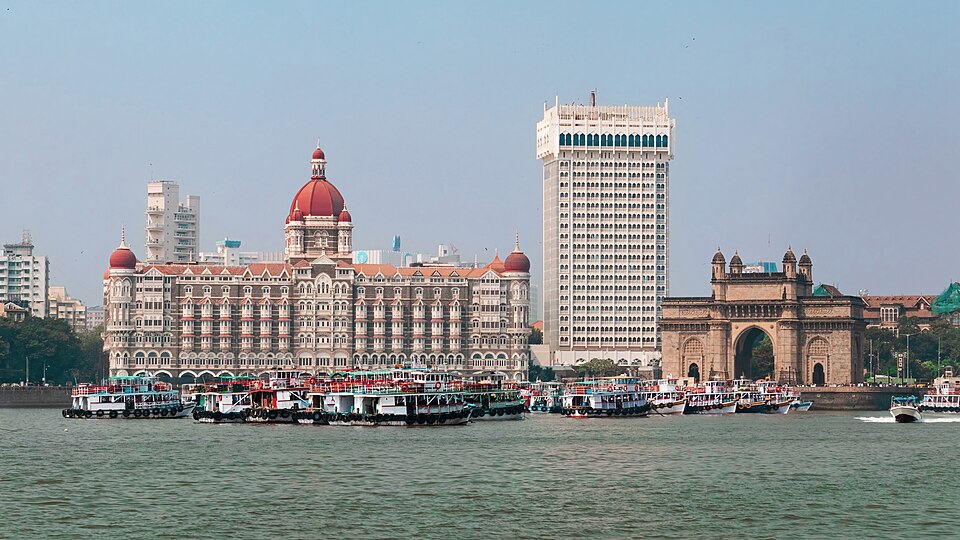
The Gateway of India is Mumbai’s most recognizable monument, a grand stone arch built in 1924 to commemorate the visit of King George V and Queen Mary in 1911. It stands on the waterfront of Mumbai Harbor and was once the ceremonial entrance point for important visitors arriving by ship. The Chhatrapati Shivaji Maharaj Terminus is a grand Victorian Gothic railway station and a UNESCO World Heritage Site that serves as one of the busiest train stations in India. The Haji Ali Dargah is a beautiful mosque and tomb built on a tiny island connected to the mainland by a narrow walkway that gets submerged during high tide. Marine Drive, a curved seaside boulevard nicknamed the “Queen’s Necklace” because of its glittering streetlights at night, is one of the city’s most popular spots for an evening stroll.
Bollywood and Entertainment
Mumbai is the home of Bollywood, India’s enormous film industry, which produces more films each year than Hollywood. The name Bollywood comes from combining “Bombay” with “Hollywood,” and the industry has been making movies since the early 1900s. Bollywood films are known for their colorful costumes, dramatic storylines, and elaborate song-and-dance sequences. The industry employs hundreds of thousands of people, from actors and directors to set designers and musicians. Bollywood movies are watched not only across India but by audiences all over the world, especially in South Asia, the Middle East, and Africa.
A City of Contrasts
Mumbai is a city of striking contrasts, where extreme wealth and deep poverty exist side by side. The city is home to some of the most expensive real estate in the world, including Antilia, a 27-story private residence. At the same time, Dharavi is one of the largest and most densely populated informal settlements in Asia, where roughly a million people live and work in a small area. Despite tough conditions, Dharavi has a thriving economy with small businesses that produce pottery, leather goods, and recycled materials. These contrasts highlight the challenges of inequality that Mumbai and many other rapidly growing cities around the world face.
Getting Around
The Mumbai suburban railway is the lifeline of the city, carrying over 7 million passengers every single day. The train network stretches across the city and its suburbs, and during rush hour, trains are packed far beyond their official capacity. Mumbai also has an extensive bus network, auto-rickshaws, and taxis, including the city’s famous black-and-yellow cabs. In recent years, the city has been building a modern metro system to help ease the crowding on roads and older rail lines. Ferries connect Mumbai to nearby islands and coastal towns, offering both transportation and scenic views of the city’s skyline.
Food and Culture
Mumbai is famous for its street food culture, and one of the city’s most beloved snacks is vada pav, a spiced potato fritter served in a soft bun that is sometimes called the “Indian burger.” Other popular street foods include pav bhaji (a thick vegetable curry with buttered bread), bhel puri (puffed rice mixed with chutneys and vegetables), and cutting chai (strong tea served in small glasses). The city celebrates many festivals throughout the year, with Ganesh Chaturthi being the biggest, when enormous statues of the elephant-headed god Ganesha are paraded through the streets and immersed in the sea. Mumbai’s diverse population includes people from every region of India, making it one of the most multicultural cities in the country.
Mumbai Today
Today, Mumbai generates a large portion of India’s total economic output and is home to the Bombay Stock Exchange, one of the oldest stock exchanges in Asia. The city is a center for banking, technology, and international trade, attracting workers and entrepreneurs from across India and the world. Mumbai faces significant challenges, including overcrowding, flooding during the monsoon season, and the need for better infrastructure. However, the city continues to invest in new projects like expanded metro lines, coastal roads, and affordable housing. With its diversity, creative energy, and determination, Mumbai remains one of the most important cities on the planet.
 OtterKnow Kids Encyclopedia