The Galapagos Islands were created by volcanic activity over millions of years. They sit above a volcanic hotspot, where magma pushes up through the ocean floor to form new land. The oldest islands in the southeast are roughly three to five million years old, while the younger western islands, such as Isabela and Fernandina, are still geologically active. Fernandina’s La Cumbre volcano erupted as recently as 2020. The landscape ranges from barren lava fields and rocky shores to misty highlands covered in dense vegetation, giving each island its own distinct character.
Unique Wildlife
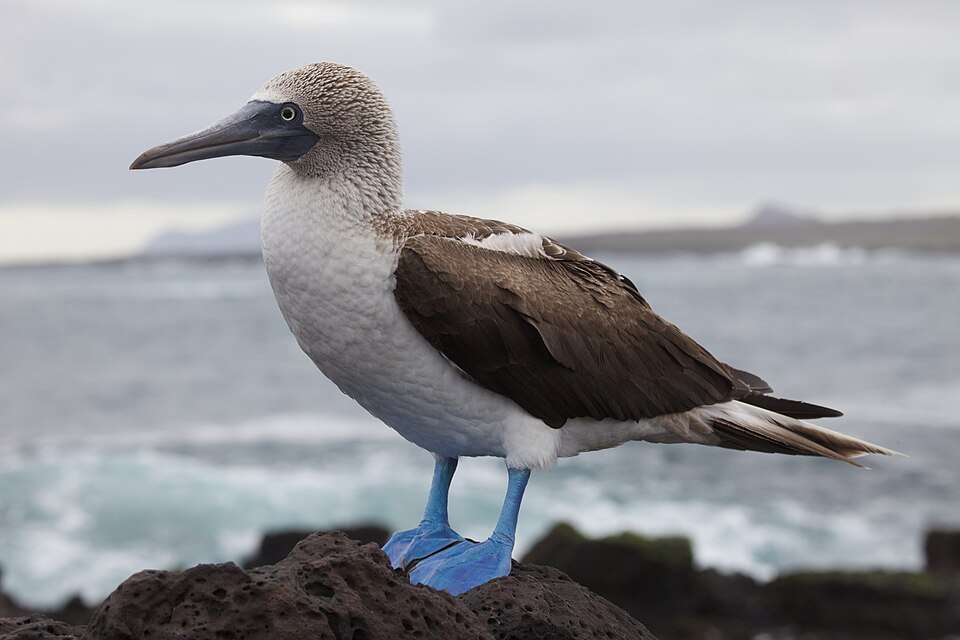
The Galapagos are famous for animals found nowhere else on Earth. Galapagos giant tortoises can live for more than 100 years and weigh up to 400 kilograms, making them among the largest tortoises in the world. Marine iguanas are the only lizards on the planet that swim and feed in the ocean, diving to munch on algae growing on underwater rocks. Blue-footed boobies perform a high-stepping dance to attract mates, showing off their brightly colored feet. The Galapagos penguin is the only penguin species that lives north of the equator, and flightless cormorants have evolved stubby wings because they have no need to fly. Because there are no native land predators, most wildlife on the islands shows remarkably little fear of humans.
Charles Darwin and Evolution
The Galapagos Islands are best known for inspiring one of the most important ideas in science. In 1835, a young English naturalist named Charles Darwin visited the islands aboard the ship HMS Beagle. He noticed that finches on different islands had differently shaped beaks, each suited to the food available on that particular island. This observation, along with other evidence he gathered, helped Darwin develop his theory of evolution by natural selection. His book, On the Origin of Species, published in 1859, changed how scientists understand life on Earth. Today, the famous Darwin finches remain a textbook example of how species adapt to their environments over time.
Conservation and Protection
About 97 percent of the Galapagos land area is protected as Galapagos National Park, which was established in 1959 to preserve the islands’ unique ecosystems. The surrounding ocean is also protected as the Galapagos Marine Reserve, one of the largest marine reserves in the world. UNESCO designated the islands as a World Heritage Site in 1978. Despite these protections, invasive species like rats, goats, and blackberry bushes have caused serious harm to native plants and animals. Conservation teams have worked for decades to remove invasive species, and these efforts have led to major successes, including the recovery of several tortoise populations.
The Ocean Around the Islands
The waters surrounding the Galapagos are fed by several ocean currents, including the cold Cromwell Current that rises from the deep ocean. These nutrient-rich waters support a wide variety of marine life, from hammerhead sharks and whale sharks to sea lions, dolphins, and sea turtles. The mixing of warm tropical and cold deep-ocean currents creates conditions where tropical fish swim alongside species normally found in much cooler waters. The Galapagos Marine Reserve covers over 133,000 square kilometers, helping protect this underwater world. Snorkeling and diving in the Galapagos offer some of the most spectacular wildlife encounters on the planet.
Visiting the Galapagos
Tourism is carefully managed in the Galapagos to protect the fragile environment. Visitors must be accompanied by licensed naturalist guides, and only certain areas are open to tourists at designated times. Most people explore the islands by small cruise ships that travel between islands overnight. The park charges an entrance fee, and the number of visitors is limited each year. These rules help ensure that the animals and habitats remain undisturbed while still allowing people from around the world to experience this place firsthand.
Fun Facts
The Galapagos Islands were named after the Spanish word “galápago,” meaning saddle, because early explorers thought the shells of the giant tortoises looked like riding saddles. Lonesome George, the last known Pinta Island tortoise, became a worldwide symbol of conservation before he died in 2012. The islands are home to the world’s only marine iguana, which sneezes out excess salt through special glands near its nose. Scientists have identified 13 different species of Darwin’s finches across the archipelago. The Galapagos penguin is not only the rarest penguin species but also the only one that occasionally crosses into the Northern Hemisphere to hunt for fish.
 OtterKnow Kids Encyclopedia