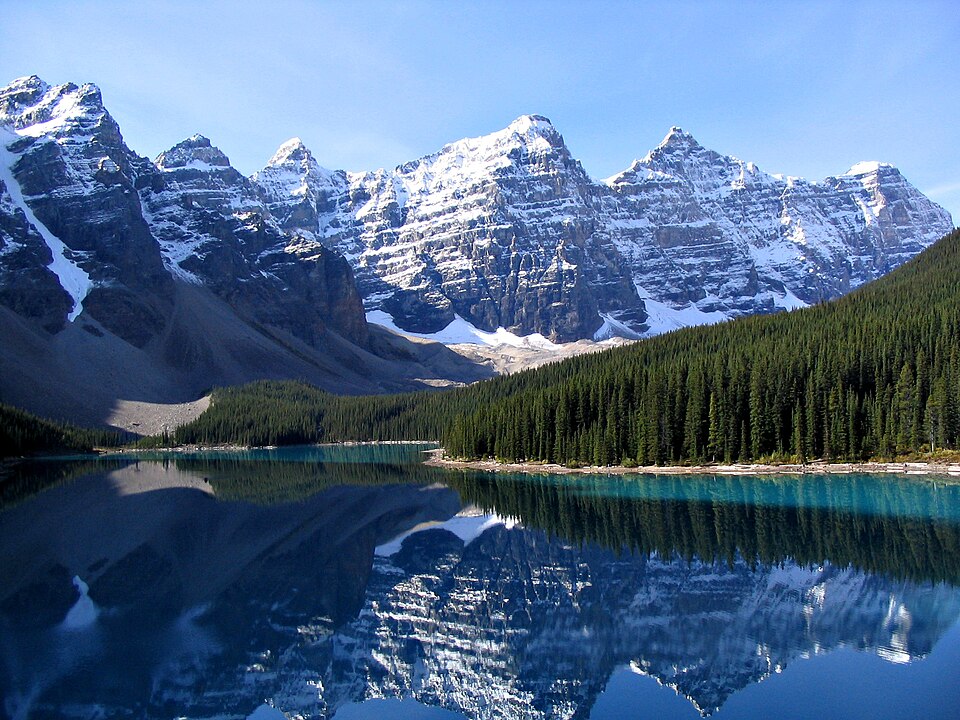
Turquoise Lakes
Banff is famous for its glacial lakes, whose waters glow an almost unbelievable shade of turquoise blue. Lake Louise and Moraine Lake are two of the most photographed lakes in the world, surrounded by jagged mountain peaks and dark green forests. The vivid color comes from rock flour, which is made up of tiny particles of rock ground down by the movement of glaciers. When glacial meltwater carries this fine powder into the lakes, the particles reflect sunlight in a way that creates that brilliant blue-green color. The color is most intense in summer when glacial melt is at its peak.
Glaciers and the Icefields Parkway
Banff National Park contains about 25 glaciers, including parts of the Columbia Icefield, the largest ice field in the Rocky Mountains. Glaciers are massive rivers of ice that move very slowly downhill, carving out valleys and shaping the landscape over thousands of years. The Icefields Parkway is a 232-kilometer highway connecting Banff to neighboring Jasper National Park, and it is considered one of the most scenic drives on Earth. Along the way, travelers pass towering waterfalls, alpine meadows filled with wildflowers, and views of ancient glaciers clinging to mountain slopes.
Wildlife of Banff
The forests, meadows, and mountains of Banff are home to a remarkable variety of animals. Grizzly bears and black bears roam the park’s wilderness, feeding on berries, roots, and fish from mountain streams. Wolves, cougars, lynx, and wolverines are among the predators that help keep the ecosystem in balance. Large herds of elk graze near the town of Banff, and visitors may also spot moose, bighorn sheep, mountain goats, and occasionally caribou. Wildlife crossings, including bridges and tunnels built over and under the Trans-Canada Highway, help animals move safely through the park.
The Town of Banff
Located in the center of the park, the town of Banff is the highest incorporated community in Canada, sitting at an elevation of 1,383 meters above sea level. About 8,000 people live in the town year-round, but it swells with visitors during both summer and winter seasons. The town offers museums, restaurants, and shops, along with easy access to hiking trails, ski resorts, and hot springs. Despite being surrounded by wilderness, the town has strict rules about development to protect the natural environment that makes the area so special.
Hot Springs and the Birth of the Park
Banff National Park owes its existence to a chance discovery of natural hot springs in 1883 by three railway workers. The Canadian government quickly recognized the importance of the site and set aside a small area to protect the hot springs from private development. That protected area grew into the full national park we know today, formally established in 1885 as the Rocky Mountains Park. The Banff Upper Hot Springs are still open to visitors, who can soak in naturally heated mineral water while gazing up at the surrounding mountain peaks.
A UNESCO World Heritage Site
Banff is part of the Canadian Rocky Mountain Parks UNESCO World Heritage Site, a designation shared with three other neighboring national parks: Jasper, Kootenay, and Yoho. Together, these parks protect one of the most spectacular mountain landscapes on the planet. The area is recognized for its outstanding natural beauty, its diverse ecosystems, and its geological significance, including fossils from the Burgess Shale that reveal life from over 500 million years ago. Being a World Heritage Site means the international community has agreed that this place is so important it must be preserved for future generations.
Visiting Banff
Banff offers adventures in every season, from hiking and canoeing in summer to skiing and snowshoeing in winter. Popular summer activities include exploring the shores of Lake Louise, paddling across turquoise waters, and hiking through alpine meadows bursting with wildflowers. In winter, the park transforms into a snowy wonderland with three major ski resorts and frozen waterfalls that attract ice climbers. From day hikes to week-long backcountry trips, Banff National Park is one of the wildest and most scenic corners of Canada.
 OtterKnow Kids Encyclopedia