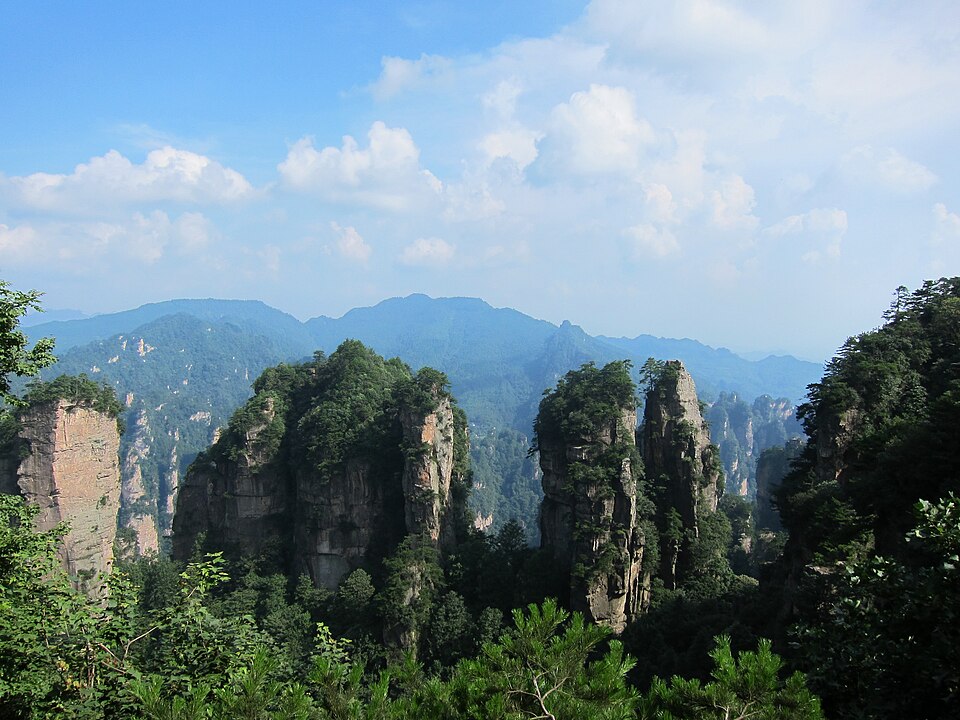
The Sandstone Pillars
The most striking feature of Zhangjiajie is its towering sandstone pillar formations. Over 3,000 quartzite sandstone columns rise throughout the park, many towering more than 200 meters (656 feet) above the valley floor. The tallest pillar, called Southern Sky Column, stands an incredible 1,080 meters (3,540 feet) tall. These pillars were formed over 380 million years as wind, water, and ice slowly eroded ancient sandstone deposits, carving away softer rock and leaving behind the harder stone columns. Mist and clouds often swirl around the pillars, making them appear to float in the sky.
The Avatar Connection
When filmmaker James Cameron released the movie “Avatar” in 2009, audiences around the world noticed that the floating mountains in the film looked remarkably like the pillars of Zhangjiajie. Cameron confirmed that the park’s landscape had inspired the movie’s scenery. In 2010, the Southern Sky Column was officially renamed “Avatar Hallelujah Mountain” in honor of the film. This connection brought international attention to the park and attracted many new visitors from outside China who wanted to see the real-life inspiration for the fictional world of Pandora.
Plants and Animals
Dense subtropical forest covers the lower slopes of Zhangjiajie, and trees and shrubs even grow on top of the dramatic pillars. The park is home to a rich variety of plant life, including ancient ginkgo trees, dove trees (whose white flowers look like fluttering doves), and thick bamboo groves. Macaque monkeys are commonly seen throughout the park, sometimes approaching visitors along the trails. The park also provides habitat for rare animals like the Chinese giant salamander, which can grow over a meter long, and the elusive clouded leopard, a spotted wild cat that hunts in the forest canopy.
Record-Breaking Attractions
Zhangjiajie is home to some remarkable human-made structures that take advantage of its dramatic scenery. The Zhangjiajie Glass Bridge, opened in 2016, is one of the world’s longest glass-bottomed bridges, stretching 430 meters long and hanging 300 meters above the valley below. Walking across it, visitors can look straight down through the transparent floor to the canyon far beneath their feet. The park also features glass-floored cliffside walkways attached to the sides of steep mountain faces. The Bailong Elevator, built into the side of a cliff, is one of the tallest outdoor elevators in the world, carrying visitors 326 meters up in less than two minutes.
Indigenous Peoples and Culture
Zhangjiajie is located in the traditional homeland of the Tujia, Miao, and Bai ethnic peoples, who have lived in the region for centuries. These communities have their own languages, festivals, music, and traditions that are still celebrated today. The Tujia people are known for their “Baishou” hand-waving dance, which has been recognized as an important piece of cultural heritage. Visitors to the area can learn about the customs, food, and craftsmanship of these communities in cultural villages near the park. The local culture adds a rich human dimension to the natural beauty of the landscape.
The story of Zhangjiajie’s pillars begins about 380 million years ago, when the area was covered by a shallow sea. Over millions of years, layers of sand and sediment built up on the seafloor and hardened into sandstone. Eventually, the land was pushed upward by geological forces, and the sea retreated. Then, over hundreds of millions of years, wind, rain, freezing, and thawing slowly wore away the softer rock, leaving behind the harder quartzite columns. Rivers carved deep valleys between the pillars, and plant roots growing in the cracks helped break the rock apart even further.
Visiting Zhangjiajie
The park offers a network of hiking trails, cable cars, and scenic viewpoints that let visitors explore the landscape from many angles. Popular routes include the Golden Whip Stream trail, a gentle walk along a clear stream at the base of the pillars, and Tianzi Mountain, which offers sweeping views over a sea of stone columns. Mornings are often the best time to visit, when mist fills the valleys and the pillars seem to emerge from clouds. The park can be very crowded during Chinese national holidays, so many travelers plan their visits during quieter times of year to enjoy the scenery in peace.
Why Zhangjiajie Matters
Zhangjiajie shows the unusual shapes that nature can create over vast stretches of time. Its UNESCO World Heritage status helps protect the unique geology and the plants and animals that depend on it. The park also shows how natural wonders can bring together science, culture, and art — from geologists studying its ancient rocks to filmmakers drawing inspiration from its otherworldly beauty. For the local Tujia, Miao, and Bai communities, the park represents a homeland where nature and culture are deeply intertwined.
 OtterKnow Kids Encyclopedia