Geography
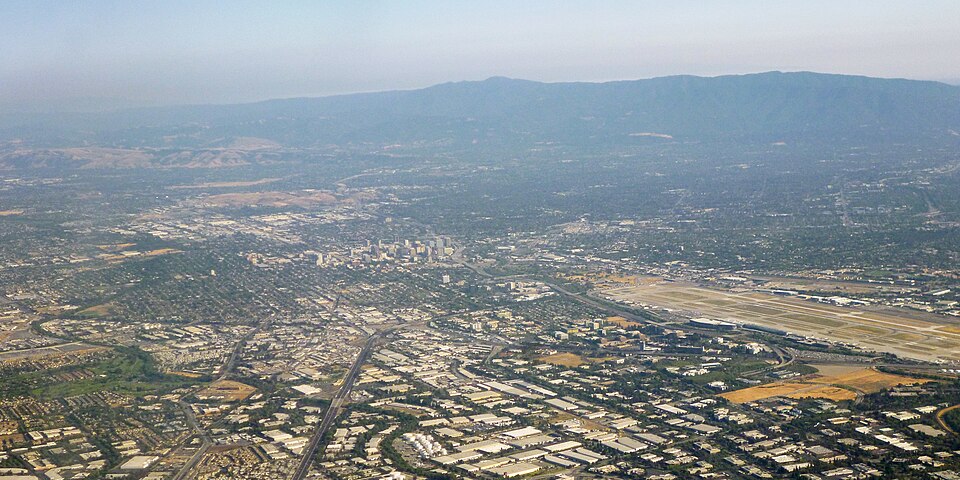
Silicon Valley occupies the Santa Clara Valley, a roughly 30-mile-long stretch of relatively flat land running from Menlo Park and Redwood City in the north to San Jose in the south. The Santa Cruz Mountains form the valley’s western boundary, while the Diablo Range and the shores of San Francisco Bay define its eastern edge. San Jose, with a population of roughly one million, is the largest city in the region and the third-largest city in California. The valley’s mild climate — with warm, dry summers and cool, wet winters — originally made it ideal for agriculture, and later proved equally appealing to the engineers and entrepreneurs who built the tech industry.
Why It’s Called Silicon Valley
The name “Silicon Valley” was coined by journalist Don Hoefler, who used it as the title of a series of articles published in the trade newspaper Electronic News in January 1971. The “silicon” part refers to the chemical element silicon, which is the key material used to manufacture semiconductor chips — the tiny electronic components at the heart of every computer, smartphone, and digital device. The “valley” part simply describes the geography of the Santa Clara Valley. Before Hoefler’s articles, the region was still commonly known as the Valley of Heart’s Delight, a name that reflected its history as one of the most productive fruit-growing regions in the world.
History
The story of Silicon Valley begins long before computers. For thousands of years, the Ohlone people lived in the Santa Clara Valley, building villages near creeks and the bay. In the 1800s and early 1900s, the valley was famous for its vast orchards of apricots, cherries, prunes, and other fruit.
The shift toward technology started at Stanford University. In 1939, Stanford professor Frederick Terman encouraged two of his students, William Hewlett and David Packard, to start an electronics company in a garage in Palo Alto. Hewlett-Packard grew into a major corporation and is often called the founding company of Silicon Valley. In 1956, physicist William Shockley, who had co-invented the transistor, opened Shockley Semiconductor Laboratory in Mountain View. When eight of his top engineers left to form Fairchild Semiconductor in 1957 — a group known as the “traitorous eight” — they launched the semiconductor industry that gave Silicon Valley its name. Fairchild alumni later went on to found Intel and dozens of other chip companies.
By the 1970s and 1980s, the orchards had given way to office parks and laboratories. Apple Computer was started in a garage in Los Altos in 1976 by Steve Jobs and Steve Wozniak. The rise of personal computers, the internet, and smartphones in the decades that followed brought wave after wave of new companies and innovation to the region.
Major Companies
Silicon Valley is home to some of the most valuable and influential companies in the world. Apple, headquartered in Cupertino, designs the iPhone, iPad, and Mac computers and is one of the most valuable companies ever. Google, now part of a parent company called Alphabet, is based in Mountain View at a campus called the Googleplex. Meta, the company behind Facebook, Instagram, and WhatsApp, has its headquarters in Menlo Park. Other major companies based in the region include Netflix, Adobe, Cisco Systems, and the electric car maker Tesla. The area is also home to the headquarters of many venture capital firms — companies that invest money in startups — particularly along Sand Hill Road in Menlo Park.
Innovation and Culture
What makes Silicon Valley unique is not just the companies but the culture surrounding them. The region has a strong tradition of risk-taking and entrepreneurship. Many famous companies started in garages, dorm rooms, or small apartments. Failure is seen as a learning experience rather than something to be ashamed of, which encourages people to try bold new ideas. Stanford University and other nearby schools provide a constant stream of talented engineers and researchers. Venture capital firms provide the funding that turns ideas into real products and services. This combination of talent, money, and a willingness to take risks has kept Silicon Valley at the forefront of technology for more than 60 years.
Fun Facts
- Before becoming a tech hub, the Santa Clara Valley had so many fruit orchards that it was called the Valley of Heart’s Delight.
- The HP Garage at 367 Addison Avenue in Palo Alto, where Hewlett and Packard started their company in 1939, is a California Historical Landmark.
- San Jose is the largest city in Silicon Valley and the tenth-largest city in the United States by population.
- The term “Silicon Valley” first appeared in print in January 1971 in Don Hoefler’s articles in Electronic News.
- Google was started as a research project by two Stanford PhD students, Larry Page and Sergey Brin, in 1998.
 OtterKnow Kids Encyclopedia