What It Looks Like
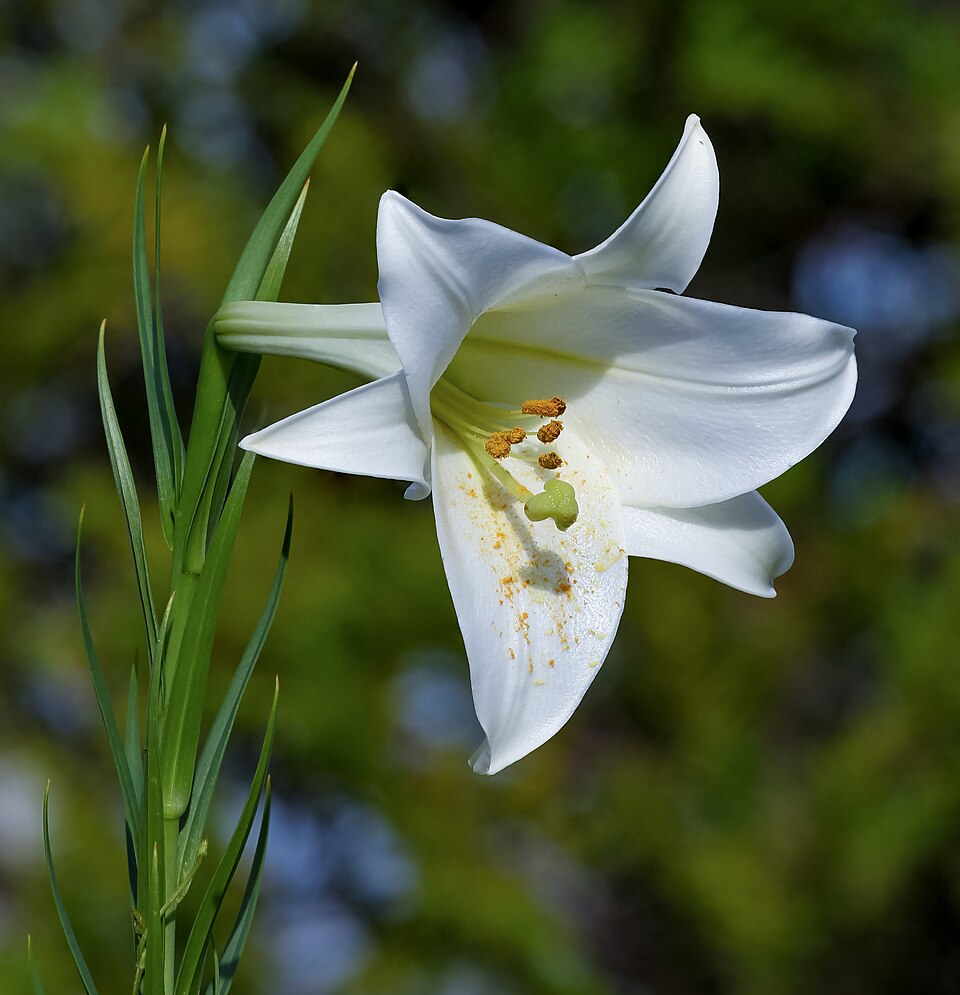
True lilies have six petal-like parts called tepals that flare outward in a star shape, curve backward into a turk’s cap, or form an upward-facing cup depending on the species. Many lilies have dramatic markings, such as the tiger lily with its bold black spots on orange petals, or the stargazer lily with its deep pink centers and white-edged petals. Lily plants grow from scaly bulbs and send up a single sturdy stem that can reach anywhere from 60 centimeters to over 2 meters tall, depending on the variety. The leaves are long and lance-shaped, arranged in whorls or spirals along the stem. At the center of each flower, six prominent stamens tipped with large, pollen-covered anthers dangle from the bloom.
How It Grows
Lilies grow from bulbs that are made up of thick, overlapping scales rather than the papery layers found in onion or tulip bulbs. Gardeners plant lily bulbs in autumn or early spring, placing them deep in well-drained soil so the roots have room to anchor the tall stems. Most lilies bloom in summer, with different species flowering from early June through September, giving gardeners months of color if they plant several types. After flowering, the stem and leaves continue to photosynthesize, storing energy in the bulb for next year’s growth. Many lily species also produce tiny bulbils along their stems or at leaf joints, which can fall to the ground and grow into new plants.
Where It Grows
Wild lilies are found across a wide arc stretching from southern Europe through Turkey, the Himalayas, China, Japan, and into North America. Some species, like the Canada lily and the Michigan lily, are native to North American woodlands and meadows. Lilies generally prefer rich, moist soil with good drainage and partial shade, often growing at the edges of forests where they receive dappled sunlight. Asiatic and Oriental hybrid lilies are now grown in gardens on every continent except Antarctica, and the Netherlands is the world’s largest commercial producer of lily bulbs.
Pollinators and Seeds
Different lily species have evolved to attract specific pollinators through their color, shape, and scent. White and pale lilies that release strong fragrances at night are typically pollinated by moths, while brightly colored day-blooming lilies attract bees, butterflies, and hummingbirds. The large, pollen-heavy anthers of lilies dust visiting insects generously, making them efficient at transferring pollen between flowers. After pollination, lilies produce seed capsules containing flat, papery seeds that can be dispersed by wind.
Uses and Symbolism
Lilies have deep symbolic meaning in many cultures, representing purity, renewal, and motherhood. The white Madonna lily has been associated with the Virgin Mary in Christian art for over a thousand years, and Easter lilies are a tradition in churches across the United States every spring. Lily bulbs of certain species, particularly Lilium lancifolium, are eaten as a food in parts of China, Japan, and Korea, where they are considered a delicacy. However, it is critically important to know that all true lilies are extremely toxic to cats, and even a small amount of pollen or leaf can cause fatal kidney failure in felines.
Interesting Facts
The oldest known image of a lily was found in a fresco on the Greek island of Crete, painted more than 3,500 years ago during the Minoan civilization. Some tall Oriental lily hybrids, often marketed as “tree lilies,” can grow over 2 meters tall and produce flowers as large as dinner plates. Lily pollen produces deep orange or brown stains that are very difficult to remove from clothing, which is why florists sometimes snip off the anthers before putting lilies in arrangements. The fragrance of some Oriental lilies is so powerful that a single stem can perfume an entire room.
 OtterKnow Kids Encyclopedia