What It Looks Like
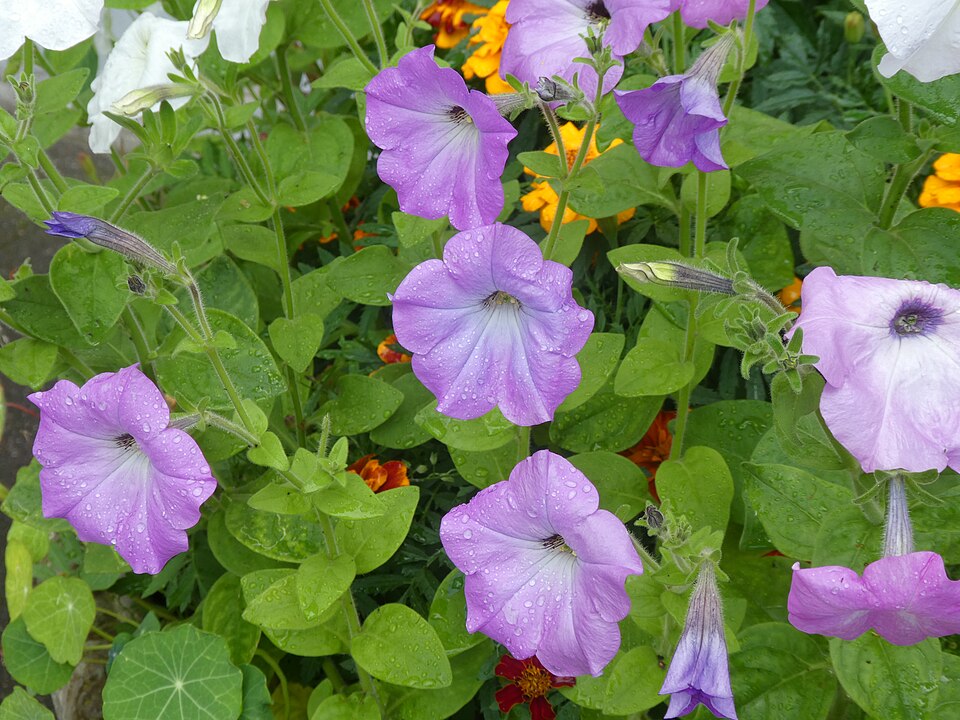
Petunia flowers are trumpet or funnel-shaped, with five fused petals that flare open into a wide, ruffled or smooth face. The blooms range from about 5 centimeters across in multiflora types to over 13 centimeters in the large-flowered grandiflora varieties. Their colors span the entire rainbow, including vibrant pinks, reds, purples, blues, yellows, whites, and even near-black, with many varieties showing dramatic veining, edges, or star patterns. The stems and leaves are covered in tiny, sticky hairs called trichomes that give the plant a slightly fuzzy feel and can leave a mild residue on your fingers. Petunia plants can grow upright in compact mounds or trail gracefully over the edges of containers, depending on the variety.
How It Grows
Petunias are tender perennials in their native South America, but in most gardens they are grown as annuals, planted fresh each spring. They love warm weather and full sun, performing best with at least six hours of direct sunlight per day and regular watering. Petunias grow quickly from transplants and begin blooming within weeks, continuing nonstop until cold weather arrives in autumn. Wave petunias and other spreading types can extend outward more than a meter from a single plant, creating impressive carpets of color without any mounding or staking. Gardeners who pinch back leggy stems and remove faded flowers are rewarded with bushier, more floriferous plants throughout the season.
Where It Grows
Wild petunias are native to South America, primarily found in southern Brazil, Argentina, Uruguay, and Paraguay, where they grow in grasslands and open areas. Modern garden petunias are hybrid creations descended mainly from two wild species, Petunia axillaris and Petunia integrifolia, first crossed by plant breeders in the 1830s. Today, petunias are grown in gardens and containers on every continent except Antarctica, from tropical lowlands to cool mountain towns. They are the best-selling bedding plant in the United States and are equally popular across Europe, Japan, and Australia.
Pollinators and Seeds
Different petunia species have evolved to attract different pollinators based on their flower color and fragrance. White and pale-colored petunias tend to release a sweet fragrance at night to attract hawk moths, while brightly colored varieties are visited by bees and butterflies during the day. The sticky trichomes on petunia stems and leaves can trap small insects, leading some scientists to classify petunias as partially carnivorous, since nutrients from decomposing trapped insects may be absorbed by the plant. After pollination, petunias produce small capsules filled with hundreds of incredibly tiny seeds, each barely larger than a grain of sand.
Uses and Symbolism
Petunias are grown almost entirely as ornamental plants, valued for their long blooming season and ability to thrive in containers, baskets, and garden borders. In the language of flowers, petunias can represent feelings of anger or resentment, though today most people simply associate them with cheerfulness and summer color. Scientists use petunias extensively in genetic research because they are easy to grow, reproduce quickly, and their genes can be manipulated to study how flower color, fragrance, and other traits are controlled. Some of the first genetically modified ornamental plants were petunias, engineered to produce unusual orange and salmon colors not found in nature.
Interesting Facts
The sticky hairs on petunia stems are so effective at trapping small insects that researchers have measured nutrients being absorbed through the stems from decomposing prey, a trait more commonly associated with carnivorous plants like sundews. Petunia seeds are so tiny that it takes about 250,000 to 300,000 seeds to weigh just one ounce, making them some of the smallest garden flower seeds. The name “petunia” comes from the French word “petun,” which was borrowed from a Tupi-Guarani word for tobacco, reflecting the flower’s close relationship to the tobacco plant. Plant breeders release dozens of new petunia varieties every year, making it one of the most actively bred ornamental plants in the horticultural industry.
 OtterKnow Kids Encyclopedia