What It Looks Like
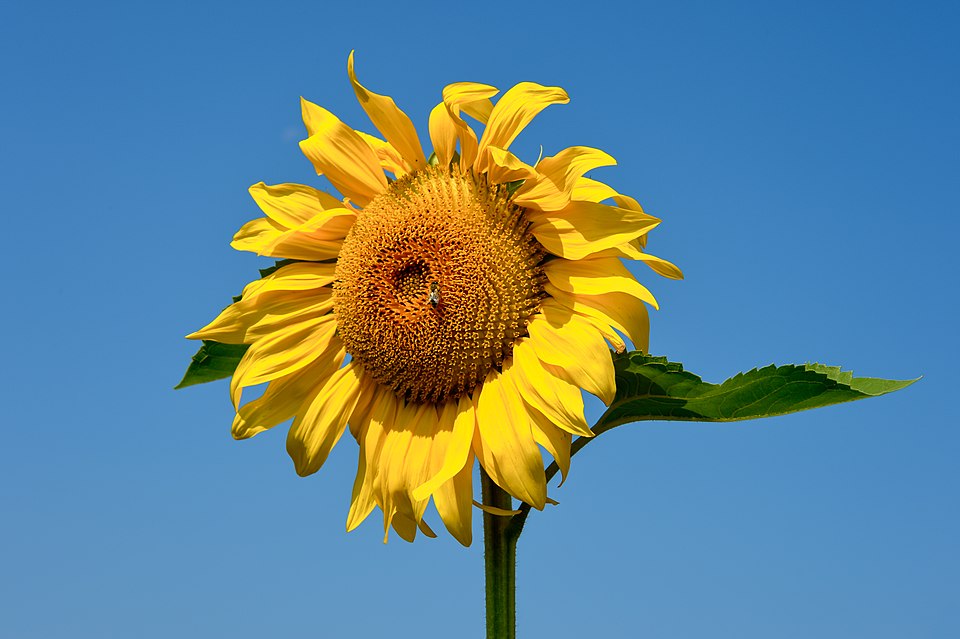
A sunflower’s “flower” is actually a composite bloom made up of as many as 2,000 individual tiny flowers called florets packed together on a large, flat disc. The bright yellow “petals” around the outside are ray florets, while the center is filled with disc florets that mature into seeds in a mesmerizing spiral pattern. The spiral arrangement of seeds follows the Fibonacci sequence, a mathematical pattern found throughout nature, which allows the maximum number of seeds to fit into the smallest possible space. Sunflower stems are thick, rough, and hairy, growing incredibly tall, with some varieties reaching over 3 meters in just a few months. The leaves are large, heart-shaped, and coarse-textured, sometimes growing as wide as 30 centimeters across.
How It Grows
Sunflowers are annual plants that grow with remarkable speed, sometimes shooting up 2 to 3 centimeters per day during their peak growth period. Young sunflower stems exhibit a behavior called heliotropism, bending to follow the sun across the sky from east to west during the day and resetting to face east again overnight. This sun-tracking is driven by growth hormones that accumulate on the shaded side of the stem, causing it to elongate and push the flower head toward the light. Once a sunflower matures and its heavy head fills with seeds, the stem stiffens and the flower permanently faces east, where the morning sun warms it and attracts more pollinating bees. Sunflowers are remarkably easy to grow, needing only full sun, moderate water, and well-drained soil to thrive.
Where It Grows
Sunflowers originated in the grasslands and prairies of central and western North America, where wild species still grow today. Spanish explorers carried sunflower seeds to Europe in the 1500s, and from there they spread to Russia, where they became hugely popular as a cooking oil source. Today, Ukraine and Russia are the world’s largest producers of sunflower seeds, followed by Argentina and China. Sunflowers grow well in temperate and subtropical climates around the world and can tolerate drought, poor soil, and high temperatures better than many other crops.
Pollinators and Seeds
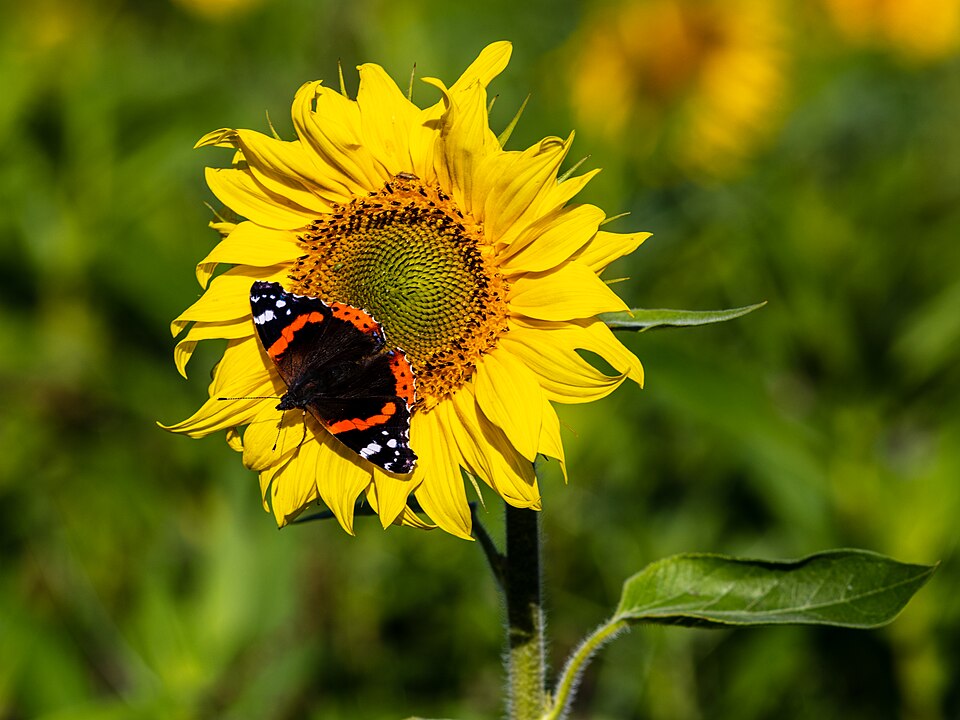
Sunflowers are pollination powerhouses, attracting bees, butterflies, beetles, and many other insects with their abundant nectar and pollen. A single sunflower head can produce enough nectar to attract over 100 bee visits in a single day, making sunflower fields vitally important for supporting pollinator populations. After pollination, each disc floret develops into one seed, meaning a large sunflower head can produce 1,000 to 2,000 seeds from a single bloom. When the seeds are ripe, birds like goldfinches, cardinals, and chickadees flock to sunflower heads for a nutritious meal.
Uses and Symbolism
Sunflower seeds are a popular snack food enjoyed around the world, rich in protein, healthy fats, and vitamin E. Sunflower oil, pressed from the seeds, is one of the most widely used cooking oils, valued for its mild flavor and high smoke point. Indigenous peoples of North America used every part of the sunflower, grinding seeds into flour, extracting oil for cooking and body paint, and using the stalks as building material. Sunflowers are a symbol of Ukraine and have become associated with peace, and they also represent loyalty and adoration because of the way young plants faithfully follow the sun.
Interesting Facts
The world record for the tallest sunflower ever grown stands at about 9.17 meters, which is taller than a two-story building, achieved by a gardener in Germany. Scientists have discovered that east-facing mature sunflowers warm up faster in the morning, attracting up to five times more pollinating bees than flowers experimentally turned to face west. Sunflowers can absorb toxic heavy metals like lead, arsenic, and uranium from contaminated soil through their roots, a process called phytoremediation, and they were planted around the Chernobyl nuclear disaster site to help clean the polluted ground. The mathematical Fibonacci spirals in sunflower seed heads have fascinated scientists and mathematicians for centuries and are considered one of the most beautiful examples of mathematics in nature.
 OtterKnow Kids Encyclopedia