
The Madagascar star orchid (Angraecum sesquipedale) is one of the most famous flowers in the history of science — not just for its beauty, but for a prediction it inspired that took over 40 years to prove correct. This striking white orchid is native to the forests of eastern Madagascar and is best known for its extraordinarily long nectar spur, which played a central role in one of biology’s greatest detective stories.
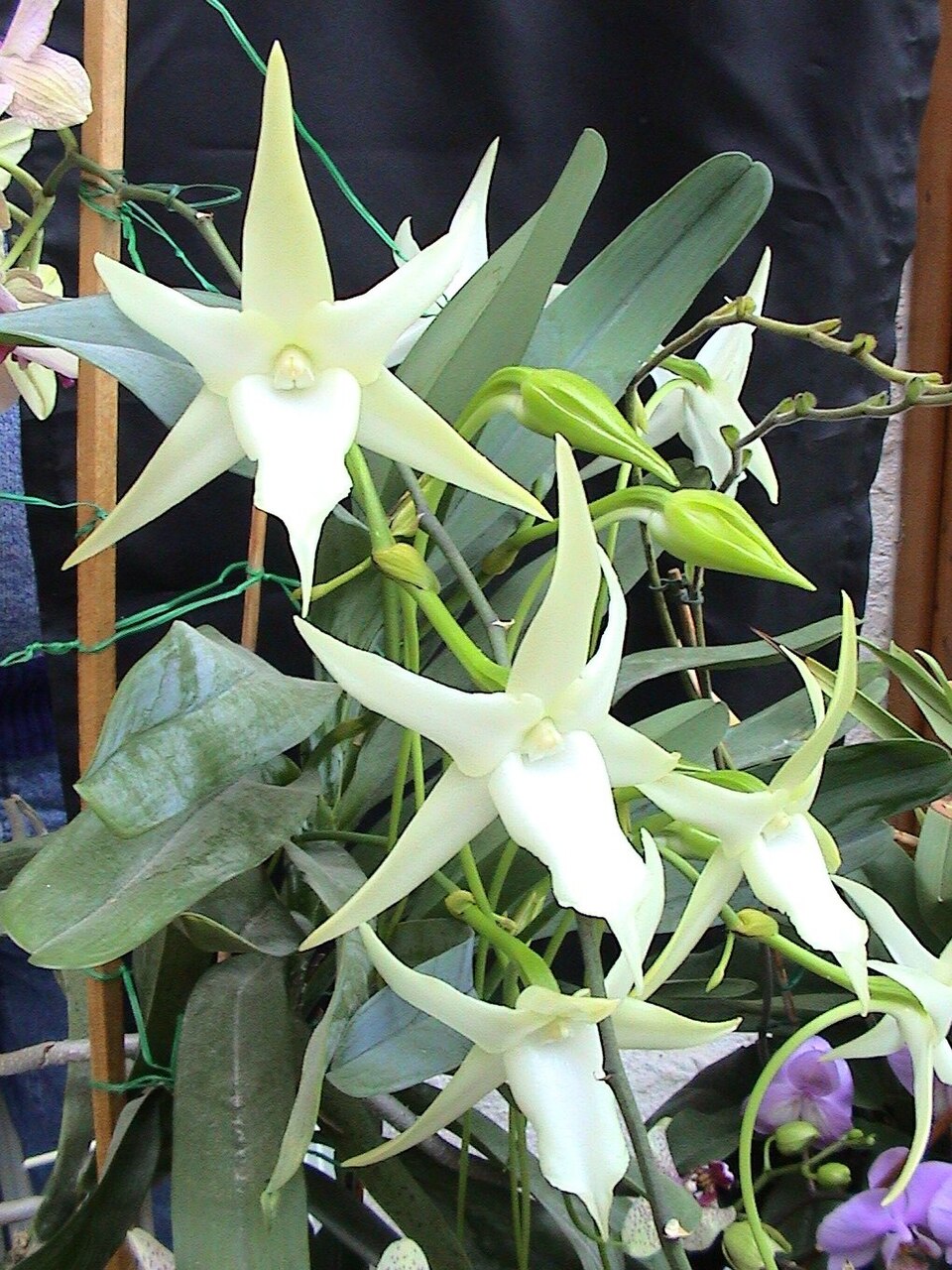
The Madagascar star orchid produces large, waxy white flowers shaped like six-pointed stars, each measuring about 15 centimeters (6 inches) across. The petals have a slightly greenish tinge and a thick, almost porcelain-like texture. But the most unusual feature hangs from the back of each flower: a thin, hollow nectar spur that can reach 20 to 35 centimeters (8 to 14 inches) in length. At the very bottom of this spur sits a small pool of sweet nectar. The plant itself is an epiphyte, meaning it grows on tree branches rather than in soil, anchoring itself with thick roots and drawing moisture from the humid forest air.
In January 1862, a package arrived at Charles Darwin’s home in England containing orchid specimens from Madagascar. When Darwin examined Angraecum sesquipedale and measured its nectar spur — nearly 30 centimeters long — he was astonished. He wrote to a friend: “What a prodigious development of the nectary! Good Heavens, what insect can suck it?” Darwin reasoned that because the nectar sat at the very bottom of the spur, only an insect with a tongue long enough to reach it could serve as the orchid’s pollinator. He predicted that a moth with an extraordinarily long proboscis must exist in Madagascar, even though no one had ever seen such a creature. Fellow scientists were skeptical, and some openly mocked the idea.
Darwin died in 1882, never learning whether his prediction was correct. But in 1903, entomologists Lionel Walter Rothschild and Karl Jordan described a subspecies of hawk moth from Madagascar with a proboscis extending to nearly 30 centimeters. They named it Xanthopan morganii praedicta — “the predicted one” — in direct tribute to Darwin. Even then, some scientists remained unconvinced. It was not until 1992 that a research team finally filmed the moth visiting the orchid at night and drinking from its spur, fully confirming Darwin’s prediction 130 years after he made it.
The relationship between the star orchid and Darwin’s hawk moth is one of the most famous examples of coevolution in biology. Over millions of years, the orchid and its pollinator drove each other to extremes. Orchids with slightly longer spurs had a reproductive advantage: a moth had to push deeper into the flower to reach the nectar, which meant more pollen stuck to its head and was transferred more reliably to the next flower’s stigma. Meanwhile, moths with slightly longer tongues could access nectar sources that shorter-tongued competitors could not. This mutual pressure — sometimes called a coevolutionary arms race — gradually produced the extraordinary dimensions we see today.
The star orchid has evolved specifically to attract nocturnal pollinators. Its flowers are white, making them visible in moonlight and starlight. It releases its strongest fragrance after dusk, sending chemical signals floating through the dark forest to attract hawk moths from a distance. The moth follows the scent trail to the glowing flower, uncoils its proboscis, and feeds. These nighttime adaptations are common among plants that rely on moth pollination and are sometimes called a “moth pollination syndrome.”
- The name “sesquipedale” comes from Latin meaning “one and a half feet,” referring to the length of the nectar spur.
- The orchid is sometimes called the “Christmas orchid” or “comet orchid” because it typically blooms between December and January.
- Darwin’s prediction about the moth was one of the earliest and most dramatic confirmations of the theory of natural selection applied to plant-pollinator relationships.
- The orchid only produces nectar at night, saving energy during daylight hours when its moth pollinator is inactive.
- Each flower lasts several weeks, increasing the chances that a moth will find it in the dark forest.
OtterKnow Kids Encyclopedia