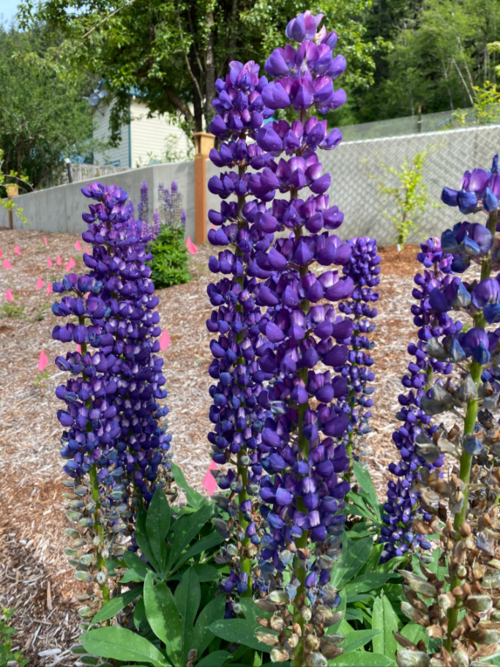
What It Looks Like
A lupine flower spike is a tall, upright cluster of individual blossoms, each one shaped like a tiny butterfly or pea flower with an upper petal called a banner and two lower petals that form a keel. The leaves are one of lupine’s most distinctive features: they are palmate, meaning the leaflets radiate outward from a central point like fingers on an open hand, and they often collect droplets of dew or rain that glitter like jewels in the morning light. Depending on the species, lupines can range from ground-hugging alpine plants just a few inches tall to bushy shrubs over four feet high. After blooming, the flowers develop into fuzzy seed pods that look like small, flattened pea pods.
Where It Grows
Lupines are found across North and South America, the Mediterranean region, and parts of Africa, growing in habitats ranging from coastal sand dunes to alpine meadows above the tree line. In North America, the most spectacular lupine displays occur in Texas (where the bluebonnet, a lupine species, is the state flower), along the Pacific Coast, and in subalpine meadows of the Rocky Mountains. Lupines prefer well-drained, slightly acidic soils and are often among the first plants to colonize bare, nutrient-poor ground like volcanic slopes and roadside cuts. Their ability to fix nitrogen allows them to enrich these poor soils and prepare the way for other plant species to follow.
Pollinators and Wildlife
Bumblebees are the primary pollinators of lupines because they are heavy and strong enough to push open the keel petals and reach the nectar and pollen inside. When a bumblebee lands on the flower and pushes down, the keel opens like a tiny trap door, dusting the bee’s belly with pollen. Some butterfly species, including the endangered Karner blue butterfly, depend on specific lupine species as the only food source for their caterpillars. Lupine seeds are eaten by birds and small mammals, and the dense foliage provides cover for ground-nesting wildlife.
Uses and History
Some lupine species produce edible seeds that have been cultivated and eaten by people for thousands of years, especially in Mediterranean and South American cultures, though the seeds must be carefully soaked and prepared to remove bitter, toxic alkaloids. Farmers and land managers plant lupines as cover crops and for ecological restoration because their nitrogen-fixing roots dramatically improve soil fertility. The beloved children’s book Miss Rumphius by Barbara Cooney tells the story of a woman who scatters lupine seeds along the coast of Maine to make the world more beautiful. In many parts of the world, lupines are now popular garden flowers prized for their dramatic vertical flower spikes.
Interesting Facts
When lupine seed pods dry out in the hot sun, they twist and split open with a sharp popping sound, flinging their seeds several feet away from the parent plant in an explosive dispersal mechanism. The name “lupine” comes from the Latin word lupus, meaning “wolf,” because ancient Romans mistakenly believed the plants were wolves of the garden that robbed nutrients from the soil, when in fact they do the opposite. After the devastating eruption of Mount St. Helens in 1980, lupines were among the first plants to recolonize the barren volcanic landscape, helping rebuild the soil for an entire ecosystem. Some lupine seeds found in the Arctic permafrost have been estimated to be over 10,000 years old, and there are reports of ancient seeds germinating after being thawed.
 OtterKnow Kids Encyclopedia