Daily Life and Culture
The Ohlone were skilled hunter-gatherers who developed a deep understanding of the land and its seasons. Acorns from the region’s plentiful oak trees were their most important food source. They developed a process of cracking, grinding, and leaching the acorns to remove bitter tannins before cooking them into porridge or bread. They also hunted deer and elk, fished in the bay and coastal waters, and gathered shellfish, seeds, and berries.
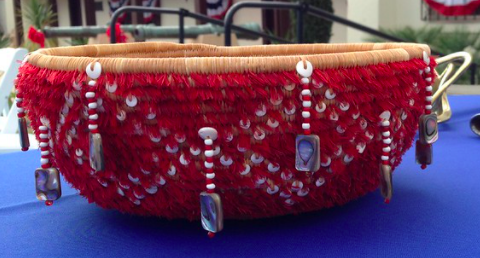
Ohlone villages were typically made up of dome-shaped houses built from a frame of willow poles covered with tule reeds. Villages could range from a few families to several hundred people, and each had its own chief and council of elders. The Ohlone were famous for their extraordinary basket-weaving skills. Their tightly woven baskets served many purposes, from cooking and food storage to carrying water. Some baskets were so finely made that they were decorated with shell beads and feathers for ceremonies.
Where They Lived
Ohlone territory stretched roughly 200 miles along the California coast, from the San Francisco Bay south to Big Sur, and inland to the Diablo Range. This land offered an incredible variety of environments: ocean shoreline, coastal marshes, grassy valleys, and oak-covered hills. Different Ohlone groups occupied specific territories within this larger region, and they maintained boundaries and trade relationships with their neighbors.
The Bay Area’s mild climate and abundance of natural resources made it one of the most densely populated regions in pre-contact North America. Hundreds of shellmounds, ancient mounds of discarded shells and other materials, have been found around the bay. Some of these mounds are thousands of years old and tell archaeologists a great deal about how the Ohlone lived over the centuries.
The Mission Period
When Spanish soldiers and missionaries arrived in 1769, everything changed for the Ohlone. Beginning in 1776 with Mission Dolores in San Francisco, the Spanish established several missions in Ohlone territory. Missionaries pressured or forced Ohlone people to move into the missions, where they were expected to convert to Christianity, speak Spanish, and perform hard labor. Ohlone people who entered the missions lost their freedom to practice their own traditions and were often punished for speaking their native languages.
The impact was devastating. European diseases like measles and smallpox swept through mission communities, killing thousands. By the early 1800s, the Ohlone population had declined dramatically. When Mexico took control of California in 1821 and later closed the missions, much of the Ohlone’s traditional land had been claimed by ranchers. The Gold Rush of 1849 brought even more settlers, pushing the Ohlone further from their homelands.
The Ohlone Today
Despite centuries of hardship, the Ohlone people are still here. Several Ohlone groups are active today, working to preserve their languages, traditions, and cultural practices. The Muwekma Ohlone Tribe of the San Francisco Bay Area has been seeking federal recognition for decades and continues to advocate for their rights. Ohlone artists like Linda Yamane have revived traditional basket-weaving techniques that were nearly lost.
In recent years, there has been growing public recognition of the Ohlone as the original inhabitants of the Bay Area. Land acknowledgments are now common at public events, and some organizations have begun returning land to Ohlone stewardship. In 2022, the city of Berkeley transferred a parcel of land to the Sogorea Te’ Land Trust, an Indigenous women-led organization, marking an important step in the movement for land reparations. The story of the Ohlone is not just ancient history; it is a living, evolving story that continues to shape the Bay Area today.
Key Facts
- The Ohlone have lived in the Bay Area for at least 10,000 years, making them among the longest continuous inhabitants of any region in North America.
- Before Spanish contact, the Ohlone population is estimated to have been between 10,000 and 20,000 people.
- There were about 50 distinct Ohlone groups, each with its own territory and leadership.
- Ohlone languages belong to the Costanoan branch of the Utian language family. Most Ohlone languages are no longer spoken daily, but revitalization efforts are underway.
- The Ohlone shellmounds around San Francisco Bay are some of the most important archaeological sites on the Pacific Coast.
 OtterKnow Kids Encyclopedia