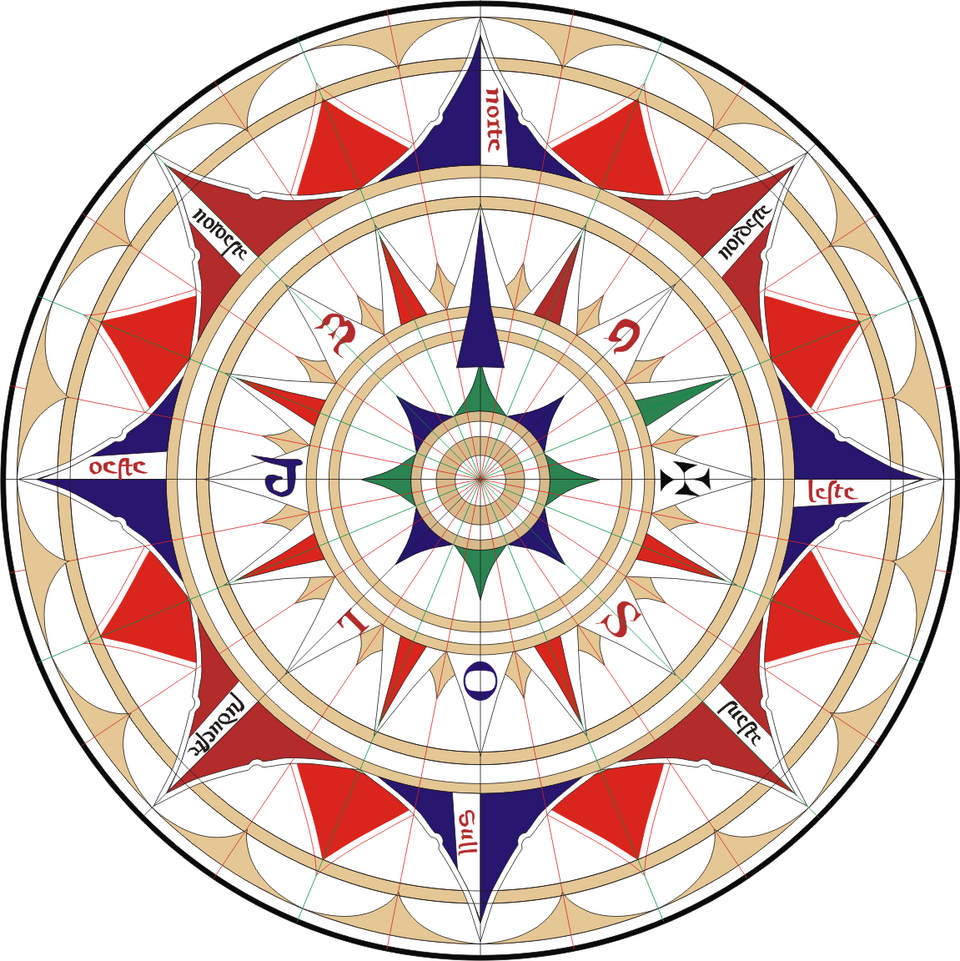
The Compass Rose
A compass rose is a symbol found on maps that shows the cardinal directions. It usually looks like a star or a decorated circle with points extending outward. The letter “N” marks north, “S” marks south, “E” marks east, and “W” marks west. Compass roses have been used on maps for hundreds of years, dating back to the 1300s when they first appeared on portolan charts made by sailors in the Mediterranean Sea. The name “compass rose” comes from the petal-like design of the points, which resemble the shape of a rose.
In addition to the four cardinal directions, there are four intermediate directions that fall between them. These are northeast, southeast, southwest, and northwest. Northeast is the direction between north and east, and southwest is between south and west. Intermediate directions are sometimes called ordinal directions. Using all eight directions together gives people a much more precise way to describe locations and give directions on a map.
How a Magnetic Compass Works
A magnetic compass is a tool that uses Earth’s magnetic field to find direction. Inside the compass is a small magnetized needle that can spin freely on a pivot. Because Earth acts like a giant magnet with magnetic poles near the North and South Poles, the needle always lines up to point roughly toward magnetic north. Travelers, hikers, and sailors have relied on magnetic compasses for nearly a thousand years. The earliest magnetic compasses were invented in China during the Han Dynasty and were later adopted by European explorers in the 1100s.
Using Directions on Maps
Most maps are drawn with north at the top of the page. This is a tradition that became standard during the Age of Exploration in the 1400s and 1500s. When you look at a map, moving your finger up means going north, down means south, right means east, and left means west. Knowing this makes it much easier to follow routes, measure distances, and understand where countries, cities, and landmarks are located. A compass rose on the map confirms which direction is which, especially on maps that are tilted or rotated.
Cardinal Directions in Everyday Life
People use cardinal directions every day, even without thinking about it. Street addresses in many cities are organized by direction, such as North Main Street or East Fifth Avenue. Weather forecasters describe storms moving from the southwest or cold air coming from the north. Pilots, ship captains, and emergency responders all depend on cardinal directions to do their jobs safely. Even your phone’s GPS app uses cardinal directions to give you turn-by-turn navigation.
Direction and the Sun
One of the oldest ways to find direction is by watching the sun. The sun rises in the east and sets in the west every day, which gives you two directions right away. If you face the rising sun, north is to your left and south is to your right. At noon in the Northern Hemisphere, the sun is roughly toward the south. Ancient civilizations, including the Egyptians and the Greeks, used the sun’s position to orient their buildings, temples, and even entire cities.
Fun Facts About Directions and Compasses
The word “north” comes from an ancient word meaning “left of the rising sun,” which makes sense if you face east. On some very old maps, east was placed at the top instead of north, which is where the word “orientation” comes from, since “orient” means east. The largest compass rose in the world is a mosaic in Lisbon, Portugal, measuring about 160 feet across. Birds, sea turtles, and even some bacteria can sense Earth’s magnetic field and use it to navigate, acting like living compasses.
 OtterKnow Kids Encyclopedia