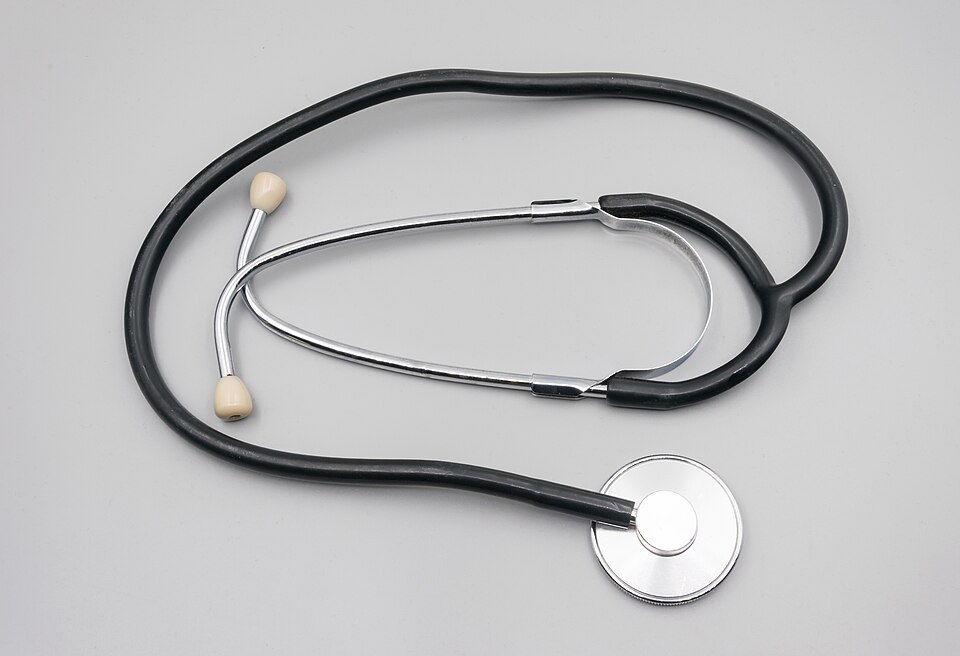
The Stethoscope
One of the most recognizable medical tools is the stethoscope, the instrument doctors place on your chest during a checkup. It was invented in 1816 by a French doctor named Rene Laennec. Before the stethoscope existed, doctors had to press their ear directly against a patient’s body to listen to the heart and lungs. Laennec came up with a clever solution by rolling sheets of paper into a tube and holding one end to the patient’s chest and the other to his ear. He discovered that sounds traveled through the tube clearly and loudly. He later carved a wooden version, and over time the stethoscope evolved into the flexible rubber and metal design that doctors still use today.
X-Rays: Seeing Inside the Body
In 1895, a German scientist named Wilhelm Roentgen made a surprising discovery while experimenting in his laboratory. He found mysterious rays that could pass through soft materials like skin and muscle but were blocked by hard materials like bone. He called them X-rays because “X” stands for something unknown. To test his discovery, he took an image of his wife’s hand, clearly showing the bones and even her ring. Roentgen’s invention earned him the very first Nobel Prize in Physics in 1901. Today, X-rays are used in hospitals everywhere to check for broken bones and other health problems without needing surgery.
MRI Machines
While X-rays are great for seeing bones, doctors sometimes need to look at softer parts of the body like the brain, muscles, and organs. That is where the MRI machine comes in. MRI stands for Magnetic Resonance Imaging, and it uses powerful magnets and radio waves to create detailed pictures of the inside of the body. An American doctor named Raymond Damadian built the first MRI scanner in 1977 after seven years of hard work. He named it “Indomitable” because it took so much effort to create. Unlike X-rays, MRI machines do not use radiation, making them a safe way to look at tissues and organs in great detail.
Robotic Surgery
Some of the newest medical technology involves robots that help surgeons perform operations. The da Vinci Surgical System, first approved for use in the United States in 2000, allows a surgeon to sit at a computer console and control tiny robotic arms that perform the surgery. These robotic arms can make movements that are even more precise than a human hand. The system is named after Leonardo da Vinci, the famous artist and inventor who studied the human body hundreds of years ago. Robotic surgery often means smaller cuts, less pain, and faster healing for patients.
3D Printing and Prosthetics
Medical technology is also helping people who have lost a limb or were born without one. Prosthetics are artificial arms, legs, hands, or feet that replace missing body parts. In the past, prosthetics were expensive and took a long time to make. Today, 3D printers can create custom prosthetic limbs quickly and at a much lower cost. A worldwide volunteer network called e-NABLE has used 3D printers to deliver free prosthetic hands and arms to thousands of children and adults in over 100 countries. These printed devices can be designed in fun colors and patterns, making them feel special instead of just medical.
The Future of Medical Technology
Medical technology keeps getting better every year. Scientists are working on tiny sensors that patients can swallow to help doctors monitor health from the inside. Researchers are developing new ways to use artificial intelligence to help spot diseases in medical images even faster than trained doctors can. Gene therapy, which involves fixing problems in a person’s DNA, may one day cure diseases that were once thought to be untreatable. As technology advances, the future of medicine looks brighter than ever, with new inventions that will continue to help people stay healthy and live well.
 OtterKnow Kids Encyclopedia